
Free Inspection & Test Plan (Welding Fabrication) Template
Download our free Inspection & Test Plan (Welding Fabrication) Template to formalise quality control for your projects. Aligned with Australian WHS principles.
Free Inspection & Test Plan (Welding Fabrication) Template
DOCX • 139 KB + PDF
Updated Oct 2026
No signup required
Purpose of the Free Inspection & Test Plan (Welding Fabrication) Template
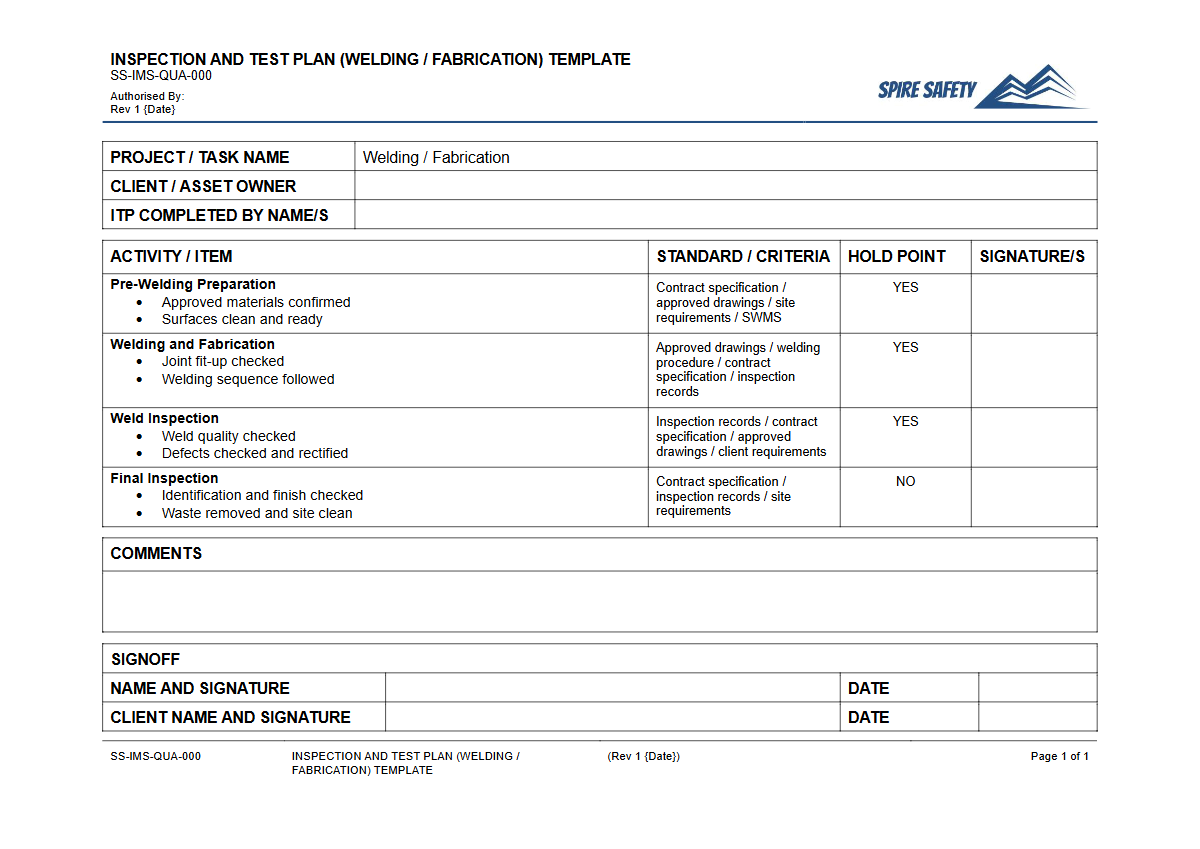
An Inspection & Test Plan (ITP) is a critical quality assurance document that outlines the plan for managing the quality of welding fabrication work. This free Inspection & Test Plan (Welding Fabrication) Template provides a structured framework for defining all necessary inspections, tests, and verification activities before, during, and after the welding process.
Using an ITP helps ensure that all fabrication work meets project specifications, client requirements, and relevant Australian Standards (such as the AS/NZS 1554 series). It serves as a formal record of quality control, demonstrating due diligence and a proactive approach to safety and compliance.
Implementing a thorough ITP reduces the risk of costly rework, project delays, and potential structural failures. It creates a clear roadmap for quality controllers, supervisors, and welders, defining responsibilities and acceptance criteria at each stage of the project.
This document is fundamental to delivering a final product that is safe, reliable, and fit for purpose. It also forms a key part of broader comprehensive WHS management systems, linking production quality directly to safety outcomes.
Video walkthrough
How to use the Free Inspection & Test Plan (Welding Fabrication) Template
This Inspection & Test Plan template is provided as a customisable DOCX file, with a PDF version available for easy reference. To use it effectively, you must adapt it to the unique requirements of your specific project.
This involves detailing the project name, relevant standards, and drawing numbers. You will then populate the plan with the specific inspection and test points relevant to your scope of work.
Please note: this template provides a structured foundation. We have designed it to be customised to your specific project, materials, welding processes, and legal obligations.
It is not a complete, out-of-the-box solution. You must ensure all relevant hold points, witness points, and surveillance checks are included and signed off by the appropriate personnel.
Key Sections in the Inspection & Test Plan
Our template prompts you to define critical checkpoints, which typically include:
- Material Verification: Confirming material certificates and specifications match the project requirements before fabrication begins.
- Welder Qualification: Verifying that all welders hold the necessary qualifications (e.g., weld tickets) for the procedures they will be performing.
- Pre-Weld Inspection: Checking joint preparation, fit-up, and cleanliness before any welding occurs.
- In-Process Welding Surveillance: Monitoring essential variables like amperage, voltage, and travel speed during welding.
- Post-Weld Visual Inspection: A 100% visual scan of all completed welds to identify surface defects.
- Non-Destructive Testing (NDT): Specifying the type (e.g., MT, PT, UT, RT) and extent of NDT required on completed welds.
- Final Inspection and Reporting: Compiling all test reports, dimensional checks, and supporting documentation into a final handover package.
When to use an Inspection & Test Plan
An ITP for welding fabrication should be developed and approved during the project planning phase, well before any physical work commences. It is essential for any project involving structural or critical welds, including building construction, bridge manufacturing, pressure vessel fabrication, pipeline installation, and heavy machinery repair.
It is a live document used throughout the fabrication lifecycle to guide and record quality activities. For projects on complex sites, coordinating fabrication with other site activities is crucial, which might also involve creating documents like a free Traffic Management Plan template.
In high-risk sectors like resources and energy, ITPs are often a mandatory component of the overall safety and quality framework. They support the objectives outlined in higher-level documents such as Principal Mining Hazard Management Plans by ensuring the structural integrity of plant and equipment.
Who should use this Inspection & Test Plan
This template is designed for use by a range of personnel involved in the management and execution of welding projects. Key users include:
- Quality Assurance / Quality Control (QA/QC) Managers: For establishing and overseeing the project's quality framework.
- Welding Supervisors & Inspectors: For guiding daily inspections and ensuring compliance on the workshop floor.
- Project Managers & Engineers: For planning, verification, and communicating quality requirements to clients and stakeholders.
- Safety Professionals: For verifying that quality controls are in place to mitigate risks associated with structural failure.
While this ITP is highly specific to the welding process, it complements broader site safety procedures. For example, a workshop supervisor might use this document for weld quality and a separate checklist for a general WHS inspection for a tyre workshop to cover other hazards in the work area.
Ultimately, the ITP serves as a formal record of diligence. The completed document, with all its signatures and attached reports, can be a crucial piece of evidence during a post-incident investigation or formal independent WHS compliance auditing. For a broader selection of checklists and forms, you can explore our free WHS resources library.
Common mistakes
Common mistakes to avoid
- Using a generic ITP without customising it for the specific project, materials, and standards.
- Failing to define clear and objective acceptance criteria for each inspection point.
- Proceeding with fabrication before the ITP has been formally approved by the client or their representative.
- Incomplete or disorganised record-keeping, making it difficult to prove compliance later.
Legal references
Legal considerations
The following legal requirements may be relevant to this type of work.
- Work Health and Safety Act (Harmonised) — Provides the primary duties for protecting workers and other people from work health and safety risks.
- Work Health and Safety Regulations (Harmonised) — Sets out requirements supporting the management of workplace hazards and risks.
The following codes may be relevant to this type of work.
- Managing WHS Risks Code of Practice — Provides practical guidance on identifying hazards, assessing risks and applying effective controls.
- Work Health and Safety Consultation, Cooperation and Coordination Code of Practice — Provides practical guidance on consulting workers and coordinating with other duty holders.
- Managing the Work Environment and Facilities Code of Practice — Provides practical guidance on safe work environments, workplace facilities and related controls.
Did you know
Australian Standards
The AS/NZS 1554 series, 'Structural steel welding', is one of the most important sets of standards for fabricators in Australia, providing minimum requirements for the welding of steel structures.
Cost of Quality
Industry studies show that the cost of correcting a defect found after delivery (external failure cost) can be 5 to 10 times higher than the cost of finding and fixing it during the fabrication process (appraisal and prevention costs).
FAQ
Frequently asked questions
01What is the difference between an Inspection & Test Plan (ITP) and a Weld Procedure Specification (WPS)?
02Is this welding ITP template suitable for all types of welding?
03Who typically signs off on an Inspection & Test Plan?
04How does an ITP for welding relate to WHS?
Share this resource
Free Inspection & Test Plan (Welding Fabrication) Template
Browse Categories
How To Use It
- 1Download and open in Word or PDF.
- 2Replace the placeholders with your business details.
- 3Get it reviewed by a WHS specialist before rollout.
Need it customised?
Our WHS consultants can adapt this template to your site, run a gap analysis, or audit what you already have in place.
Book a Free Consultation WHS consulting servicesor call 1300 156 382
Related templates
- Free Inspection & Test Plan (Wet Area Lining Villaboard) Template
- Free Inspection & Test Plan (Wet Area Waterproofing) Template
- Free Inspection & Test Plan (Window and Door Frame Installation) Template
- Free Inspection & Test Plan (Access Flooring System) Template
- Free Inspection & Test Plan (Air Conditioning Unit Installation) Template
- Free Inspection & Test Plan (Aluminium Composite Panel Cladding) Template