
Free Inspection & Test Plan (Wet Area Lining Villaboard) Template
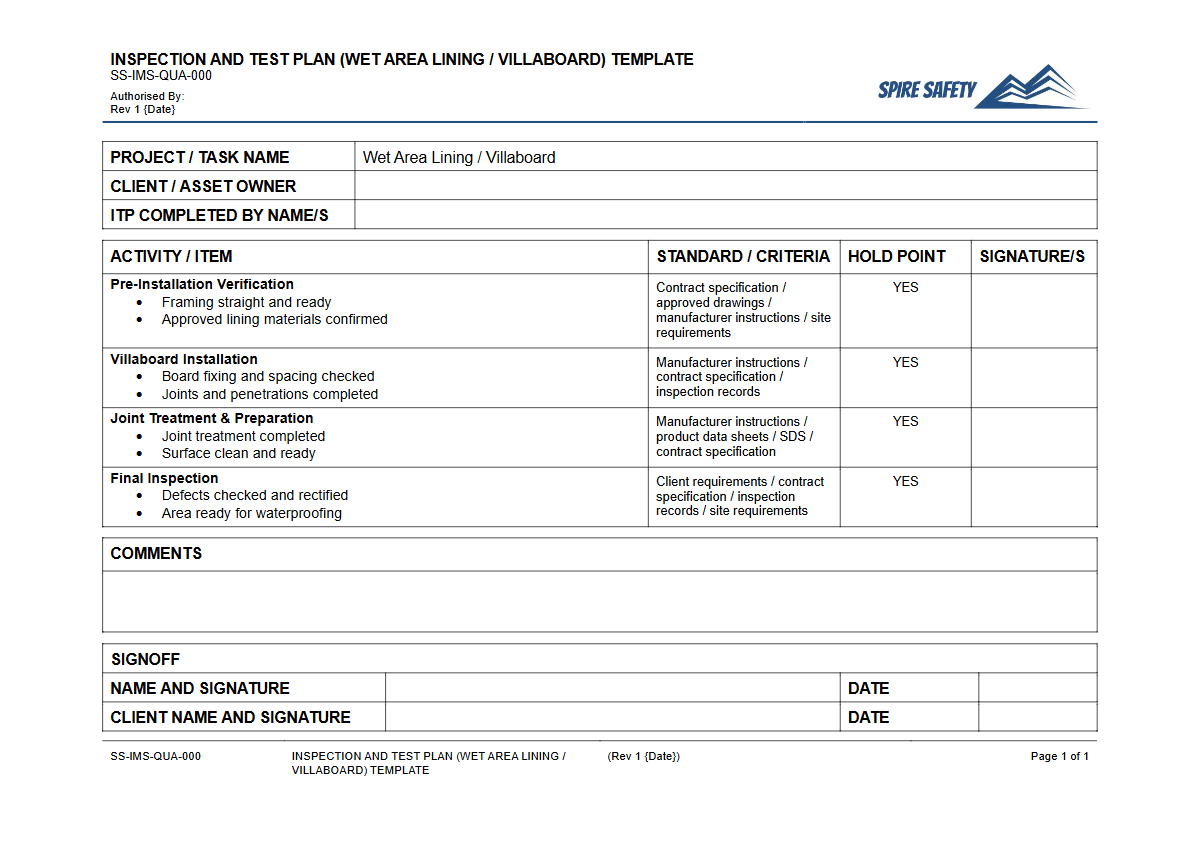
Download our free Inspection & Test Plan (Wet Area Lining Villaboard) Template.
Free Inspection & Test Plan (Wet Area Lining Villaboard) Template
DOCX • 140 KB + PDF
Updated Oct 2026
No signup required
Purpose of the Free Inspection & Test Plan (Wet Area Lining Villaboard) Template
Ensuring the quality and compliance of wet area construction is critical to preventing long-term defects like water damage and mould. Our Free Inspection & Test Plan (Wet Area Lining Villaboard) Template provides a structured framework for documenting and verifying each critical stage of the installation process.
This document is designed to guide site personnel through the required checks, from framing preparation to final inspection, ensuring that all work meets project specifications, manufacturer guidelines, and Australian standards.
An Inspection & Test Plan (ITP) is a key quality assurance document that outlines a schedule of inspections and tests. It defines the 'what, when, and how' of verification activities, assigning responsibilities and creating a formal record of compliance.
Using this template helps standardise your processes, reduce the risk of rework, and provide clear evidence of due diligence. Integrating ITPs is a fundamental component of robust WHS management systems, linking quality control directly to safety outcomes by ensuring structures are built correctly and safely.
Video walkthrough
How to use the Free Inspection & Test Plan (Wet Area Lining Villaboard) Template
This template is provided as a starting point. It includes typical inspection points for Villaboard installation, such as framing checks, fixing compliance, joint and corner treatment, and surface preparation.
To use it effectively, you should review and adapt the plan to align with your specific project requirements, the contractor's scope of works, and the relevant building codes. The ITP format includes columns for defining Hold Points (work must stop for inspection), Witness Points (inspection is required, but work may proceed), and surveillance checks.
Important: This is a template only. We have populated it with common criteria, but you must customise it to suit the specific requirements of your project, site, and legal obligations.
Always reference the current manufacturer’s installation manual and relevant Australian Standards (e.g., AS 3740) when developing your final ITP. If you need assistance tailoring this document, our WHS consulting team can provide expert guidance.
When to use it
An ITP for wet area lining should be developed and approved before any physical work commences on site. It forms part of the initial project planning and quality management setup.
The document should be treated as a live record, actively used by site supervisors and installers throughout the construction phase. Each checkpoint is signed and dated as it is completed, providing a progressive record of quality verification.
This proactive approach is much more effective than identifying issues at the final handover, which often leads to costly and time-consuming rectification work. It should be used alongside other key safety documents, such as a free Traffic Management Plan Template, to ensure a holistically safe and organised work site.
Who should use it
This template is designed for use by a range of personnel involved in construction projects, including:
- Project Managers: For overall quality planning and project oversight.
- Site Supervisors and Foremen: For day-to-day management and verification of installation work on site.
- Quality Assurance/Quality Control (QA/QC) Officers: For formalising inspection processes and maintaining quality records.
- Builders and Principal Contractors: To ensure subcontractors are adhering to specified quality standards.
- Specialist Lining and Waterproofing Contractors: To clarify expectations and document their own quality control processes.
The ITP serves as a critical communication tool between all parties, ensuring everyone understands the quality benchmarks at each stage. The completed records can also be invaluable during a WHS compliance auditing process to demonstrate that procedures were followed correctly. For more templates and safety documentation, you can browse our complete free WHS resources library.
Common mistakes
Common mistakes to avoid
- Failing to reference the correct Australian Standard, particularly AS 3740 'Waterproofing of domestic wet areas'.
- Using a generic ITP without customising it for project-specific details and current manufacturer instructions.
- Treating checkpoints as a box-ticking exercise instead of performing genuine quality verification.
- Poor record-keeping, making it difficult to prove compliance and track progress if issues arise later.
Legal references
Legal considerations
The following legal requirements may be relevant to this type of work.
- Work Health and Safety Act (Harmonised) — Provides the primary duties for protecting workers and other people from work health and safety risks.
- Work Health and Safety Regulations (Harmonised) — Sets out requirements supporting the management of workplace hazards and risks.
The following codes may be relevant to this type of work.
- Managing WHS Risks Code of Practice — Provides practical guidance on identifying hazards, assessing risks and applying effective controls.
- Work Health and Safety Consultation, Cooperation and Coordination Code of Practice — Provides practical guidance on consulting workers and coordinating with other duty holders.
- Managing the Work Environment and Facilities Code of Practice — Provides practical guidance on safe work environments, workplace facilities and related controls.
Did you know
Cost of Water Damage
A significant percentage of building defects in Australia are related to water ingress, often originating from improperly constructed wet areas. A detailed ITP is a key tool in preventing these costly defects.
Manufacturer's Data is Key
James Hardie Villaboard Lining has specific requirements for fastener type, spacing, and jointing methods that can change over time. Your ITP must always reference the manufacturer's current technical data sheets for compliance.
FAQ
Frequently asked questions
01What is the difference between a Hold Point and a Witness Point in an ITP?
02Is this ITP suitable for other types of fibre cement lining?
03Does this template cover the waterproofing membrane application?
04Who is responsible for signing off ITP checkpoints?
Share this resource
Free Inspection & Test Plan (Wet Area Lining Villaboard) Template
Browse Categories
How To Use It
- 1Download and open in Word or PDF.
- 2Replace the placeholders with your business details.
- 3Get it reviewed by a WHS specialist before rollout.
Need it customised?
Our WHS consultants can adapt this template to your site, run a gap analysis, or audit what you already have in place.
Book a Free Consultation WHS consulting servicesor call 1300 156 382
Related templates
- Free Inspection & Test Plan (Wet Area Waterproofing) Template
- Free Inspection & Test Plan (Window and Door Frame Installation) Template
- Free Inspection & Test Plan (Access Flooring System) Template
- Free Inspection & Test Plan (Air Conditioning Unit Installation) Template
- Free Inspection & Test Plan (Aluminium Composite Panel Cladding) Template
- Free Inspection & Test Plan (As-Built Documentation Review) Template