
Free Inspection & Test Plan (As-Built Documentation Review) Template
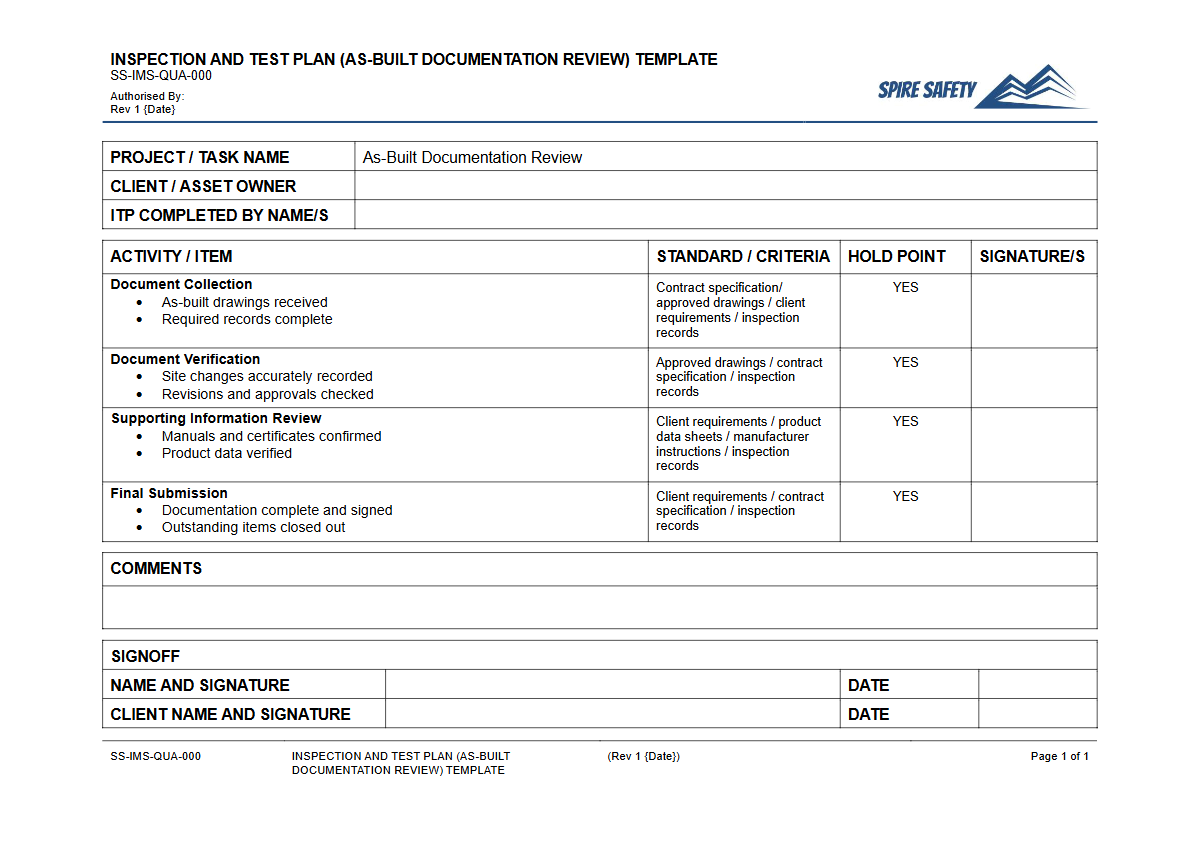
Download our free Inspection & Test Plan for As-Built Documentation Review. This template helps verify final project documents against specifications.
Free Inspection & Test Plan (As-Built Documentation Review) Template
DOCX • 139 KB + PDF
Updated Oct 2026
No signup required
Purpose of the Free Inspection & Test Plan (As-Built Documentation Review) Template
An Inspection & Test Plan (ITP) for as-built documentation review is a critical quality assurance document used to verify that the final project records accurately reflect the finished product. This Free Inspection & Test Plan (As-Built Documentation Review) Template provides a structured framework for managing this process, ensuring all handover documents—such as drawings, manuals, and specifications—are complete, correct, and aligned with what has actually been built or installed.
It serves as a formal record of verification, which is essential for project closeout, client handover, and demonstrating due diligence. Properly executed, these plans form a cornerstone of robust WHS management systems by ensuring that information critical for safe operation and maintenance is accurately captured.
Benefits of a Structured As-Built Review
Implementing a formal review process using an ITP offers significant advantages for any project. It systematically reduces the risk of errors and omissions in critical documentation, which can lead to costly rework or operational issues later.
A thorough review process enhances client satisfaction by providing a verified, high-quality handover package. It also creates a clear and defensible audit trail, demonstrating that all contractual and quality requirements have been met.
For complex projects, this level of detail is indispensable and often benefits from specialist WHS consulting to ensure all technical and safety aspects are covered.
Video walkthrough
How to use the Free Inspection & Test Plan (As-Built Documentation Review) Template
This Free Inspection & Test Plan (As-Built Documentation Review) Template is designed to be a flexible starting point for project teams. Available as an easily editable DOCX file, it can be adapted to suit projects of any scale in construction, engineering, manufacturing, or technology sectors.
- Customise the Plan: Begin by adding project-specific details, including project name, document numbers, and revision history. Define the full scope of documentation to be reviewed, listing each drawing, manual, certificate, or report.
- Set Acceptance Criteria: For each document type, clearly define what constitutes a 'pass'. Criteria might include correct versioning, necessary signatures, accurate dimensions, inclusion of all amendments, and legibility.
- Assign Responsibilities: Nominate the person or role responsible for conducting the review (e.g., Project Engineer, QA Manager), as well as those responsible for any required corrective actions.
- Execute and Record: Use the template to schedule and track the review process. Document the date of review, the outcome (pass/fail), and any comments or references to non-conformance reports. This creates an essential evidence log for project completion. The structured nature of an ITP is adaptable across various industries, similar to how a WHS inspection for a vehicle workshop follows a clear, repeatable process.
Important: This document is a template and must be customised. We provide it as a starting point, and it is your responsibility to ensure it is adapted to the specific legal, contractual, and technical requirements of your workplace and project.
When to use it
An as-built documentation review is typically conducted at the completion of a project or major project phase, immediately prior to handover to the client or end-user. This timing ensures that the documentation package is fully verified before it is formally accepted.
However, for large or complex projects, it is best practice to conduct progressive reviews at key milestones. This approach prevents a large volume of documentation review from creating a bottleneck at the end of the project.
The records generated from this ITP are often a key input for final WHS compliance audits and contractual sign-off.
Who should use it
This template is intended for professionals responsible for project quality, delivery, and compliance. Key roles include:
- Project Managers: For overall oversight and confirmation that project deliverables meet contractual requirements.
- Construction Managers: To verify that as-built drawings reflect site conditions and all variations have been captured.
- Quality Assurance / Quality Control (QA/QC) Managers: To manage the formal quality process and ensure procedural adherence.
- Engineers (Civil, Mechanical, Electrical, etc.): To technically verify that discipline-specific drawings and data are accurate.
- Document Controllers: To manage the flow of information and ensure the final document set is complete and correctly indexed.
In high-risk industries, the accuracy of as-built documentation is directly linked to operational safety, influencing everything from maintenance procedures to the development of principal mining hazard management plans. Similar rigour is applied in food and beverage production, where accurate Process and Instrumentation Diagrams (P&IDs) are essential for safety and quality, much like those verified during a WHS inspection for a beverage plant. For more tools and templates, you can browse our complete free WHS resources library.
Common mistakes
Common mistakes to avoid
- Failing to define clear and measurable acceptance criteria for each document.
- Treating the review as a rubber-stamping exercise instead of a thorough verification.
- Not involving the end-users or facility managers who will rely on the documents for future work.
- Leaving the entire documentation review until the end of the project, creating a major bottleneck.
Legal references
Legal considerations
The following legal requirements may be relevant to this type of work.
- Work Health and Safety Act (Harmonised) — Provides the primary duties for protecting workers and other people from work health and safety risks.
- Work Health and Safety Regulations (Harmonised) — Sets out requirements supporting the management of workplace hazards and risks.
The following codes may be relevant to this type of work.
- Managing WHS Risks Code of Practice — Provides practical guidance on identifying hazards, assessing risks and applying effective controls.
- Work Health and Safety Consultation, Cooperation and Coordination Code of Practice — Provides practical guidance on consulting workers and coordinating with other duty holders.
- Managing the Work Environment and Facilities Code of Practice — Provides practical guidance on safe work environments, workplace facilities and related controls.
Did you know
Project Handovers
In major construction projects, the as-built documentation package can be as critical as the physical asset itself, forming the basis for all future operational and maintenance activities. Incomplete or inaccurate documents are a leading cause of disputes during project closeout.
FAQ
Frequently asked questions
01What is the difference between an ITP and a checklist?
02Can this template be used for software development projects?
03Does this ITP cover safety compliance?
04What are 'hold points' and 'witness points' in an ITP?
Share this resource
Free Inspection & Test Plan (As-Built Documentation Review) Template
Browse Categories
How To Use It
- 1Download and open in Word or PDF.
- 2Replace the placeholders with your business details.
- 3Get it reviewed by a WHS specialist before rollout.
Need it customised?
Our WHS consultants can adapt this template to your site, run a gap analysis, or audit what you already have in place.
Book a Free Consultation WHS consulting servicesor call 1300 156 382
Related templates
- Free Inspection & Test Plan (Asphalt Bitumen Sealing) Template
- Free Inspection & Test Plan (Autoclaved Aerated Concrete (AAC) Block) Template
- Free Inspection & Test Plan (Balcony Podium Waterproofing) Template
- Free Inspection & Test Plan (Basement Waterproofing) Template
- Free Inspection & Test Plan (Bathroom Vanity and Fixtures) Template
- Free Inspection & Test Plan (Bracing and Tie-Down) Template