
Free Inspection & Test Plan (Asphalt Bitumen Sealing) Template
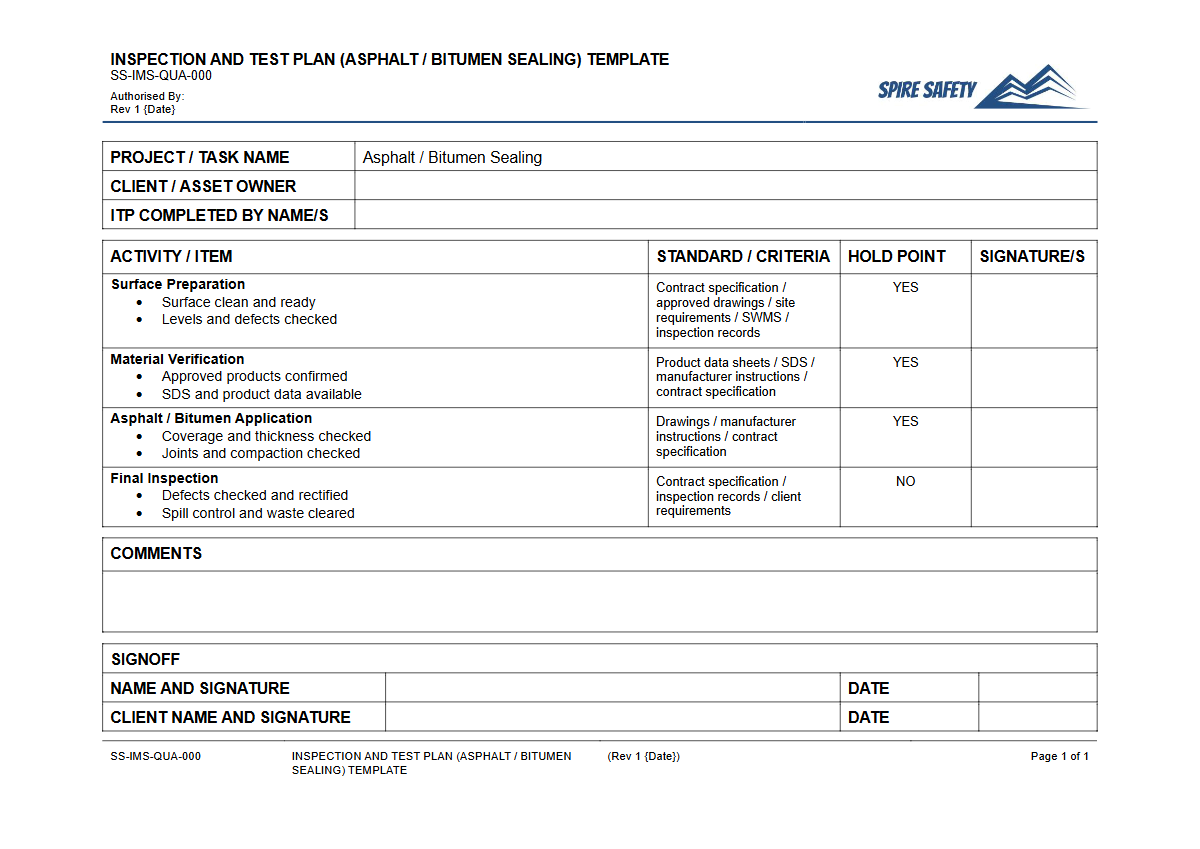
Download our Free Inspection & Test Plan (Asphalt Bitumen Sealing) Template. This DOCX & PDF provides a structured framework for quality and safety checks.
Free Inspection & Test Plan (Asphalt Bitumen Sealing) Template
DOCX • 139 KB + PDF
Updated Oct 2026
No signup required
Purpose of the Free Inspection & Test Plan (Asphalt Bitumen Sealing) Template
Asphalt and bitumen sealing projects require rigorous quality and safety controls to ensure a durable, safe, and compliant pavement surface. This Free Inspection & Test Plan (Asphalt Bitumen Sealing) Template provides a structured framework for documenting these essential checks.
An Inspection and Test Plan (ITP) is a formal document that outlines the sequence of inspections and tests required to verify that work meets project specifications and WHS standards. It systematically identifies what will be checked, how it will be checked, who is responsible, and what records need to be kept.
Using an ITP helps ensure that critical stages of the sealing process are not overlooked. This includes verifying material quality upon delivery, ensuring correct surface preparation, monitoring application temperatures and rates, and confirming compaction efforts achieve the required density.
By formalising this process, you create a clear audit trail that demonstrates due diligence and commitment to quality outcomes. It also standardises the inspection process across different teams and projects, improving consistency. Before work begins each day, operators should also complete equipment-specific checks, such as those outlined in a Free Pre-Start Checklist (Bitumen Spray) Template.
Video walkthrough
How to use the Free Inspection & Test Plan (Asphalt Bitumen Sealing) Template
This template is provided in both DOCX and PDF formats for your convenience. It is organised into logical stages of a typical asphalt or bitumen sealing project, from pre-construction activities to final handover.
Each line item includes columns for specifying the activity, inspection criteria, acceptance standards (often referencing Australian Standards or client specifications), and the type of verification required (e.g., Hold Point, Witness Point, Surveillance).
To use the template effectively, you should review each item and adapt it to your specific project scope. This includes filling in project-specific details, assigning responsibilities to personnel like the Site Engineer or Project Manager, and referencing the correct technical specifications. You must also ensure all personnel involved in inspections are competent to perform their duties, which can be formally documented using a resource like our Verification of Competency (Asphalt Paver) Template.
Important: This template provides a solid foundation, but it is not a complete, ready-to-use document. We have designed it as a starting point that you must customise to reflect the specific requirements of your project, client specifications, relevant Australian Standards, and your organisation's own Safe Work Method Statements (SWMS).
When to use it
An ITP should be developed during the project planning phase, well before any physical work commences on site. It forms a key component of the project's quality management plan and should be reviewed and approved by relevant stakeholders, including the client or principal contractor.
It is a live document that should be followed throughout the construction lifecycle, from initial site establishment through to the completion of the sealing works. Regularly updating and referring to the ITP ensures that quality control is proactive, not reactive.
This process of proactive planning and documentation is a cornerstone of effective WHS management systems, as it integrates quality control directly into the workflow. The completed ITP, along with all its supporting test records and sign-offs, becomes a critical part of the project completion and handover documentation, providing evidence that all specified requirements have been met.
Who should use it
This ITP template is designed for use by a range of personnel involved in civil construction and road maintenance projects. This includes:
- Project Managers: For overall quality assurance and project oversight.
- Site Engineers & Supervisors: For day-to-day management and execution of inspection and testing activities.
- Quality Assurance (QA) Managers: For developing, implementing, and auditing the project's quality systems.
- WHS Advisors & Officers: To ensure safety-critical checks are integrated into the quality process.
- Contractors and Subcontractors: To demonstrate to the principal contractor or client that their work will meet the required standards.
Using a standardised ITP is also beneficial for organisations undergoing third-party certification or regular safety audits. The document serves as clear, objective evidence of a systematic approach to quality and safety management, which can be verified during a WHS compliance auditing process.
Key Inspection Stages for Asphalt Sealing
A comprehensive ITP for asphalt and bitumen sealing covers several critical phases. While the template provides a detailed list, key stages typically include:
Pre-Construction & Material Checks
This stage involves verifying that all preliminary requirements are met. This includes confirming survey set-out is correct, the pavement substrate is prepared and approved, and that all materials (like bitumen, aggregate, and asphalt mix) delivered to site meet the specified standards.
Sourcing materials from quarries that have robust safety procedures, such as those detailed in Principal Mining Hazard Management Plans: A Guide, can contribute to overall project quality and safety.
Application & Laydown Process
During application, the focus shifts to process control. For spray sealing, this means monitoring binder spray rates and application temperatures.
For asphalt paving, it involves checking the laydown temperature, paver speed, screed operation, and mat thickness. Weather conditions, such as ambient temperature, humidity, and wind speed, must also be monitored and recorded as they can significantly impact the quality of the final product.
Compaction & Finishing
This is arguably the most critical stage for ensuring the long-term performance of the pavement. The ITP will detail the requirements for roller types, rolling patterns, and the number of passes needed to achieve the specified level of compaction.
Temperatures must be monitored closely, as compaction is only effective within a specific temperature range. Checks on surface finish, levels, and joint quality are also performed at this stage.
By using this ITP template, you can systematically manage these stages and build a comprehensive quality file for your project. Explore our entire free WHS resources library for more templates and guides to support your safety and quality management systems.
Common mistakes
Common mistakes to avoid
- Failing to customise the ITP to specific project specifications and Australian Standards.
- Poor record-keeping, leaving gaps in the quality assurance audit trail.
- Not clearly defining or communicating responsibilities for each hold and witness point.
- Overlooking the calibration status of testing equipment, such as thermometers and nuclear density gauges.
Legal references
Legal considerations
The following legal requirements may be relevant to this type of work.
- Work Health and Safety Act (Harmonised) — Provides the primary duties for protecting workers and other people from work health and safety risks.
- Work Health and Safety Regulations (Harmonised) — Sets out requirements supporting the management of workplace hazards and risks.
The following codes may be relevant to this type of work.
- Managing WHS Risks Code of Practice — Provides practical guidance on identifying hazards, assessing risks and applying effective controls.
- Work Health and Safety Consultation, Cooperation and Coordination Code of Practice — Provides practical guidance on consulting workers and coordinating with other duty holders.
- Managing the Work Environment and Facilities Code of Practice — Provides practical guidance on safe work environments, workplace facilities and related controls.
Did you know
Temperature is Critical
Asphalt must be delivered to the site and compacted within a specific temperature range (typically 120°C to 160°C). If it's too cool, proper compaction cannot be achieved, leading to premature pavement failure.
Hazardous Fumes
Bitumen fumes contain hazardous substances, including polycyclic aromatic hydrocarbons (PAHs). Effective ventilation and the use of appropriate Personal Protective Equipment (PPE) are essential to control worker exposure.
FAQ
Frequently asked questions
01What is the difference between a Hold Point and a Witness Point in an ITP?
02Does this ITP template cover traffic management?
03How often should I review my Inspection and Test Plan?
04Can this template be used for both council roads and private works?
Share this resource
Free Inspection & Test Plan (Asphalt Bitumen Sealing) Template
Browse Categories
How To Use It
- 1Download and open in Word or PDF.
- 2Replace the placeholders with your business details.
- 3Get it reviewed by a WHS specialist before rollout.
Need it customised?
Our WHS consultants can adapt this template to your site, run a gap analysis, or audit what you already have in place.
Book a Free Consultation WHS consulting servicesor call 1300 156 382
Related templates
- Free Inspection & Test Plan (Autoclaved Aerated Concrete (AAC) Block) Template
- Free Inspection & Test Plan (Balcony Podium Waterproofing) Template
- Free Inspection & Test Plan (Basement Waterproofing) Template
- Free Inspection & Test Plan (Bathroom Vanity and Fixtures) Template
- Free Inspection & Test Plan (Bracing and Tie-Down) Template
- Free Inspection & Test Plan (Brick Veneer Cladding) Template