
Free Safe Operating Procedure (Air Curtain Cleaning) Template
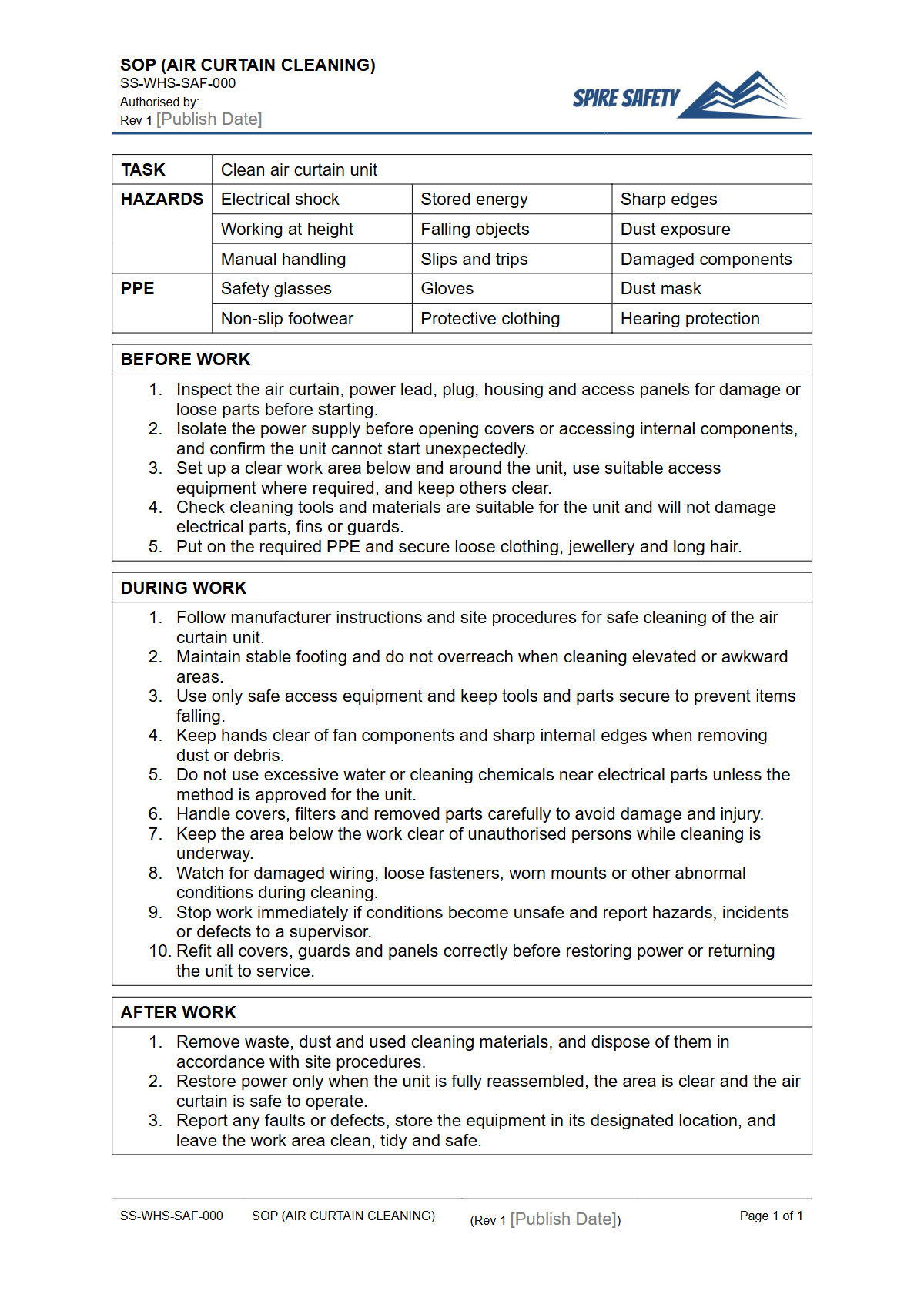
Need to formalise your air curtain cleaning process? Our Free Safe Operating Procedure (Air Curtain Cleaning) Template provides a structured starting point.
Free Safe Operating Procedure (Air Curtain Cleaning) Template
DOCX • 126 KB + PDF
Updated Oct 2026
No signup required
Purpose of the Free Safe Operating Procedure (Air Curtain Cleaning) Template
Standardising the process for cleaning commercial air curtains is a crucial step in maintaining equipment efficiency, ensuring indoor air quality, and upholding workplace safety. Our Free Safe Operating Procedure (Air Curtain Cleaning) Template provides a comprehensive framework to help you document the specific steps, risks, and controls for this common maintenance task.
While it may seem simple, cleaning air curtains involves potential hazards such as electrical shock, working at heights, manual handling, and exposure to dust and biological contaminants. This Safe Operating Procedure (SOP) helps you formalise the task, ensuring it is performed consistently and safely every time.
Using a documented procedure transforms an ad-hoc task into a controlled process, which is a fundamental component of a comprehensive WHS management system. It provides a reliable source of information for training new staff, conducting refresher courses for existing workers, and demonstrating due diligence in managing workplace risks. It systematically outlines pre-operational checks, the sequence of work, required Personal Protective Equipment (PPE), and emergency procedures.
Video walkthrough
How to use the Free Safe Operating Procedure (Air Curtain Cleaning) Template
This document is designed to be a flexible starting point, not a final, universal solution. To use the Free Safe Operating Procedure (Air Curtain Cleaning) Template effectively, download the DOCX version and adapt it to your specific operational context.
It is essential that you review and modify the content to accurately reflect the equipment, environment, and personnel at your site.
Important: We have created this template as a guide. You must customise it by consulting with the workers who actually perform the cleaning task. Incorporate details about the specific brand and model of your air curtain, the cleaning agents approved for use, the tools required, and the unique risks present in your workplace (e.g., proximity to the public, slippery floors).
If you need assistance tailoring this or other safety documents, consider engaging our expert WHS consulting services for personalised support.
When to use it
This Safe Operating Procedure should be referenced before and during any scheduled cleaning of air curtains. It is a critical tool for pre-task planning, allowing supervisors and workers to review hazards and confirm control measures are in place.
Since many air curtains are installed above doorways, cleaning them often involves working from a height. This SOP should be used in conjunction with other relevant procedures, such as our Step Ladder SOP template, to ensure all aspects of the job are performed safely.
It should also be a core document for new worker inductions and periodic safety training to reinforce correct and safe work practices.
Who should use it
This SOP is intended for a range of personnel within an organisation. Persons Conducting a Business or Undertaking (PCBUs) and managers can use it to fulfil their duty of care by establishing a safe system of work.
Supervisors should use it to instruct, monitor, and guide workers performing the cleaning task. Maintenance workers and cleaning staff are the primary end-users, following the procedure step-by-step to ensure their own safety and the safety of others.
Additionally, WHS officers and auditors will find this document valuable during safety inspections and when conducting regular WHS compliance audits to verify that documented procedures are being followed correctly.
By implementing this procedure, you create a clear, repeatable, and defensible process for a routine but risk-associated task. To discover other valuable tools to support your safety management system, feel free to browse our extensive free WHS resources library.
Common mistakes
Common mistakes to avoid
- Forgetting to electrically isolate the unit by locking out the circuit breaker before starting work.
- Using inappropriate or harsh cleaning chemicals that can damage plastic components or electrical parts.
- Neglecting to clean all parts, including intake grilles, filters, and fan blades, which reduces effectiveness.
- Failing to provide task-specific training on the procedure, especially regarding working at heights.
Legal references
Legal considerations
The following legal requirements may be relevant to this type of work.
- Work Health and Safety Act (Harmonised) — Provides the primary duties for protecting workers and other people from work health and safety risks.
- Work Health and Safety Regulations (Harmonised) — Sets out requirements supporting the management of workplace hazards and risks.
The following codes may be relevant to this type of work.
- Managing WHS Risks Code of Practice — Provides practical guidance on identifying hazards, assessing risks and applying effective controls.
- Work Health and Safety Consultation, Cooperation and Coordination Code of Practice — Provides practical guidance on consulting workers and coordinating with other duty holders.
- Managing the Work Environment and Facilities Code of Practice — Provides practical guidance on safe work environments, workplace facilities and related controls.
Did you know
Energy Savings
Regularly cleaned air curtains operate more efficiently, maintaining a stronger air barrier. This prevents conditioned air from escaping and outside air from entering, which can significantly reduce heating and cooling energy costs.
Air Quality Impact
Clogged air curtains can accumulate and circulate dust, allergens, and mould spores throughout a facility. Proper cleaning is essential for maintaining healthy indoor air quality for both staff and customers.
FAQ
Frequently asked questions
01Why do I need a Safe Operating Procedure for cleaning an air curtain?
02What are the main hazards involved in air curtain cleaning?
03Can I use this template for any brand of air curtain?
04How often should air curtains be cleaned?
Share this resource
Free Safe Operating Procedure (Air Curtain Cleaning) Template
Browse Categories
How To Use It
- 1Download and open in Word or PDF.
- 2Replace the placeholders with your business details.
- 3Get it reviewed by a WHS specialist before rollout.
Need it customised?
Our WHS consultants can adapt this template to your site, run a gap analysis, or audit what you already have in place.
Book a Free Consultation WHS consulting servicesor call 1300 156 382
Related templates
- Free Safe Operating Procedure (Air Curtain Operation) Template
- Free Safe Operating Procedure (Air Die Grinder) Template
- Free Safe Operating Procedure (Air Diffuser Cleaning) Template
- Free Safe Operating Procedure (Air Fed Respirator) Template
- Free Safe Operating Procedure (Air Grease Gun) Template
- Free Safe Operating Procedure (Air Handling Unit) Template