
Free Safe Operating Procedure (Air Curtain Operation) Template
Download our Free Safe Operating Procedure (Air Curtain Operation) Template. This customisable DOCX and PDF helps you create clear safety guidelines.
Free Safe Operating Procedure (Air Curtain Operation) Template
DOCX • 126 KB + PDF
Updated Oct 2026
No signup required
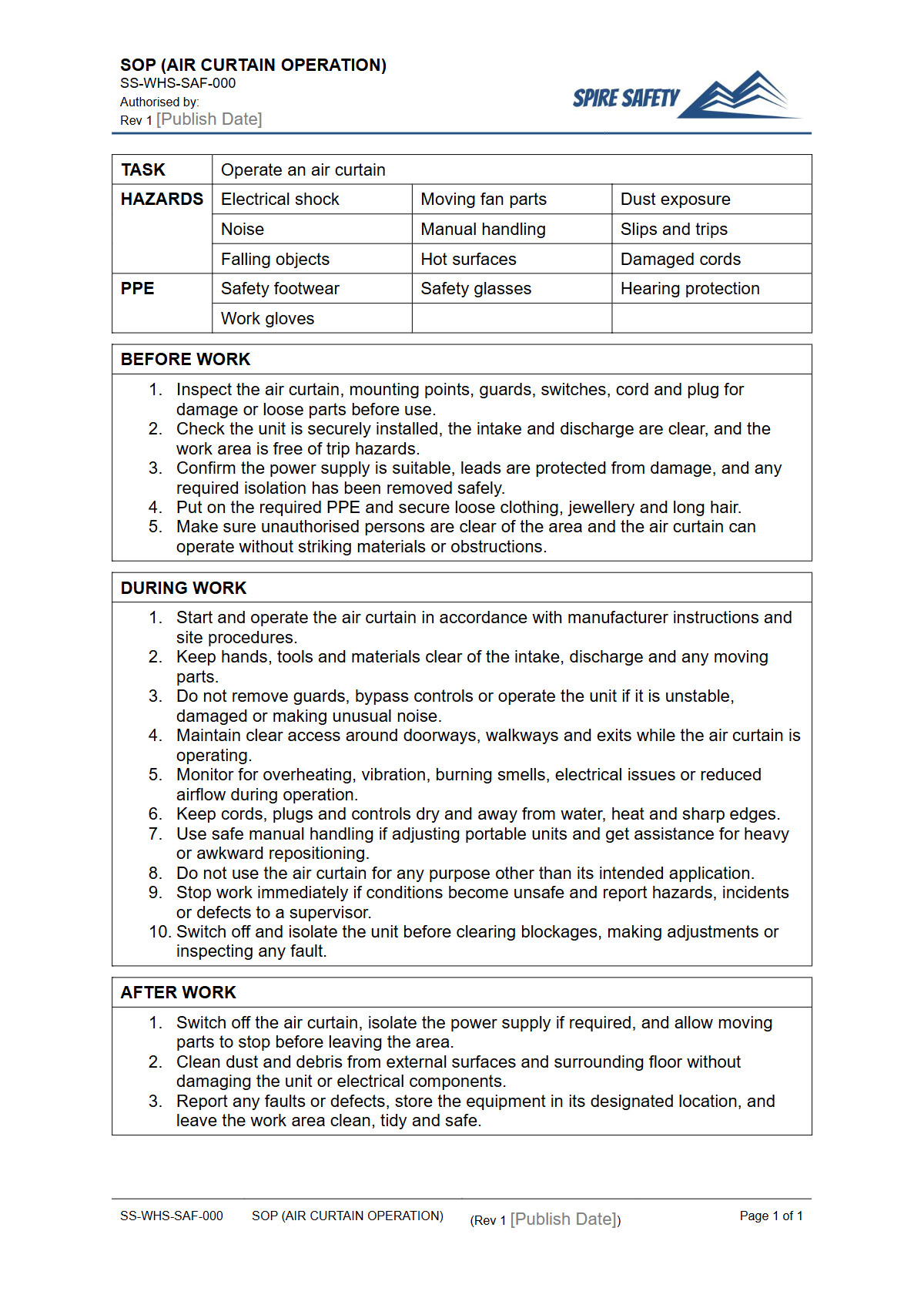
Purpose of the Free Safe Operating Procedure (Air Curtain Operation) Template
This Safe Operating Procedure for Air Curtain Operation provides a structured framework for documenting the safe use, cleaning, and maintenance of air curtains in your workplace. Air curtains, also known as air doors, are vital for maintaining climate control, preventing pest entry, and improving energy efficiency, but they also carry inherent risks, primarily electrical and mechanical.
Using this template helps you meet your duty of care by providing clear, step-by-step instructions to workers, reducing the risk of injury or equipment damage.
Developing and implementing robust SOPs is a fundamental component of a successful safety program. These procedures form a critical part of your overall WHS management system, demonstrating a commitment to proactive risk management and worker safety.
Video walkthrough
How to use the Free Safe Operating Procedure (Air Curtain Operation) Template
Our Safe Operating Procedure template is designed for ease of use and customisation. After downloading the DOCX or PDF file, you should adapt it to the specific context of your business and the particular air curtain models you use.
Important: This is a template that you must customise for your workplace. We have provided a comprehensive starting point, but you are responsible for adding site-specific details, such as equipment models, locations, specific energy isolation points, and emergency contacts. Consultation with your workers is a critical step; involve the people who operate the equipment daily to ensure the procedure is practical, accurate, and effective.
A well-written SOP is only effective if it's used. Ensure the finalised procedure is integrated into your induction and training programs.
For workplaces with a variety of equipment, you can use this document alongside other templates, such as our free Air Compressor SOP template, to build a consistent library of safety documents.
When to use an Air Curtain SOP
A formal Safe Operating Procedure for an air curtain should be in place before the equipment is first used. It is a vital document for several key operational activities, including:
- New Equipment Installation: To establish safe operating benchmarks from day one.
- Worker Training and Induction: As a core training resource for new and existing employees.
- Routine Inspections and Maintenance: To guide staff on pre-start checks, cleaning procedures, and basic maintenance tasks.
- Risk Assessments: As a documented control measure that helps mitigate identified hazards.
- Post-Incident Investigations: To review and refine procedures after a near miss or incident.
If you require assistance in integrating SOPs into your broader risk management framework, our WHS consulting team can provide expert guidance.
Who should use this Safe Operating Procedure
This template is intended for use by anyone with responsibility for health and safety in the workplace. Key users include:
- WHS Managers and Safety Officers: For developing, implementing, and reviewing safety documentation.
- Facility and Maintenance Managers: To standardise operating and maintenance protocols for building equipment.
- Supervisors and Team Leaders: To train their teams and enforce safe work practices daily.
- Business Owners: To ensure they are fulfilling their primary duty of care under WHS legislation.
In environments like large retail stores, warehouses, or food production facilities, air curtains are often used alongside other specialised equipment. Your safety system can be enhanced by maintaining consistent SOPs for all machinery, including items covered by our free conveyor belt operation SOP.
Regular reviews are essential to keep your safety documents current. A systematic check of all procedures, including those for air curtains, can be a key part of periodic WHS compliance auditing activities.
Whether in a commercial kitchen that also needs a deep fryer standard operation SOP or a large logistics hub, standardising your approach to safety documentation improves clarity and reinforces safe behaviour across your entire organisation. You can explore our complete collection of templates in our free WHS resources library to find documents that suit your needs.
Common mistakes
Common mistakes to avoid
- Neglecting to clean intake grills, filters, and fans, leading to reduced performance and fire risk from dust buildup.
- Failing to isolate the unit from the power supply before performing any cleaning or maintenance.
- Running the unit at an incorrect fan speed for the conditions, rendering it ineffective against outside air pressure.
- Blocking the airflow path with stock, signage, or other objects, which compromises its function and can cause the motor to overheat.
Legal references
Legal considerations
The following legal requirements may be relevant to this type of work.
- Work Health and Safety Act (Harmonised) — Provides the primary duties for protecting workers and other people from work health and safety risks.
- Work Health and Safety Regulations (Harmonised) — Sets out requirements supporting the management of workplace hazards and risks.
The following codes may be relevant to this type of work.
- Managing WHS Risks Code of Practice — Provides practical guidance on identifying hazards, assessing risks and applying effective controls.
- Work Health and Safety Consultation, Cooperation and Coordination Code of Practice — Provides practical guidance on consulting workers and coordinating with other duty holders.
- Managing the Work Environment and Facilities Code of Practice — Provides practical guidance on safe work environments, workplace facilities and related controls.
Did you know
Energy Savers
A properly functioning air curtain can reduce energy loss through an open doorway by up to 80%, significantly lowering a building's heating and cooling costs.
More Than a Breeze
Beyond temperature control, air curtains are effective at preventing flying insects, dust, and airborne pollutants from entering a clean environment, improving indoor air quality.
FAQ
Frequently asked questions
01What is a Safe Operating Procedure for an air curtain?
02Who is responsible for training on air curtain operation?
03How often should an air curtain SOP be reviewed?
04Are air curtains considered a significant risk in the workplace?
Share this resource
Free Safe Operating Procedure (Air Curtain Operation) Template
Browse Categories
How To Use It
- 1Download and open in Word or PDF.
- 2Replace the placeholders with your business details.
- 3Get it reviewed by a WHS specialist before rollout.
Need it customised?
Our WHS consultants can adapt this template to your site, run a gap analysis, or audit what you already have in place.
Book a Free Consultation WHS consulting servicesor call 1300 156 382
Related templates
- Free Safe Operating Procedure (Air Die Grinder) Template
- Free Safe Operating Procedure (Air Diffuser Cleaning) Template
- Free Safe Operating Procedure (Air Fed Respirator) Template
- Free Safe Operating Procedure (Air Grease Gun) Template
- Free Safe Operating Procedure (Air Handling Unit) Template
- Free Safe Operating Procedure (Air Hose Connection) Template