
Free Safe Operating Procedure (Air Hose Connection) Template
Download our free Safe Operating Procedure (Air Hose Connection) template for Australian workplaces.
Free Safe Operating Procedure (Air Hose Connection) Template
DOCX • 126 KB + PDF
Updated Oct 2026
No signup required
Purpose of the Free Safe Operating Procedure (Air Hose Connection) Template
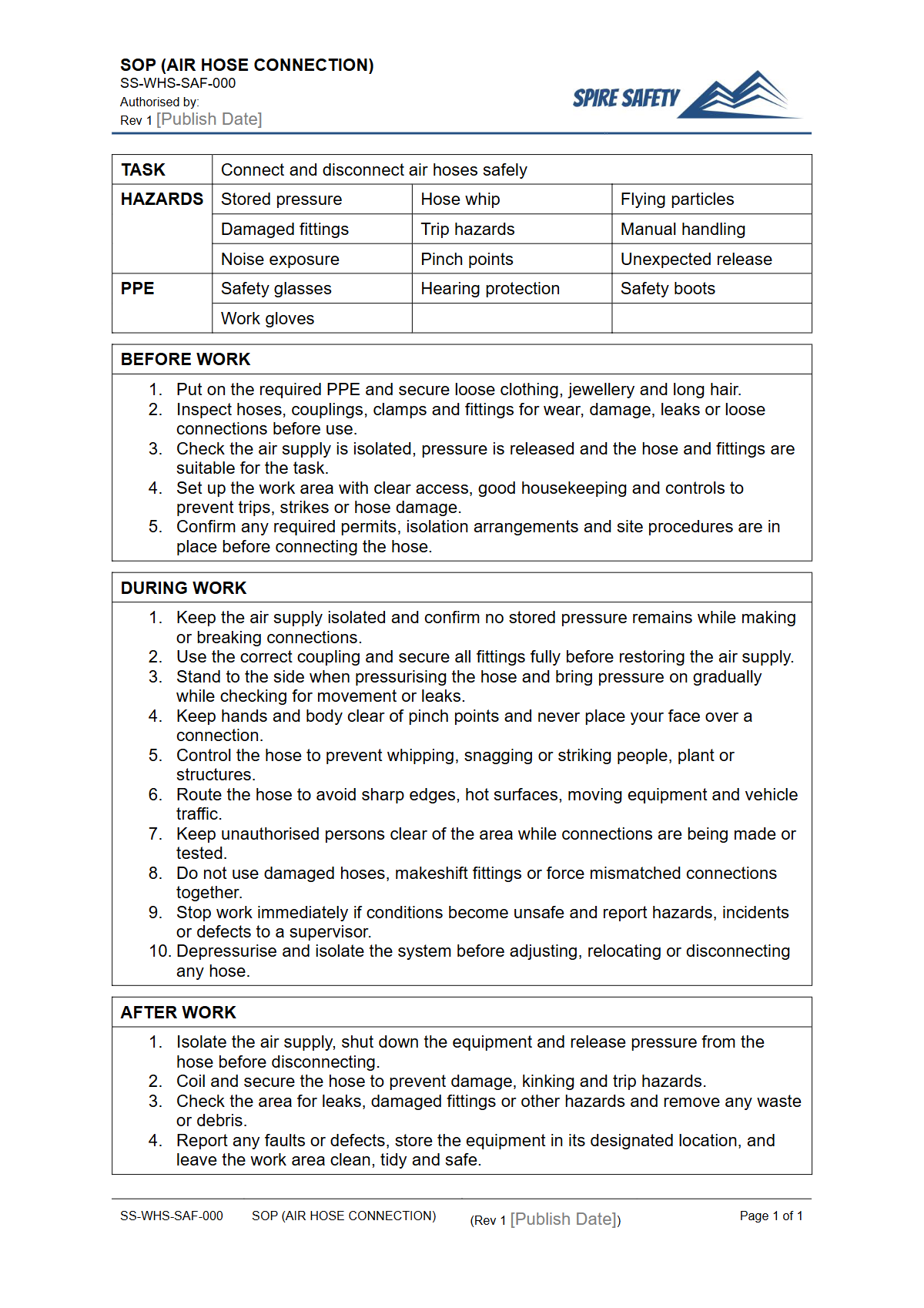
This Free Safe Operating Procedure (Air Hose Connection) Template provides a structured framework for documenting the safe steps required to connect and disconnect pressurised air hoses. Correctly managing air hose connections is critical for preventing serious injuries, such as those from whipping hoses, high-pressure fluid injection, or sudden equipment movement.
Using a documented procedure helps ensure all workers perform this common but potentially hazardous task in a consistent and safe manner, minimising risks associated with compressed air systems.
A well-defined Safe Operating Procedure (SOP) is a fundamental control measure under Australian WHS laws. It serves as a key training document and a reference tool for workers, demonstrating that an organisation has established a safe system of work.
This SOP should be used alongside other relevant procedures, such as our free Air Compressor SOP, to manage the entire compressed air system safely.
By implementing this procedure, you formalise the steps for inspection, connection, testing, and disconnection, helping to reduce equipment damage and prevent workplace incidents. It forms an integral part of comprehensive WHS management systems, providing clear instructions that support your organisation's commitment to safety.
Video walkthrough
How to use the Free Safe Operating Procedure (Air Hose Connection) Template
This document is provided in DOCX format for easy editing and customisation. To use it effectively, you must adapt its contents to your specific operational context.
This involves identifying the specific types of air hoses, couplings (e.g., claw, push-to-connect), and equipment used at your site. You should also incorporate the findings from your site-specific risk assessment.
Key areas to customise include:
- Personal Protective Equipment (PPE): Specify the exact PPE required, such as safety glasses, gloves, and hearing protection, based on your workplace hazards.
- Procedure Steps: Detail the step-by-step process, including pre-connection checks (verifying pressure rating, checking for damage), connection method, securing connections (e.g., with whip checks), and depressurisation before disconnection.
- Emergency Procedures: Outline the specific actions to take in case of a hose failure, uncontrolled pressure release, or injury.
Remember, this is a template. We've given you a structured starting point, but you must customise it to reflect your specific equipment, workplace conditions, and risk controls.
A generic procedure is not sufficient; it must be made relevant to the tasks your workers perform. This process of site-specific customisation is just as important for a complex task covered by our plasma cutter SOP as it is for seemingly simple tasks.
When to use it
A Safe Operating Procedure for air hose connection should be an active document within your safety management system. It should be used during the induction and training of new employees or contractors who will be working with compressed air.
It serves as the primary training document to ensure they understand the hazards and control measures from day one.
The SOP should also be readily available in the work area as a reference for experienced operators, reinforcing correct procedure and acting as a quick reminder of safety-critical steps. Furthermore, it is a key document to review during toolbox talks, safety meetings, and any incident investigations related to compressed air.
It is also an essential piece of evidence during WHS compliance audits to demonstrate that safe systems of work have been established and communicated.
Who should use it
This Safe Operating Procedure is intended for a broad range of personnel within an organisation. Primarily, it is for workers, operators, and tradespeople who are required to connect or disconnect air hoses as part of their daily duties.
For them, it is a practical guide to performing the task safely.
Supervisors and team leaders should use the SOP to supervise work, conduct training, and verify competency. They are responsible for ensuring the procedures are followed and that any deviations are corrected.
WHS managers and safety professionals will use this template as a foundation for developing their site-specific documentation, integrating it into the broader safety framework and using it to standardise practices across different work areas or sites. You can find more templates like this in our complete library of free WHS resources.
Common mistakes
Common mistakes to avoid
- Using damaged or mismatched fittings which can lead to poor seals or sudden disconnection.
- Forgetting to depressurise the airline completely before attempting to disconnect the coupling.
- Failing to install whip checks or safety cables on larger diameter hoses, especially in high-pressure applications.
- Tugging on the hose itself to disconnect it instead of properly operating the coupling mechanism.
Legal references
Legal considerations
The following legal requirements may be relevant to this type of work.
- Work Health and Safety Act (Harmonised) — Provides the primary duties for protecting workers and other people from work health and safety risks.
- Work Health and Safety Regulations (Harmonised) — Sets out requirements supporting the management of workplace hazards and risks.
The following codes may be relevant to this type of work.
- Managing WHS Risks Code of Practice — Provides practical guidance on identifying hazards, assessing risks and applying effective controls.
- Work Health and Safety Consultation, Cooperation and Coordination Code of Practice — Provides practical guidance on consulting workers and coordinating with other duty holders.
- Managing the Work Environment and Facilities Code of Practice — Provides practical guidance on safe work environments, workplace facilities and related controls.
Did you know
Whipping Force
An unsecured 1-inch air hose at just 100 PSI can whip about with over 220kg of force if it breaks free, easily causing severe or fatal injuries.
Hidden Noise Hazard
Small, persistent leaks at air hose connections are a common source of high-frequency noise pollution in workshops. Over time, this can contribute significantly to industrial hearing loss among workers.
FAQ
Frequently asked questions
01What is the biggest risk when connecting air hoses?
02Does this SOP cover the entire compressed air system?
03Why can't I just use the manufacturer's manual?
04Is this SOP template WHS-aligned?
Share this resource
Free Safe Operating Procedure (Air Hose Connection) Template
Browse Categories
How To Use It
- 1Download and open in Word or PDF.
- 2Replace the placeholders with your business details.
- 3Get it reviewed by a WHS specialist before rollout.
Need it customised?
Our WHS consultants can adapt this template to your site, run a gap analysis, or audit what you already have in place.
Book a Free Consultation WHS consulting servicesor call 1300 156 382
Related templates
- Free Safe Operating Procedure (Air Hose Whip Check) Template
- Free Safe Operating Procedure (Air Intake Cleaning) Template
- Free Safe Operating Procedure (Air Line Isolation) Template
- Free Safe Operating Procedure (Air Operated Pump) Template
- Free Safe Operating Procedure (Air Ratchet) Template
- Free Safe Operating Procedure (Air Receiver Drain) Template