
Free Safe Operating Procedure (Air Ratchet) Template
Download our free Safe Operating Procedure (SOP) for air ratchets. This template helps you outline safe work methods for pneumatic ratchet use.
Free Safe Operating Procedure (Air Ratchet) Template
DOCX • 126 KB + PDF
Updated Oct 2026
No signup required
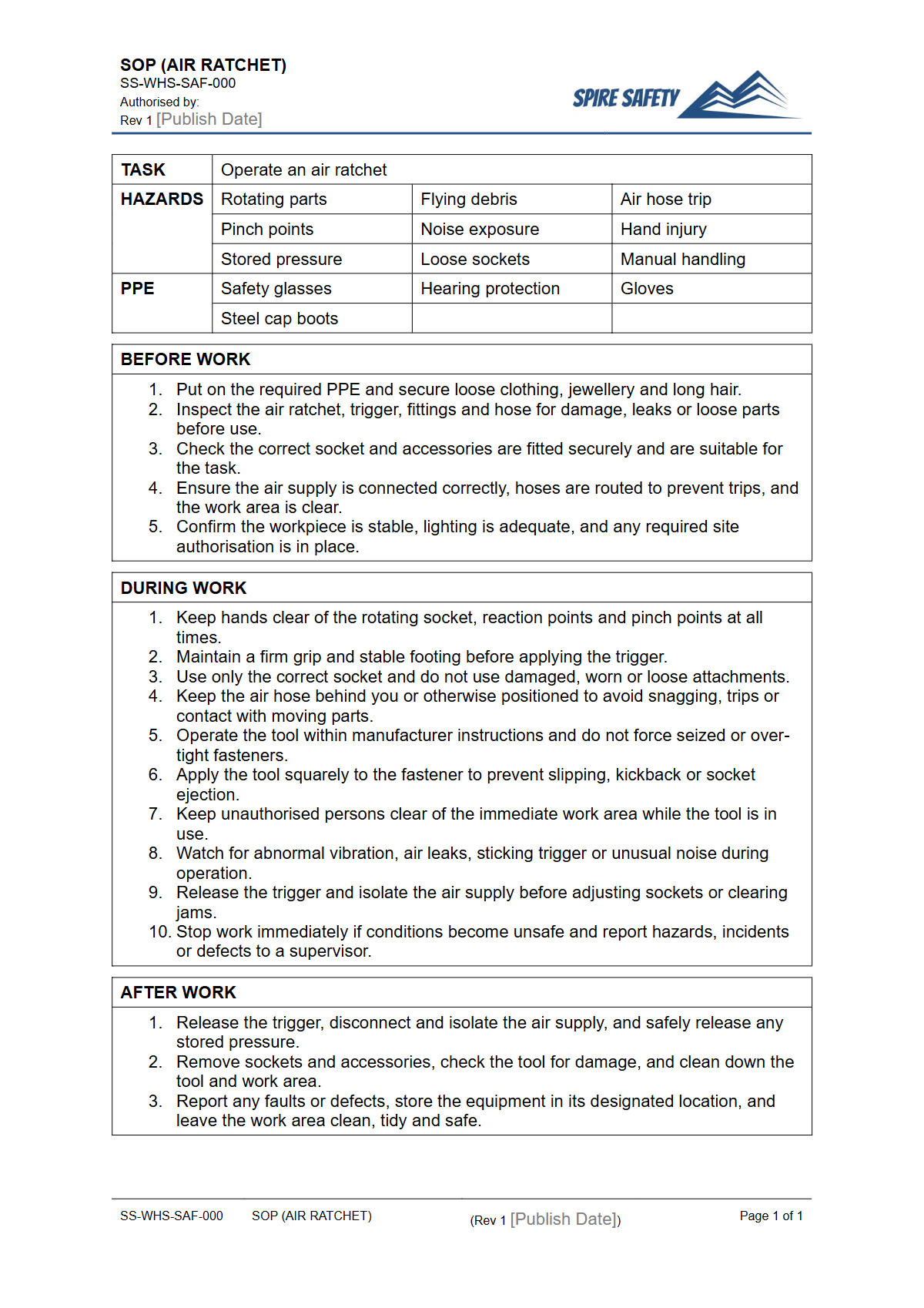
Purpose of the Free Safe Operating Procedure (Air Ratchet) Template
This Free Safe Operating Procedure (Air Ratchet) Template provides a structured framework for documenting the safe use of pneumatic ratchets in your workplace. Its primary purpose is to help you establish a clear, step-by-step guide that minimises the risk of injury to operators.
By systematically outlining pre-operational checks, operational steps, and post-operational tasks, this Safe Operating Procedure helps your organisation meet its duty of care. It addresses common hazards associated with air ratchets, including noise, vibration, air-line hazards, and risks from moving parts or projectiles.
An air ratchet is powered by compressed air, so it's critical to consider the entire system. Your SOP should integrate with procedures for the power source, making our free Air Compressor SOP a valuable companion document.
Using this template helps standardise work methods, ensuring every worker understands the approved, safe way to complete their tasks and handle potential emergencies. This consistency is a cornerstone of a strong safety culture.
Video walkthrough
How to use the Free Safe Operating Procedure (Air Ratchet) Template
This document is a starting point designed for customisation. Download the DOCX file and adapt it to reflect the specific air ratchet models, tasks, and environment at your worksite.
It is crucial to conduct a site-specific risk assessment and incorporate your findings into the final document. You must add details such as your company name, specific locations, required personal protective equipment (PPE), and emergency contact information.
Important Note: We have developed this template as a guide based on common industry practices. It is your responsibility to ensure the final Safe Operating Procedure is tailored to your unique operational needs and complies with all relevant state and federal WHS legislation.
Integrating these documents effectively into your safety framework is key, a process that is central to well-developed WHS management systems. Review and approve the final SOP with relevant personnel, including operators and supervisors, before implementation.
When to use it
A Safe Operating Procedure for an air ratchet should be a living document used consistently across your operations. It is essential during worker induction and training, providing the authoritative guide for new operators.
It should be readily accessible in the work area as a quick reference for all workers before they start a task. The SOP is also a vital tool for supervisors conducting pre-start meetings or toolbox talks, allowing them to reinforce key safety points and address specific task-related hazards.
Furthermore, this SOP should be used as a benchmark during safety observations or audits. It serves as the basis for reviewing work practices and identifying any deviations from the established safe procedure.
If you work with a variety of workshop equipment, it's good practice to maintain a library of similar documents, such as a free Plasma Cutter SOP, to ensure consistency across all tasks.
Who should use it
This Safe Operating Procedure is intended for a range of personnel within an organisation. Primarily, it is for the operators who use air ratchets as part of their daily tasks.
They rely on it for clear instruction on how to perform their work safely. Supervisors and team leaders must also use the SOP to train their teams, monitor work, and ensure that safety standards are consistently upheld.
They are responsible for enforcing the procedures outlined in the document.
WHS managers and safety officers will use this template as part of their role in developing, implementing, and reviewing the organisation's overall safety system. It provides evidence that a process is in place to manage the risks associated with pneumatic tools. For complex customisation or system-wide reviews, our general WHS consulting services can provide expert guidance. Finally, maintenance personnel should also be familiar with the SOP, particularly sections related to equipment inspection and integrity. The document helps form a complete safety picture, covering all asepcts of the equipment lifecycle from setup to use and maintenance. You can find more templates covering different equipment in our free WHS resources library.
Common mistakes
Common mistakes to avoid
- Using incorrect, ill-fitting, or worn sockets that can slip or shatter under torque.
- Failing to inspect air hoses for cracks, bulges, or damage, which can lead to sudden failure.
- Neglecting to wear appropriate hearing and eye protection during every use.
- Holding the workpiece or tool in a way that creates hand or finger entanglement risks with the rotating socket.
Legal references
Legal considerations
The following legal requirements may be relevant to this type of work.
- Work Health and Safety Act (Harmonised) — Provides the primary duties for protecting workers and other people from work health and safety risks.
- Work Health and Safety Regulations (Harmonised) — Sets out requirements supporting the management of workplace hazards and risks.
The following codes may be relevant to this type of work.
- Managing WHS Risks Code of Practice — Provides practical guidance on identifying hazards, assessing risks and applying effective controls.
- Work Health and Safety Consultation, Cooperation and Coordination Code of Practice — Provides practical guidance on consulting workers and coordinating with other duty holders.
- Managing the Work Environment and Facilities Code of Practice — Provides practical guidance on safe work environments, workplace facilities and related controls.
Did you know
Vibration Risks
Prolonged exposure to vibration from tools like air ratchets can lead to Hand-Arm Vibration Syndrome (HAVS), a painful and disabling condition affecting nerves, blood vessels, and joints.
Correct Air Pressure
Operating an air ratchet above its recommended pressure (typically 90 PSI) doesn't just waste air; it dramatically increases wear on internal parts and heightens the risk of catastrophic tool failure.
FAQ
Frequently asked questions
01What are the main hazards of using an air ratchet?
02Is an SOP a legal requirement for an air ratchet in Australia?
03How often should an Air Ratchet SOP be reviewed?
04What PPE is required when using a pneumatic ratchet?
Share this resource
Free Safe Operating Procedure (Air Ratchet) Template
Browse Categories
How To Use It
- 1Download and open in Word or PDF.
- 2Replace the placeholders with your business details.
- 3Get it reviewed by a WHS specialist before rollout.
Need it customised?
Our WHS consultants can adapt this template to your site, run a gap analysis, or audit what you already have in place.
Book a Free Consultation WHS consulting servicesor call 1300 156 382
Related templates
- Free Safe Operating Procedure (Air Receiver Drain) Template
- Free Safe Operating Procedure (Air Return Cleaning) Template
- Free Safe Operating Procedure (Air Riveter) Template
- Free Safe Operating Procedure (Air Sampling Pump) Template
- Free Safe Operating Procedure (Air Sander) Template
- Free Safe Operating Procedure (Air Tool Operation) Template