
Free Safe Operating Procedure (Air Return Cleaning) Template
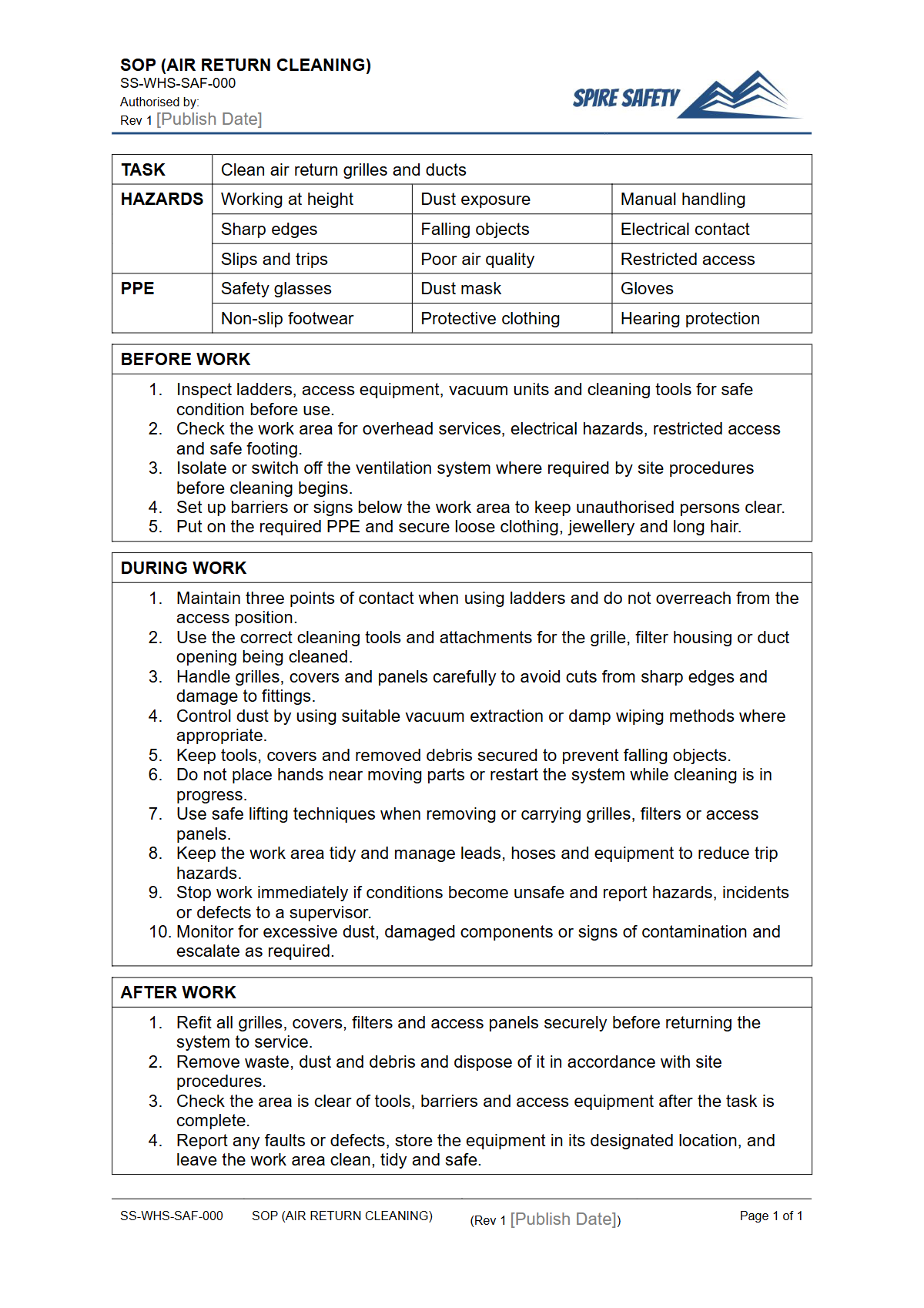
Download our free Safe Operating Procedure (Air Return Cleaning) Template. This Word & PDF document helps you control dust, mould, and electrical hazards.
Free Safe Operating Procedure (Air Return Cleaning) Template
DOCX • 126 KB + PDF
Updated Oct 2026
No signup required
Purpose of the Free Safe Operating Procedure (Air Return Cleaning) Template
This template helps your organisation document the step-by-step process for safely cleaning air return vents and associated ductwork. Its primary purpose is to mitigate risks to workers and building occupants by controlling exposure to airborne contaminants like dust, mould, bacteria, and allergens.
A properly implemented SOP ensures that cleaning is performed consistently and safely, reducing the likelihood of incidents and improving indoor air quality. Integrating this procedure supports your duty of care and forms a crucial part of proactive WHS management systems, demonstrating a commitment to a healthy workplace environment.
Video walkthrough
How to use the Free Safe Operating Procedure (Air Return Cleaning) Template
To effectively use this Free Safe Operating Procedure (Air Return Cleaning) Template, you must adapt it to the specific context of your workplace. Start by conducting a thorough risk assessment for the task, identifying the unique equipment (e.g., specific vacuum cleaners with HEPA filters, cleaning agents) and environmental conditions at your site.
It is vital to consult with the workers who will be performing the cleaning to incorporate their valuable on-the-ground knowledge into the final document.
Important: This document is a template and not a complete safety solution. We strongly recommend you customise it to reflect your specific tools, chemicals, site hazards, and control measures identified in your risk assessment.
For tasks involving related equipment, our Free Air Compressor SOP Template can serve as a useful cross-reference.
When to use this Safe Operating Procedure
This Safe Operating Procedure should be referenced whenever maintenance or cleaning of air return systems is undertaken. Common scenarios include:
- Regularly scheduled preventative maintenance to uphold indoor air quality standards.
- Post-construction or renovation clean-ups to remove building dust and debris from the HVAC system.
- Reactive cleaning in response to occupant complaints, visible mould growth, or identified contamination.
- As part of an annual facilities maintenance schedule.
The procedure is also an essential document to have available during internal safety checks or external WHS compliance auditing activities to demonstrate that formalised controls are in place for managing associated hazards.
Who should use this SOP?
This SOP is designed for use by trained and competent personnel, such as facilities maintenance staff, HVAC technicians, and specialised cleaning contractors responsible for building upkeep. It is also a key guidance document for supervisors and Work Health and Safety (WHS) managers who oversee this type of work.
Before any work begins, all individuals involved must be instructed on the procedures outlined in the customised SOP, including hazard identification, the correct use of Personal Protective Equipment (PPE), and emergency protocols. Since accessing vents often requires working from height, personnel must also be competent in using ladders or platforms safely; our FREE Step Ladder SOP Template provides specific guidance on this.
For organisations needing expert support to develop and implement robust safety procedures, engaging professional WHS consulting services can provide tailored solutions.
A well-organised system of safety documentation makes it easier for your team to find and follow the correct procedures for every high-risk task. By building a comprehensive collection of customised SOPs, you create a more predictable and safer working environment for everyone.
You can explore our complete free WHS resources library to find other templates that can help you strengthen your safety framework.
Common mistakes
Common mistakes to avoid
- Using the template without conducting and documenting a site-specific risk assessment.
- Failing to electrically isolate the HVAC system before starting cleaning work.
- Using inappropriate cleaning chemicals that can damage system components or create new airborne hazards.
- Not providing workers with adequate PPE, especially certified respiratory protection (P2/N95 masks).
Legal references
Legal considerations
The following legal requirements may be relevant to this type of work.
- Work Health and Safety Act (Harmonised) — Provides the primary duties for protecting workers and other people from work health and safety risks.
- Work Health and Safety Regulations (Harmonised) — Sets out requirements supporting the management of workplace hazards and risks.
The following codes may be relevant to this type of work.
- Managing WHS Risks Code of Practice — Provides practical guidance on identifying hazards, assessing risks and applying effective controls.
- Work Health and Safety Consultation, Cooperation and Coordination Code of Practice — Provides practical guidance on consulting workers and coordinating with other duty holders.
- Managing the Work Environment and Facilities Code of Practice — Provides practical guidance on safe work environments, workplace facilities and related controls.
Did you know
Indoor Air Quality
Studies by the CSIRO have shown that poor indoor air quality can reduce office productivity by up to 10% due to factors like fatigue and difficulty concentrating.
Hidden Contaminants
A single gram of dust can contain hundreds of thousands of mould spores, which can become airborne and distributed throughout a building by the HVAC system if not properly cleaned.
FAQ
Frequently asked questions
01What are the main hazards when cleaning air returns?
02Is this Safe Operating Procedure template enough for WHS compliance?
03What PPE is typically required for air return cleaning?
04How often should air return systems be cleaned?
Share this resource
Free Safe Operating Procedure (Air Return Cleaning) Template
Browse Categories
How To Use It
- 1Download and open in Word or PDF.
- 2Replace the placeholders with your business details.
- 3Get it reviewed by a WHS specialist before rollout.
Need it customised?
Our WHS consultants can adapt this template to your site, run a gap analysis, or audit what you already have in place.
Book a Free Consultation WHS consulting servicesor call 1300 156 382
Related templates
- Free Safe Operating Procedure (Air Riveter) Template
- Free Safe Operating Procedure (Air Sampling Pump) Template
- Free Safe Operating Procedure (Air Sander) Template
- Free Safe Operating Procedure (Air Tool Operation) Template
- Free Safe Operating Procedure (Airbag Isolation) Template
- Free Safe Operating Procedure (Aircraft Battery Cart) Template