
Free Safe Operating Procedure (Air Sampling Pump) Template
Download our free Safe Operating Procedure for Air Sampling Pumps. This Word & PDF template helps you document safe work methods for air quality monitoring.
Free Safe Operating Procedure (Air Sampling Pump) Template
DOCX • 126 KB + PDF
Updated Oct 2026
No signup required
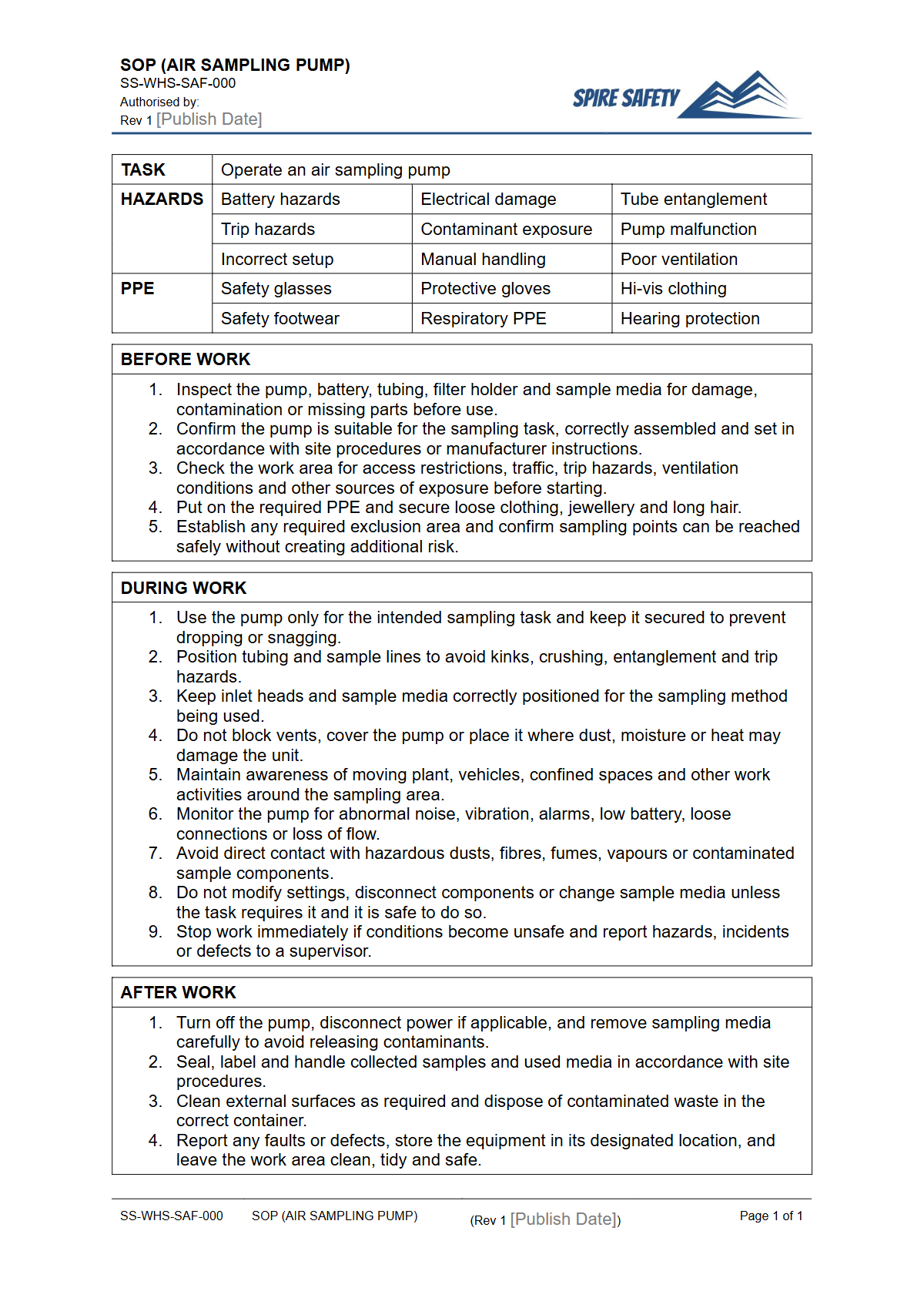
Purpose of the Free Safe Operating Procedure (Air Sampling Pump) Template
Effectively managing workplace health and safety involves identifying and controlling risks associated with airborne contaminants. This Free Safe Operating Procedure (Air Sampling Pump) Template provides a structured framework for businesses to document the safe use of air sampling pumps.
These devices are critical for monitoring worker exposure to dust, fumes, vapours, and gases, ensuring that control measures are effective and exposure limits are not exceeded. Using a standardised SOP helps ensure consistency, reduces the risk of procedural errors, and demonstrates a commitment to maintaining a safe breathing atmosphere for all personnel.
Video walkthrough
How to Use the Free Safe Operating Procedure (Air Sampling Pump) Template
This template is designed to be a comprehensive starting point. After downloading the DOCX or PDF file, you must adapt it to the specific pumps, sampling media, and workplace hazards present at your site.
A generic procedure is not sufficient for compliance or safety. Similar to our Free Air Compressor SOP, this document provides a clear, step-by-step structure that you can populate with your own operational details, PPE requirements, and emergency contacts.
Important Customisation Note:
This is a template only. It has been developed as a guide and does not cover every potential hazard or control measure for your specific equipment or situation.
We are not responsible for the outcomes if you use this document without customising it to your workplace. You must conduct your own risk assessment and update the SOP to reflect the unique requirements of your business, state/territory legislation, and the manufacturer's instructions for the air sampling pump model in use.
Key Elements of an Effective Air Sampling Pump SOP
A robust SOP for air sampling should be clear, concise, and easy for operators to follow. Our template is organised into logical sections to help you build a comprehensive document.
These include pre-operational checks like battery level and calibration status, step-by-step instructions for setting up the sampling train, correct placement of the sampling head on the worker, and procedures for starting, stopping, and documenting the sample. It also covers post-sampling handling and basic maintenance, especially in environments with known hazards from processes like welding or using a plasma cutter.
When to Use This Safe Operating Procedure
An SOP for air sampling pumps should be used whenever personal or static air monitoring is required. Common scenarios include assessing exposure to specific chemicals or dusts as part of a risk assessment, verifying the effectiveness of ventilation systems, clearance monitoring after asbestos removal, and routine compliance checks against workplace exposure standards. It's also vital for tasks where conditions may change, requiring real-time data to ensure worker safety, or sampling at height which may require its own procedures, such as those outlined in a step ladder SOP.
Who Should Use This Safe Operating Procedure
This SOP is intended for use by competent persons tasked with conducting air quality monitoring. This typically includes Occupational Hygienists, WHS Advisors, and trained technicians.
All personnel responsible for operating, calibrating, or maintaining air sampling pumps should be trained on the contents of the finalised SOP. It also serves as a valuable training tool for new team members and a reference document for supervisors and managers overseeing hazardous work areas.
Integrating Your SOP into a Broader WHS Framework
A single procedure is most effective when it is part of a holistic safety strategy. Integrating this SOP into your organisation's overall safety plan is a core component of effective WHS management systems. It should link directly to your chemical and hazardous substances register, risk assessments, and training records.
This ensures that procedures are not just documents on a shelf, but are active, integrated parts of your daily safety management practices, helping to build a proactive safety culture.
Verifying and Auditing Procedure Effectiveness
Once implemented, the SOP's effectiveness must be regularly verified. This involves workplace observations to confirm that operators are following the documented steps correctly and consistently.
Regular reviews and periodic WHS compliance auditing ensure the SOP remains relevant, up-to-date with current standards, and effective in controlling risks. Feedback from operators should be encouraged and used to make practical improvements to the procedure.
To find other useful templates to support your safety system, you can explore our complete free WHS resources library for more downloads.
Common mistakes
Common mistakes to avoid
- Failing to properly calibrate the pump before and after each sample.
- Incorrectly placing the sampling head, leading to unrepresentative samples.
- Using the wrong type of sampling media for the target contaminant.
- Poor documentation of start/stop times, flow rates, and environmental conditions.
Legal references
Legal considerations
The following legal requirements may be relevant to this type of work.
- Work Health and Safety Act (Harmonised) — Provides the primary duties for protecting workers and other people from work health and safety risks.
- Work Health and Safety Regulations (Harmonised) — Sets out requirements supporting the management of workplace hazards and risks.
The following codes may be relevant to this type of work.
- Managing WHS Risks Code of Practice — Provides practical guidance on identifying hazards, assessing risks and applying effective controls.
- Work Health and Safety Consultation, Cooperation and Coordination Code of Practice — Provides practical guidance on consulting workers and coordinating with other duty holders.
- Managing the Work Environment and Facilities Code of Practice — Provides practical guidance on safe work environments, workplace facilities and related controls.
Did you know
Exposure Standards
Safe Work Australia publishes the Workplace Exposure Standards for Airborne Contaminants, which lists over 700 substances and their legal concentration limits in workplace air.
Breathing Zone
For personal exposure monitoring, the sampling media is placed in the worker's 'breathing zone'—a hemisphere 300mm in radius extending in front of the face, centred at the midpoint of the ears.
FAQ
Frequently asked questions
01What is an air sampling pump used for in WHS?
02Does this SOP template cover pump calibration procedures?
03Who is considered a competent person to conduct air sampling?
04How often should an SOP for an air sampling pump be reviewed?
Share this resource
Free Safe Operating Procedure (Air Sampling Pump) Template
Browse Categories
How To Use It
- 1Download and open in Word or PDF.
- 2Replace the placeholders with your business details.
- 3Get it reviewed by a WHS specialist before rollout.
Need it customised?
Our WHS consultants can adapt this template to your site, run a gap analysis, or audit what you already have in place.
Book a Free Consultation WHS consulting servicesor call 1300 156 382
Related templates
- Free Safe Operating Procedure (Air Sander) Template
- Free Safe Operating Procedure (Air Tool Operation) Template
- Free Safe Operating Procedure (Airbag Isolation) Template
- Free Safe Operating Procedure (Aircraft Battery Cart) Template
- Free Safe Operating Procedure (Aircraft Cabin Cleaning) Template
- Free Safe Operating Procedure (Aircraft Cabin Restock) Template