
Free Safe Operating Procedure (Aircraft Cabin Restock) Template
Download our Free Safe Operating Procedure (Aircraft Cabin Restock) Template.
Free Safe Operating Procedure (Aircraft Cabin Restock) Template
DOCX • 126 KB + PDF
Updated Oct 2026
No signup required
Purpose of the Free Safe Operating Procedure (Aircraft Cabin Restock) Template
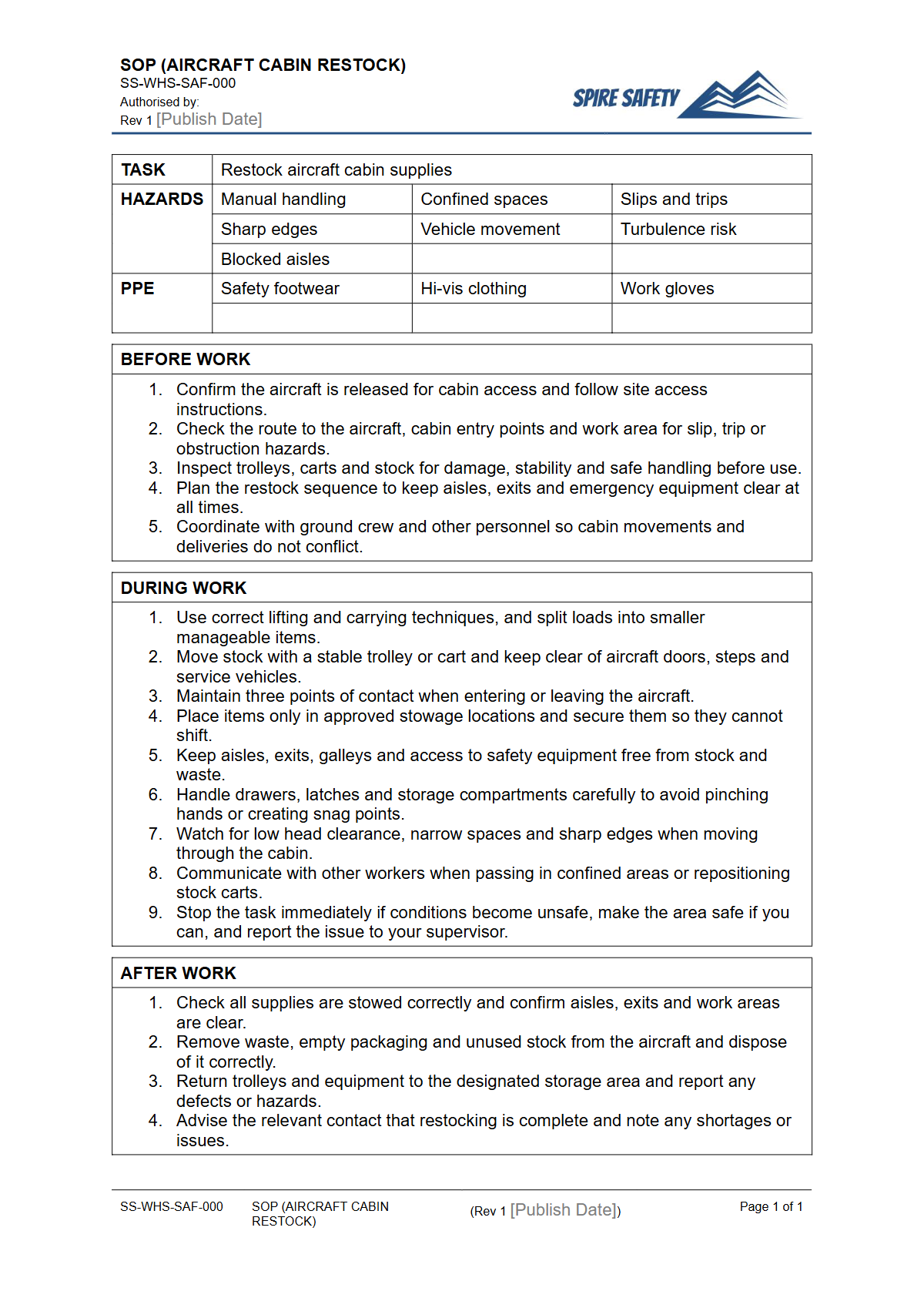
This Free Safe Operating Procedure (Aircraft Cabin Restock) Template provides a structured framework for documenting the safe systems of work required for restocking aircraft cabins. Its primary purpose is to help organisations identify hazards and implement effective risk controls for this specific, high-turnaround task.
By clearly outlining step-by-step instructions, required personal protective equipment (PPE), and emergency procedures, the SOP helps standardise safe work practices across all ground crew teams.
Using a formal SOP helps meet your duties under WHS legislation by providing clear information and instruction to workers. It acts as a critical tool for managing risks associated with manual handling, working in confined spaces, time pressure, and potential slips, trips, and falls.
A well-developed procedure is a key component of any effective safety management system, demonstrating a proactive approach to worker health and safety in the aviation sector.
Video walkthrough
How to use the Free Safe Operating Procedure (Aircraft Cabin Restock) Template
This template is a starting point designed for customisation. To use it effectively, download the DOCX file and adapt it to the specific aircraft, equipment, and environment of your operation.
It is crucial that the final document reflects the reality of the work being performed.
Follow these steps:
- Consult Workers: Involve the ground crew and team leaders who perform the restocking tasks. Their direct experience is invaluable for identifying practical hazards and effective control measures.
- Conduct a Risk Assessment: Use the template in conjunction with a task-specific risk assessment to identify all potential hazards and determine the necessary controls.
- Customise the Content: Populate the sections with details specific to your workplace. This includes the types of service carts used, specific manual handling techniques for different items (e.g., beverage canisters, comfort kits), PPE requirements, and your site's emergency contacts.
- Train Your Team: Once finalised, use the SOP as a training tool for new employee induction and for regular refresher training to ensure everyone understands the required procedures.
- Review and Revise: The SOP should be a living document, reviewed regularly and updated after any incident, or when processes, aircraft, or equipment change.
A well-implemented SOP is a fundamental part of demonstrating due diligence and building strong, compliant WHS management systems. Please note: we have designed this template as a guide. You must adapt it to your specific circumstances to ensure it is effective and relevant.
Key Hazards in Aircraft Cabin Restocking
Restocking an aircraft cabin involves a unique combination of hazards within a confined and time-sensitive environment. Key risks that must be managed include:
- Musculoskeletal Disorders (MSDs): Resulting from hazardous manual tasks such as lifting heavy galley boxes, pushing and pulling heavy trolleys, and reaching into overhead lockers. Repetitive movements and awkward postures are significant contributors.
- Slips, Trips, and Falls: Caused by wet galley floors, discarded packaging materials, uneven surfaces between the airbridge and aircraft, or rushing to meet turnaround times.
- Falls from Height: Even a small fall can cause serious injury. This risk is present when using steps or unsecured ladders to access high storage areas. Using a dedicated FREE Step Ladder SOP Template can help formalise procedures for this specific hazard.
- Being Struck By Objects: Items falling from overhead lockers or unstable trolleys can cause impact injuries. Securing items during movement is critical.
- Confined Spaces: Working in narrow galleys and aisles restricts movement and can make manual handling tasks more difficult and hazardous.
When to use it
A Safe Operating Procedure for aircraft cabin restocking should be used consistently as a reference and training tool. Its application is crucial in several key scenarios:
- Before a task begins: As a pre-start prompt for workers to review the key steps and safety requirements.
- Worker Induction and Training: As a foundational document for training new ground crew members on the established safe way to perform their duties.
- Refresher Training: For periodic training sessions to reinforce safe work habits and communicate any updates to the procedure.
- Incident Investigation: As a reference point to determine if procedural deviations contributed to an incident or near-miss.
- Workplace Audits: To demonstrate that a formal, documented process for managing restocking hazards is in place.
Consistent use ensures the SOP is not just a document that sits on a shelf, but an active part of the daily safety culture. This proactive approach is often examined during a WHS compliance auditing process to verify that documented procedures are understood and implemented.
Who should use it
This SOP is intended for all personnel involved in the aircraft cabin servicing and restocking process. The primary users include:
- Ground Crew/Cabin Appearance Agents: The workers who physically perform the restocking tasks. The SOP is their guide to working safely.
- Team Leaders and Supervisors: Responsible for ensuring their teams follow the documented procedure, providing training, and monitoring for compliance.
- WHS Managers and Officers: Who oversee the development, implementation, and review of safety procedures as part of the broader safety management system.
- Operations Managers: To ensure that safety and efficiency are integrated and that adequate resources (e.g., appropriate equipment, time, training) are allocated for safe operations.
For complex ground handling operations, seeking external advice can help ensure your procedures are robust and effective. A specialist can provide guidance on risk management, procedure development, and training through tailored WHS consulting services.
Common mistakes
Common mistakes to avoid
- Using a generic template without customising it with site-specific details.
- Failing to consult with the workers who actually perform the restocking tasks.
- Not providing practical training and verification of competency on the finalised SOP.
- Forgetting to schedule and conduct regular reviews, especially after an incident.
Legal references
Legal considerations
The following legal requirements may be relevant to this type of work.
- Work Health and Safety Act (Harmonised) — Provides the primary duties for protecting workers and other people from work health and safety risks.
- Work Health and Safety Regulations (Harmonised) — Sets out requirements supporting the management of workplace hazards and risks.
The following codes may be relevant to this type of work.
- Managing WHS Risks Code of Practice — Provides practical guidance on identifying hazards, assessing risks and applying effective controls.
- Work Health and Safety Consultation, Cooperation and Coordination Code of Practice — Provides practical guidance on consulting workers and coordinating with other duty holders.
- Managing the Work Environment and Facilities Code of Practice — Provides practical guidance on safe work environments, workplace facilities and related controls.
Did you know
Manual Task Injuries
Musculoskeletal disorders resulting from hazardous manual tasks are one of the leading causes of serious workers' compensation claims in Australia's transport, postal, and warehousing industry.
FAQ
Frequently asked questions
01What is a Safe Operating Procedure (SOP)?
02Why is a specific SOP for aircraft cabin restocking necessary?
03Is this template sufficient for WHS compliance on its own?
04How often should our Aircraft Cabin Restocking SOP be reviewed?
Share this resource
Free Safe Operating Procedure (Aircraft Cabin Restock) Template
Browse Categories
How To Use It
- 1Download and open in Word or PDF.
- 2Replace the placeholders with your business details.
- 3Get it reviewed by a WHS specialist before rollout.
Need it customised?
Our WHS consultants can adapt this template to your site, run a gap analysis, or audit what you already have in place.
Book a Free Consultation WHS consulting servicesor call 1300 156 382
Related templates
- Free Safe Operating Procedure (Aircraft Catering Load) Template
- Free Safe Operating Procedure (Aircraft Chocking) Template
- Free Safe Operating Procedure (Aircraft Deicing Prep) Template
- Free Safe Operating Procedure (Aircraft Door Check) Template
- Free Safe Operating Procedure (Aircraft Galley Cleaning) Template
- Free Safe Operating Procedure (Aircraft Interior Clean) Template