
Free Safe Operating Procedure (Aircraft Interior Clean) Template
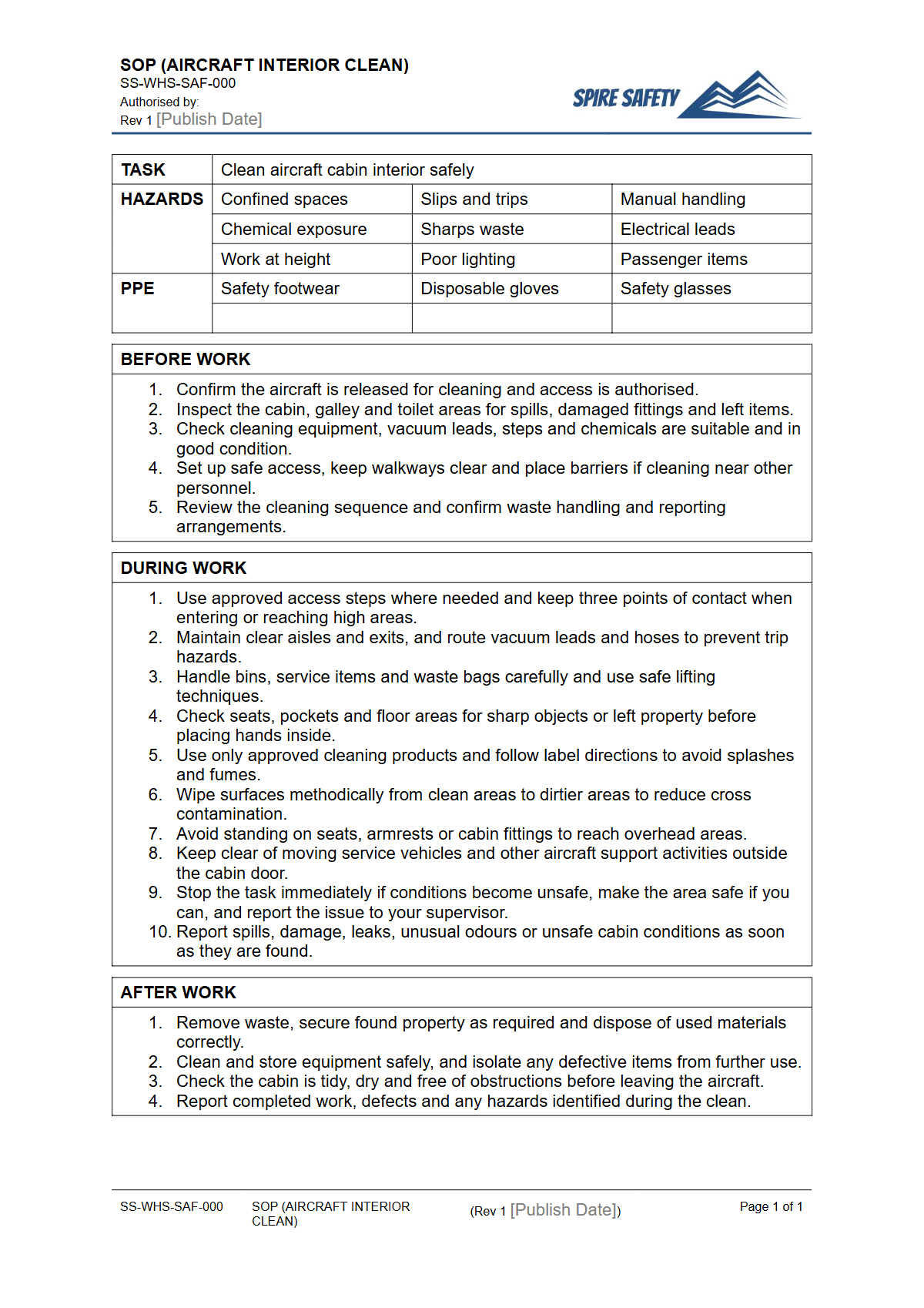
Download our free Safe Operating Procedure (Aircraft Interior Clean) template. This customisable DOCX and PDF provides a clear framework for your WHS processes.
Free Safe Operating Procedure (Aircraft Interior Clean) Template
DOCX • 126 KB + PDF
Updated Oct 2026
No signup required
Purpose of the Free Safe Operating Procedure (Aircraft Interior Clean) Template
This Safe Operating Procedure (SOP) template provides a structured framework for documenting the safe method of cleaning aircraft interiors. It is designed to help your organisation establish and standardise the steps required to manage risks associated with this specialised task.
A well-developed SOP is a critical tool for worker training and for demonstrating that you have a formal process for controlling hazards like chemical exposure, manual handling, and slip, trip, and fall risks in a confined and busy environment.
Using this template as a foundation helps ensure that all team members, from new hires to experienced crew, understand the required safety controls, Personal Protective Equipment (PPE), and emergency procedures. Documenting your process helps in fulfilling your primary duty of care under Australian WHS legislation by providing a safe system of work.
It forms an essential part of broader comprehensive WHS management systems, acting as a practical, on-the-ground control measure.
Video walkthrough
How to use the Free Safe Operating Procedure (Aircraft Interior Clean) Template
To effectively use this free Safe Operating Procedure (Aircraft Interior Clean) template, download the DOCX file and adapt it to the unique context of your workplace. It is crucial to add details specific to your operations, including the types of aircraft serviced (e.g., narrow-body, wide-body), the exact cleaning chemicals used, and the specific equipment provided to your staff.
You must reference the relevant Safety Data Sheets (SDS) for all hazardous chemicals.
Important: This is a template only. We have provided a structured starting point, but you must customise this document to reflect your actual work practices, equipment, and identified hazards.
A generic procedure that doesn't match your reality offers little protection. If you need assistance tailoring this document or implementing it effectively, our specialist WHS consulting services can provide expert guidance.
When to use a Safe Operating Procedure
A Safe Operating Procedure for aircraft interior cleaning should be used consistently as a key part of your daily operations. It is an essential document for inducting and training new cleaning staff, ensuring they learn the correct, safe method from day one.
It should also be used as a reference for pre-start meetings or toolbox talks, especially when there are changes in crew or equipment.
Furthermore, the SOP serves as a benchmark for workplace inspections and behaviour observations. Following an incident or near-miss, the SOP should be reviewed as part of the investigation to determine if the procedure was adequate and if it was followed correctly.
Regular reviews ensure the document remains relevant and effective. For a deeper analysis of your procedural compliance, consider undertaking periodic WHS compliance auditing.
Who should use this SOP
This SOP is intended for use by all personnel involved in or responsible for the cleaning of aircraft interiors. This includes:
- Cleaning Operatives and Ground Crew: The primary users who must follow the step-by-step procedure to perform their tasks safely.
- Team Leaders and Supervisors: Responsible for ensuring the SOP is followed, providing training, and monitoring compliance on the tarmac and within the cabin.
- WHS Managers and Advisors: Use the SOP as a tool for risk management, training development, and incident investigation.
- Operations and Airline Managers: Accountable for providing the resources and systems necessary to implement the safe work practices outlined in the SOP.
The procedure is also a useful resource for procurement teams when selecting new cleaning chemicals or equipment, as it outlines the established safety requirements. The use of equipment like ladders for accessing high areas must also be controlled, which can be detailed in a separate step ladder SOP.
Waste management and the transport of supplies are also key logistical components of the cleaning process. If this involves vehicles, ensuring the safe operation of a body truck or similar vehicle is another critical consideration for your overall safety system.
You can browse our entire free WHS resources library for more templates to support your operations.
Common mistakes
Common mistakes to avoid
- Using the template without customising it for specific aircraft models and cleaning products.
- Failing to list or make available the correct Safety Data Sheets (SDS) for all cleaning chemicals.
- Providing inadequate training on the procedure, especially for new or casual staff.
- Neglecting to review and update the SOP after a process change or near-miss incident.
Legal references
Legal considerations
The following legal requirements may be relevant to this type of work.
- Work Health and Safety Act (Harmonised) — Provides the primary duties for protecting workers and other people from work health and safety risks.
- Work Health and Safety Regulations (Harmonised) — Sets out requirements supporting the management of workplace hazards and risks.
The following codes may be relevant to this type of work.
- Managing WHS Risks Code of Practice — Provides practical guidance on identifying hazards, assessing risks and applying effective controls.
- Work Health and Safety Consultation, Cooperation and Coordination Code of Practice — Provides practical guidance on consulting workers and coordinating with other duty holders.
- Managing the Work Environment and Facilities Code of Practice — Provides practical guidance on safe work environments, workplace facilities and related controls.
Did you know
Chemical Exposure Risk
Cleaners can be exposed to Volatile Organic Compounds (VOCs) from cleaning agents in the enclosed aircraft cabin. Proper ventilation and PPE are critical controls.
Manual Task Injuries
Musculoskeletal disorders from repetitive bending, reaching into overhead lockers, and lifting rubbish bags are among the most common injuries for aircraft cabin cleaners.
FAQ
Frequently asked questions
01Does this aircraft cleaning SOP cover specific cleaning chemicals?
02Is this SOP template suitable for all types of aircraft?
03How often should a Safe Operating Procedure be reviewed?
04What is the difference between an SOP and a SWMS?
Share this resource
Free Safe Operating Procedure (Aircraft Interior Clean) Template
Browse Categories
How To Use It
- 1Download and open in Word or PDF.
- 2Replace the placeholders with your business details.
- 3Get it reviewed by a WHS specialist before rollout.
Need it customised?
Our WHS consultants can adapt this template to your site, run a gap analysis, or audit what you already have in place.
Book a Free Consultation WHS consulting servicesor call 1300 156 382
Related templates
- Free Safe Operating Procedure (Aircraft Jacking) Template
- Free Safe Operating Procedure (Aircraft Lavatory Clean) Template
- Free Safe Operating Procedure (Aircraft Marshalling) Template
- Free Safe Operating Procedure (Aircraft Refuelling) Template
- Free Safe Operating Procedure (Aircraft Seat Cleaning) Template
- Free Safe Operating Procedure (Aircraft Towbar) Template