
Free Safe Operating Procedure (Aircraft Jacking) Template
Download our free Safe Operating Procedure (Aircraft Jacking) Template.
Free Safe Operating Procedure (Aircraft Jacking) Template
DOCX • 126 KB + PDF
Updated Oct 2026
No signup required
Purpose of the Free Safe Operating Procedure (Aircraft Jacking) Template
Aircraft jacking is a high-risk maintenance task that demands precision, planning, and a deep understanding of safety protocols. An error can lead to catastrophic failure, causing severe injury, extensive aircraft damage, and significant operational downtime.
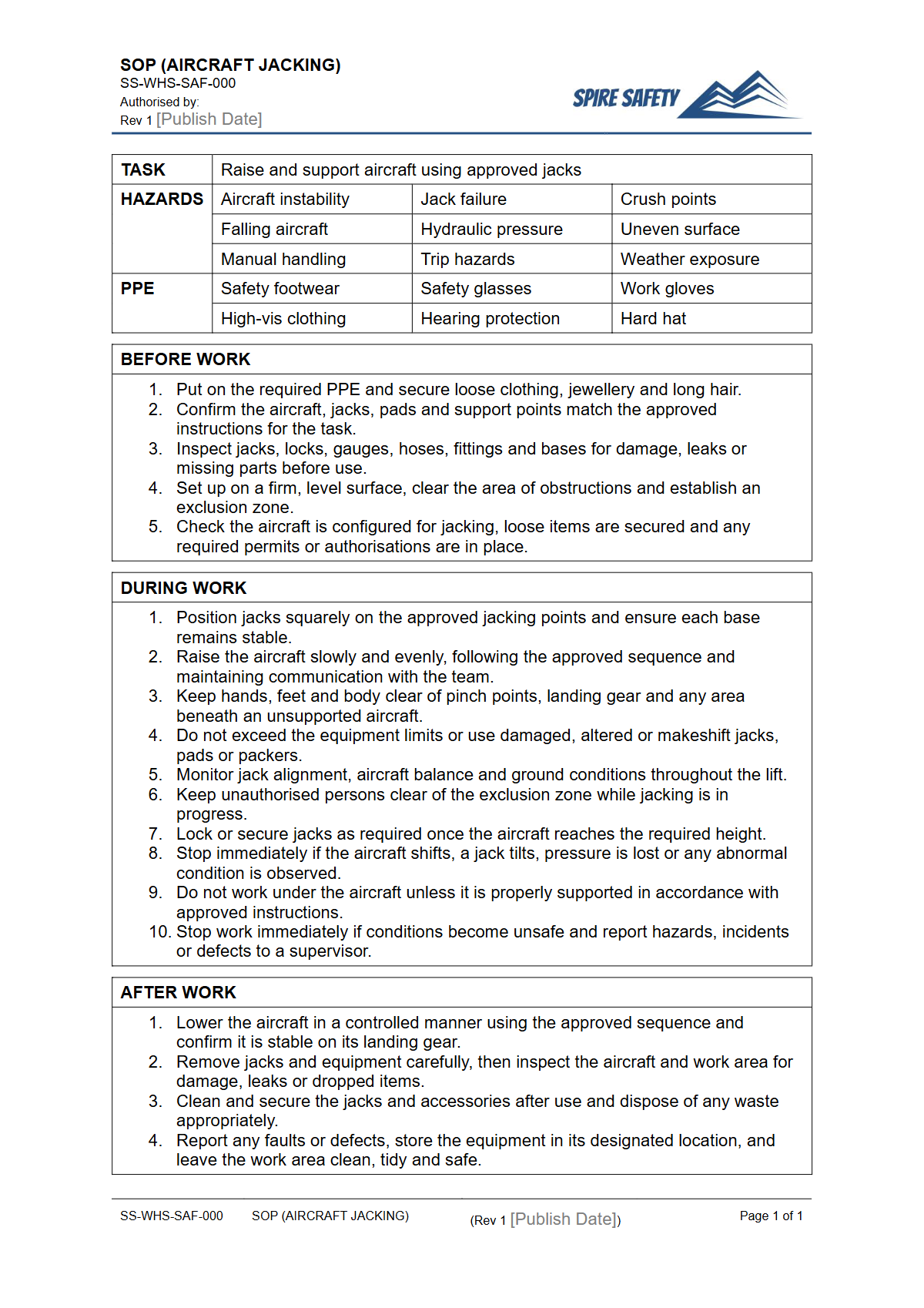
This Free Safe Operating Procedure (Aircraft Jacking) Template provides a structured framework for documenting the specific steps, hazards, and control measures required to perform this task safely at your facility. It is designed to assist your organisation in meeting its work health and safety obligations by formalising a critical process.
Using a standardised SOP helps ensure that every team member follows the same verified process every time, reducing the risk of human error. It serves as a vital training tool for new personnel and a reference for experienced technicians.
Formalising your procedures is a cornerstone of effective WHS management systems, demonstrating a proactive approach to risk management.
Video walkthrough
How to use the Free Safe Operating Procedure (Aircraft Jacking) Template
This template is provided in both DOCX and PDF formats for your convenience. The DOCX file is fully editable, allowing you to tailor the content to your unique operational context.
Simply download the document and begin customising it with information specific to your workplace, including the types of aircraft you service, the specific jacking equipment used, and your site's environmental conditions.
Important: This is a template only. We have provided a comprehensive starting point based on Australian WHS principles, but you must customise this document to reflect the specific aircraft, equipment, environment, and personnel at your workplace.
It is not a complete, out-of-the-box solution. After customisation, a competent person should review and approve the final document before implementation.
Consider engaging professional WHS compliance auditing services to verify the effectiveness of your customised procedures.
Key Elements to Customise
- Aircraft Specifics: Detail the specific models of aircraft the SOP applies to, referencing the relevant Aircraft Maintenance Manual (AMM) for jacking points, weights, and limitations.
- Equipment Details: List the make, model, and capacity of jacks, tail stands, and any ancillary equipment. Include pre-use inspection criteria for this equipment.
- Personnel: Define the roles, responsibilities, and required competencies for the jacking team (e.g., team leader, jack operators, safety observer).
- Emergency Procedures: Outline the specific steps to take in case of jack failure, hydraulic leak, or unexpected aircraft movement.
When to use it
A Safe Operating Procedure for aircraft jacking should be consulted and followed every time an aircraft needs to be lifted for maintenance, inspections, repairs, gear retraction tests, or weighing. Its use is mandatory for all personnel involved in the jacking operation, from the initial planning stages through to the final lowering and securing of the aircraft.
This procedure should be integrated with other relevant safety documents, such as your risk assessments and permits to work. Many maintenance tasks also rely on other equipment, each requiring its own procedure, such as our free Air Compressor SOP template for tasks involving pneumatic tools.
Who should use it
This Safe Operating Procedure template is intended for use by organisations and individuals involved in aircraft maintenance. This includes:
- Licensed Aircraft Maintenance Engineers (LAMEs)
- Aircraft Maintenance Engineers (AMEs)
- Maintenance Supervisors and Managers
- Work Health and Safety (WHS) Officers
- Aviation Training Organisations
The SOP should be readily accessible to all workers performing the task. It provides the practical, step-by-step guidance they need to work safely, while also giving supervisors a clear standard against which to monitor performance and supports your compliance efforts. For complex operations involving the movement of other large components within the hangar, you may also need procedures like a Telehandler SOP.
Proper access to jacking points and other areas of the aircraft is also a critical safety consideration. Ensure you have documented procedures for tasks like working at height, even for seemingly simple equipment.
Our Step Ladder SOP provides a useful starting point for these ancillary tasks. Explore our complete free WHS resources library for more templates to support your safety management system.
Common mistakes
Common mistakes to avoid
- Failing to consult the specific Aircraft Maintenance Manual (AMM) before starting.
- Using jacks with insufficient weight capacity or that have not been recently inspected and certified.
- Jacking on an uneven or contaminated surface, leading to instability.
- Not using tail or nose stands, creating an unstable 'tripod' that is prone to tipping.
Legal references
Legal considerations
The following legal requirements may be relevant to this type of work.
- Work Health and Safety Act (Harmonised) — Provides the primary duties for protecting workers and other people from work health and safety risks.
- Work Health and Safety Regulations (Harmonised) — Sets out requirements supporting the management of workplace hazards and risks.
The following codes may be relevant to this type of work.
- Managing WHS Risks Code of Practice — Provides practical guidance on identifying hazards, assessing risks and applying effective controls.
- Work Health and Safety Consultation, Cooperation and Coordination Code of Practice — Provides practical guidance on consulting workers and coordinating with other duty holders.
- Managing the Work Environment and Facilities Code of Practice — Provides practical guidance on safe work environments, workplace facilities and related controls.
Did you know
Centre of Gravity
The aircraft's centre of gravity (CG) is a critical factor in jacking. Fuel load, installed equipment, and even the placement of toolboxes inside can shift the CG, affecting stability and the required jacking sequence.
Creep and Settle
After an aircraft is jacked, hydraulic jacks can 'creep' or settle slightly over time. This is why mechanical locks or safety stands are mandatory to support the aircraft's weight for any extended maintenance work.
FAQ
Frequently asked questions
01What are the key hazards in aircraft jacking?
02Does this SOP replace the aircraft manufacturer's maintenance manual (AMM)?
03Who is qualified to perform aircraft jacking?
04How often should an aircraft jacking SOP be reviewed?
Share this resource
Free Safe Operating Procedure (Aircraft Jacking) Template
Browse Categories
How To Use It
- 1Download and open in Word or PDF.
- 2Replace the placeholders with your business details.
- 3Get it reviewed by a WHS specialist before rollout.
Need it customised?
Our WHS consultants can adapt this template to your site, run a gap analysis, or audit what you already have in place.
Book a Free Consultation WHS consulting servicesor call 1300 156 382
Related templates
- Free Safe Operating Procedure (Aircraft Lavatory Clean) Template
- Free Safe Operating Procedure (Aircraft Marshalling) Template
- Free Safe Operating Procedure (Aircraft Refuelling) Template
- Free Safe Operating Procedure (Aircraft Seat Cleaning) Template
- Free Safe Operating Procedure (Aircraft Towbar) Template
- Free Safe Operating Procedure (Aircraft Tug) Template