
Free Safe Operating Procedure (Aircraft Seat Cleaning) Template
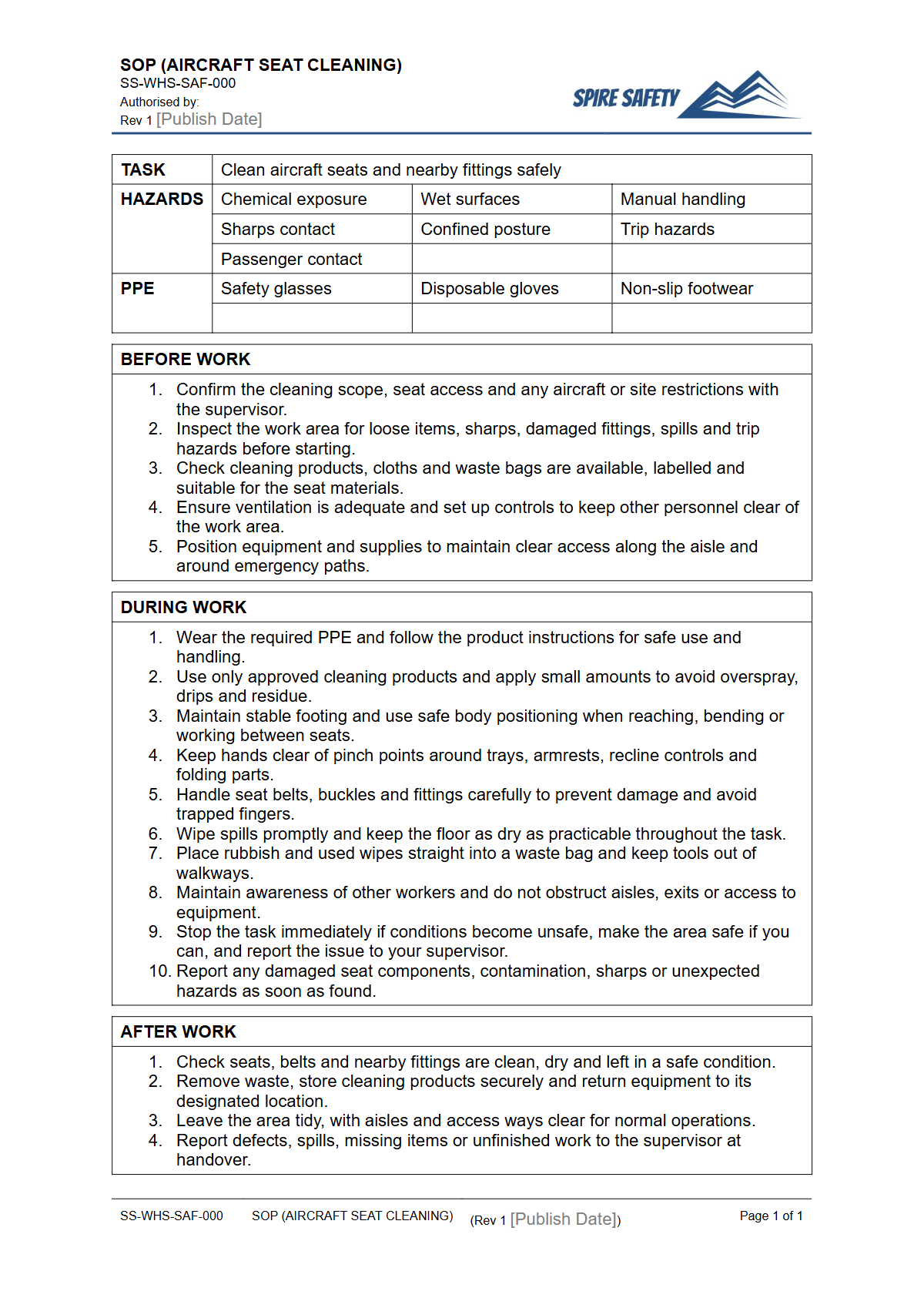
Download our Free Safe Operating Procedure (Aircraft Seat Cleaning) Template. This user-friendly DOCX and PDF helps formalise your safety process.
Free Safe Operating Procedure (Aircraft Seat Cleaning) Template
DOCX • 126 KB + PDF
Updated Oct 2026
No signup required
Purpose of the Free Safe Operating Procedure (Aircraft Seat Cleaning) Template
Effectively managing workplace safety in the aviation sector requires clear, documented processes for all tasks, including routine ones like cleaning. This Free Safe Operating Procedure (Aircraft Seat cleaning) Template provides a structured starting point for your business to formalise instructions for this critical task.
The SOP aims to guide workers through the process step-by-step, minimising risks associated with chemical handling, manual tasks, and working within the confined space of an aircraft cabin.
Documenting your processes is a fundamental part of risk management. A well-drafted SOP identifies potential hazards before they cause an incident, specifies necessary personal protective equipment (PPE), and outlines emergency responses.
Integrating this document into your operations demonstrates a commitment to safety and is a key component of comprehensive WHS management systems that protect both your employees and your assets.
Video walkthrough
How to use the Free Safe Operating Procedure (Aircraft Seat Cleaning) Template
This template is provided in an editable DOCX format for easy customisation, along with a printable PDF version. Your goal is to adapt the document to reflect the specific equipment, chemicals, and environment of your workplace.
A generic procedure is not sufficient; you must make it your own.
A thorough SOP should detail:
- Required PPE (e.g., gloves, safety glasses, masks).
- Pre-operational checks, such as ensuring proper ventilation and checking chemical containers.
- A sequential guide to the cleaning process, from preparation to waste disposal.
- Post-operational clean-up and storage instructions.
- Emergency procedures for spills, chemical exposure, or injury.
Important: This document is a template only. We are not familiar with your unique operational context, so you must customise this SOP by consulting with your team, reviewing Safety Data Sheets (SDS) for all chemicals, and conducting a site-specific risk assessment.
Depending on the task, you may also need to integrate procedures from other SOPs, such as an air compressor safe operating procedure if compressed air is used for detailing.
When to use this Safe Operating Procedure
A Safe Operating Procedure for aircraft seat cleaning should be a living document within your organisation. It is not meant to be written once and filed away.
It serves as a primary reference tool during several key phases of work.
Use this SOP for:
- Worker Training: It forms the basis of training for new cleaners and ground crew, ensuring they understand the approved, safe method from day one.
- Refresher Training: It can be used for periodic refresher training to prevent complacency and reinforce safe work habits among experienced staff.
- Pre-start or Toolbox Talks: Supervisors can use the SOP to brief teams on the day's tasks, highlighting specific risks or changes in procedure.
- Audits and Reviews: The document provides clear evidence of your documented safety processes during internal or external WHS compliance audits.
Who should use this Safe Operating Procedure
This SOP template is designed for use by a range of personnel within the aviation and cleaning industries. The primary users are the workers performing the cleaning task, as it provides them with clear, unambiguous instructions to follow.
Additionally, the following roles will benefit from this resource:
- WHS Managers and Safety Officers: For developing, implementing, and reviewing safety protocols as part of the broader safety management system.
- Supervisors and Team Leaders: For training their teams, supervising work, and ensuring procedures are followed correctly on the ground.
- Cleaning Contractors: To standardise their service delivery and demonstrate a professional approach to safety management to their aviation clients.
If you require assistance in adapting this document or developing more complex safety procedures for your specific operational needs, consider engaging specialist WHS consulting to ensure your systems are robust and practical. You can also explore our complete free WHS resources library for other templates and guides.
Common mistakes
Common mistakes to avoid
- Using non-aviation-approved cleaning agents that can damage seat materials or affect their fire-retardant qualities.
- Failing to ensure adequate ventilation in the cabin, leading to a build-up of chemical fumes.
- Not consulting the Safety Data Sheet (SDS) for each cleaning product to understand its specific hazards and PPE requirements.
- Applying poor manual handling techniques when moving within the confined space or lifting equipment.
Legal references
Legal considerations
The following legal requirements may be relevant to this type of work.
- Work Health and Safety Act (Harmonised) — Provides the primary duties for protecting workers and other people from work health and safety risks.
- Work Health and Safety Regulations (Harmonised) — Sets out requirements supporting the management of workplace hazards and risks.
The following codes may be relevant to this type of work.
- Managing WHS Risks Code of Practice — Provides practical guidance on identifying hazards, assessing risks and applying effective controls.
- Work Health and Safety Consultation, Cooperation and Coordination Code of Practice — Provides practical guidance on consulting workers and coordinating with other duty holders.
- Managing the Work Environment and Facilities Code of Practice — Provides practical guidance on safe work environments, workplace facilities and related controls.
Did you know
Turnaround Time
A quick turnaround clean for a narrow-body aircraft can be completed by a team in as little as 15-20 minutes, while a 'deep clean' can take several hours and involve removing seat covers and carpets.
Material Sensitivity
Aircraft seat materials and cabin plastics are sensitive to certain chemicals. Using non-approved cleaners can compromise the material's fire-retardant properties, a critical aviation safety feature.
FAQ
Frequently asked questions
01What hazards are involved in aircraft seat cleaning?
02Is an SOP legally required for cleaning aircraft seats in Australia?
03What kind of PPE should be worn for aircraft seat cleaning?
04How often should an SOP for aircraft seat cleaning be reviewed?
Share this resource
Free Safe Operating Procedure (Aircraft Seat Cleaning) Template
Browse Categories
How To Use It
- 1Download and open in Word or PDF.
- 2Replace the placeholders with your business details.
- 3Get it reviewed by a WHS specialist before rollout.
Need it customised?
Our WHS consultants can adapt this template to your site, run a gap analysis, or audit what you already have in place.
Book a Free Consultation WHS consulting servicesor call 1300 156 382
Related templates
- Free Safe Operating Procedure (Aircraft Towbar) Template
- Free Safe Operating Procedure (Aircraft Tug) Template
- Free Safe Operating Procedure (Aircraft Tyre Change) Template
- Free Safe Operating Procedure (Aircraft Washing) Template
- Free Safe Operating Procedure (Aircraft Water Service) Template
- Free Safe Operating Procedure (Airfield Lighting Work) Template