
Free Safe Operating Procedure (Airfield Lighting Work) Template
Download our free Safe Operating Procedure (Airfield Lighting Work) template.
Free Safe Operating Procedure (Airfield Lighting Work) Template
DOCX • 126 KB + PDF
Updated Oct 2026
No signup required
Purpose of the Free Safe Operating Procedure (Airfield Lighting Work) Template
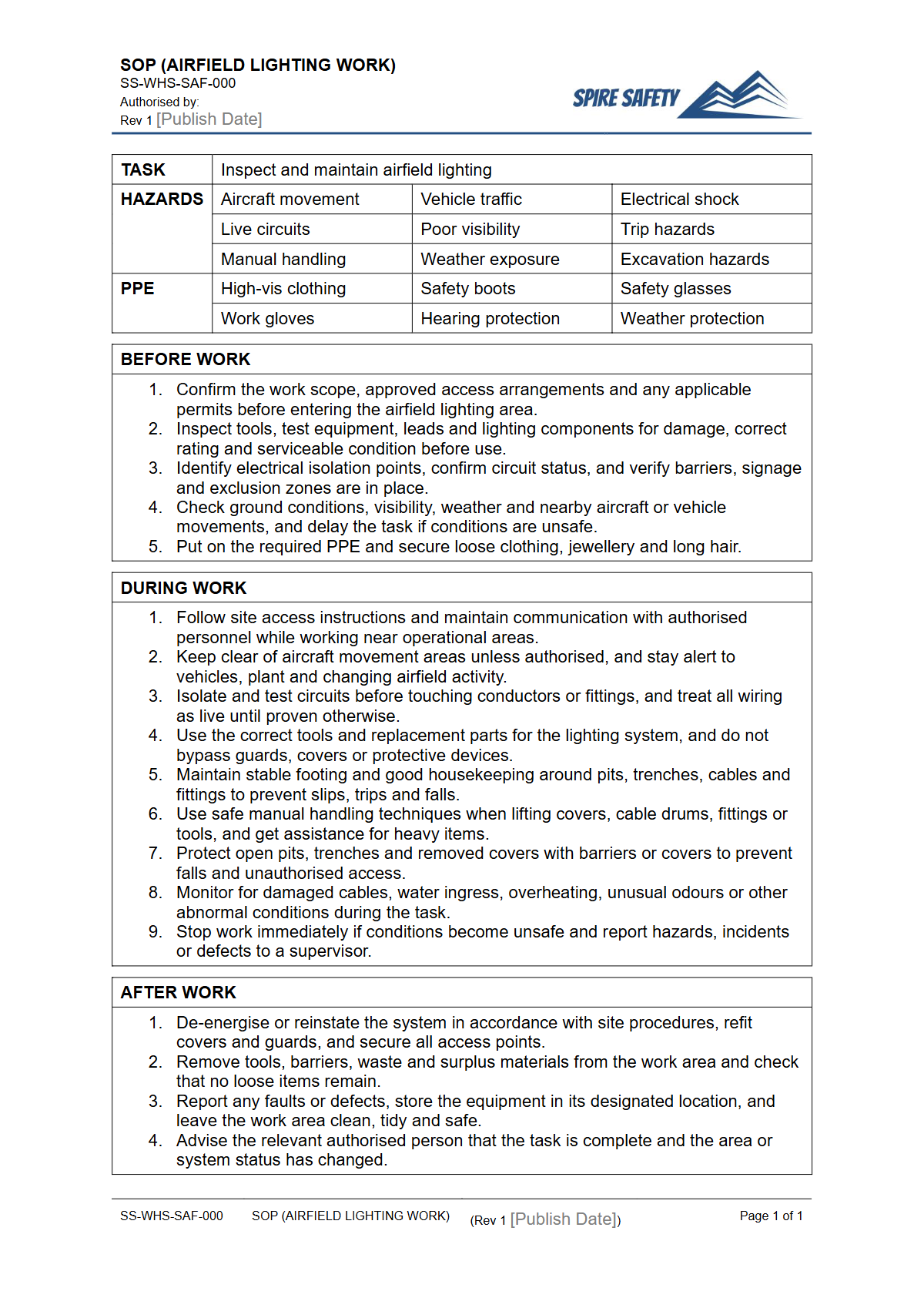
Working on airfield lighting systems involves a unique combination of electrical, height, and vehicle movement risks, all within a highly regulated environment. To help manage these complexities, Spire Safety offers this free Safe Operating Procedure (Airfield Lighting Work) template.
This document provides a structured framework for outlining the step-by-step process for performing tasks safely, ensuring all personnel understand the required controls. It is designed as a starting point, aligned with Australian WHS principles, for you to adapt to your specific site requirements and operational procedures.
A well-developed Safe Operating Procedure (SOP) is a critical component of a compliant safety framework. It serves as a practical tool for hazard identification and risk control, specifically for tasks involving aeronautical ground lighting (AGL).
Using this template helps standardise work methods, reduce the risk of incidents, and provides a clear reference for training and competency verification. Integrating this SOP into your broader safety framework helps build a more robust and effective WHS management system.
Video walkthrough
How to use the Free Safe Operating Procedure (Airfield Lighting Work) Template
This template is provided in both DOCX and PDF formats for your convenience. Download the DOCX file to edit and tailor the content to your business.
You must conduct a thorough risk assessment for each airfield lighting task and incorporate the specific findings into the procedure. This includes identifying all potential hazards, assessing their risk levels, and documenting the precise control measures to be implemented.
Controls may range from specific isolation procedures and PPE requirements to communication protocols with air traffic control.
IMPORTANT: This is a template only. You must customise it to reflect the specific hazards, equipment, personnel, and control measures relevant to your workplace and operations.
Spire Safety is not responsible for the outcomes of any documentation you produce from this template. After customisation, the SOP should be reviewed by competent persons and approved before implementation.
Regular reviews and updates are essential, and a formal WHS compliance audit can verify that your documented procedures are being effectively applied in practice.
Key Elements to Include
When customising this SOP, ensure you address the following critical areas:
- Scope of Work: Clearly define the tasks covered by the procedure (e.g., runway edge light replacement, taxiway sign maintenance, constant current regulator checks).
- Responsibilities: Outline the specific safety duties of each role, from the qualified electrician to the safety observer and site supervisor.
- PPE Requirements: List all mandatory personal protective equipment, such as high-visibility clothing, safety footwear, electrical gloves, and eye protection.
- Plant and Equipment: Specify the equipment to be used and the pre-start checks required, whether it's a simple toolbox or larger machinery. Transport of materials may require adherence to a separate body truck SOP.
- Step-by-Step Procedure: Detail the work sequence from start to finish, including site setup, securing work areas, lockout-tagout (LOTO) for electrical isolation, the work itself, and cleanup.
- FOD Control: Foreign Object Debris is a major risk. Document the procedures for tool accountability and meticulous worksite cleaning to prevent any debris from being left on the airfield.
- Communication Protocols: Define the requirements for communicating with airport operations or air traffic control, including call signs and procedures for gaining access to and exiting movement areas.
- Emergency Procedures: Outline the steps to take in case of an electrical shock, injury, vehicle incident, or other emergency.
When to Use This Safe Operating Procedure
An SOP for airfield lighting work should be used as a primary reference document before, during, and after the task. It is a critical tool for pre-start meetings, allowing teams to review the work plan, potential hazards, and safety controls together.
It should also be used for inducting and training new workers or subcontractors who will be involved in these specialised tasks. Following an incident or a near miss, the SOP should be reviewed as part of the investigation to identify any gaps or areas for improvement. For other common but hazardous tasks, you can find more templates in our free WHS resources library.
Who Should Use It
This document is intended for use by all personnel involved in the planning, supervision, and execution of airfield lighting maintenance and installation. This includes Qualified Electricians, Electrical Engineers, Project Managers, Site Supervisors, and WHS Advisors.
Workers, including apprentices and trade assistants, must be trained in the SOP's content to ensure they understand the risks and the safety measures they are required to follow. For tasks that involve working at heights, even at low levels, personnel should also be familiar with the procedures in a relevant step ladder SOP.
Effectively implementing a site-specific SOP demonstrates a commitment to managing risk in a high-consequence environment. If you need assistance developing comprehensive, site-specific safety documentation that goes beyond this template, consider engaging professional WHS consulting services to ensure your systems are practical and robust.
Common mistakes
Common mistakes to avoid
- Failing to perform a positive, physical isolation and lockout-tagout (LOTO) of electrical circuits before starting.
- Neglecting to establish clear communication protocols with Air Traffic Control or airport operations before entering a movement area.
- Poor tool and material management, leading to the creation of Foreign Object Debris (FOD) on the airside.
- Using a generic SOP without customising it based on a site-specific risk assessment.
Legal references
Legal considerations
The following legal requirements may be relevant to this type of work.
- Work Health and Safety Act (Harmonised) — Provides the primary duties for protecting workers and other people from work health and safety risks.
- Work Health and Safety Regulations (Harmonised) — Sets out requirements supporting the management of workplace hazards and risks.
The following codes may be relevant to this type of work.
- Managing WHS Risks Code of Practice — Provides practical guidance on identifying hazards, assessing risks and applying effective controls.
- Work Health and Safety Consultation, Cooperation and Coordination Code of Practice — Provides practical guidance on consulting workers and coordinating with other duty holders.
- Managing the Work Environment and Facilities Code of Practice — Provides practical guidance on safe work environments, workplace facilities and related controls.
Did you know
Aviation Colour Code
The precise colour and intensity of airfield lights are governed by strict international standards set by ICAO. This ensures pilots from anywhere in the world can correctly interpret runways, taxiways, and obstacles at any airport.
FOD Risk
Foreign Object Debris (FOD), such as a small tool or bolt left on a runway after maintenance, can be ingested by a jet engine and cause catastrophic failure. Meticulous cleanup and tool control are critical safety procedures in all airfield work.
FAQ
Frequently asked questions
01What is a Safe Operating Procedure (SOP)?
02Is this airfield lighting SOP template enough for my site?
03What are the main hazards in airfield lighting work?
04Who is responsible for developing a site-specific SOP?
Share this resource
Free Safe Operating Procedure (Airfield Lighting Work) Template
Browse Categories
How To Use It
- 1Download and open in Word or PDF.
- 2Replace the placeholders with your business details.
- 3Get it reviewed by a WHS specialist before rollout.
Need it customised?
Our WHS consultants can adapt this template to your site, run a gap analysis, or audit what you already have in place.
Book a Free Consultation WHS consulting servicesor call 1300 156 382
Related templates
- Free Safe Operating Procedure (Airless Paint Sprayer) Template
- Free Safe Operating Procedure (Airport Bus) Template
- Free Safe Operating Procedure (Airside Baggage Transfer) Template
- Free Safe Operating Procedure (Airside Cabin Supplies) Template
- Free Safe Operating Procedure (Airside Catering Delivery) Template
- Free Safe Operating Procedure (Airside Equipment Clean) Template