
Free Safe Operating Procedure (Airport Bus) Template
Download our free Safe Operating Procedure (Airport Bus) template. A structured starting point for managing risks associated with airport transport.
Free Safe Operating Procedure (Airport Bus) Template
DOCX • 126 KB + PDF
Updated Oct 2026
No signup required
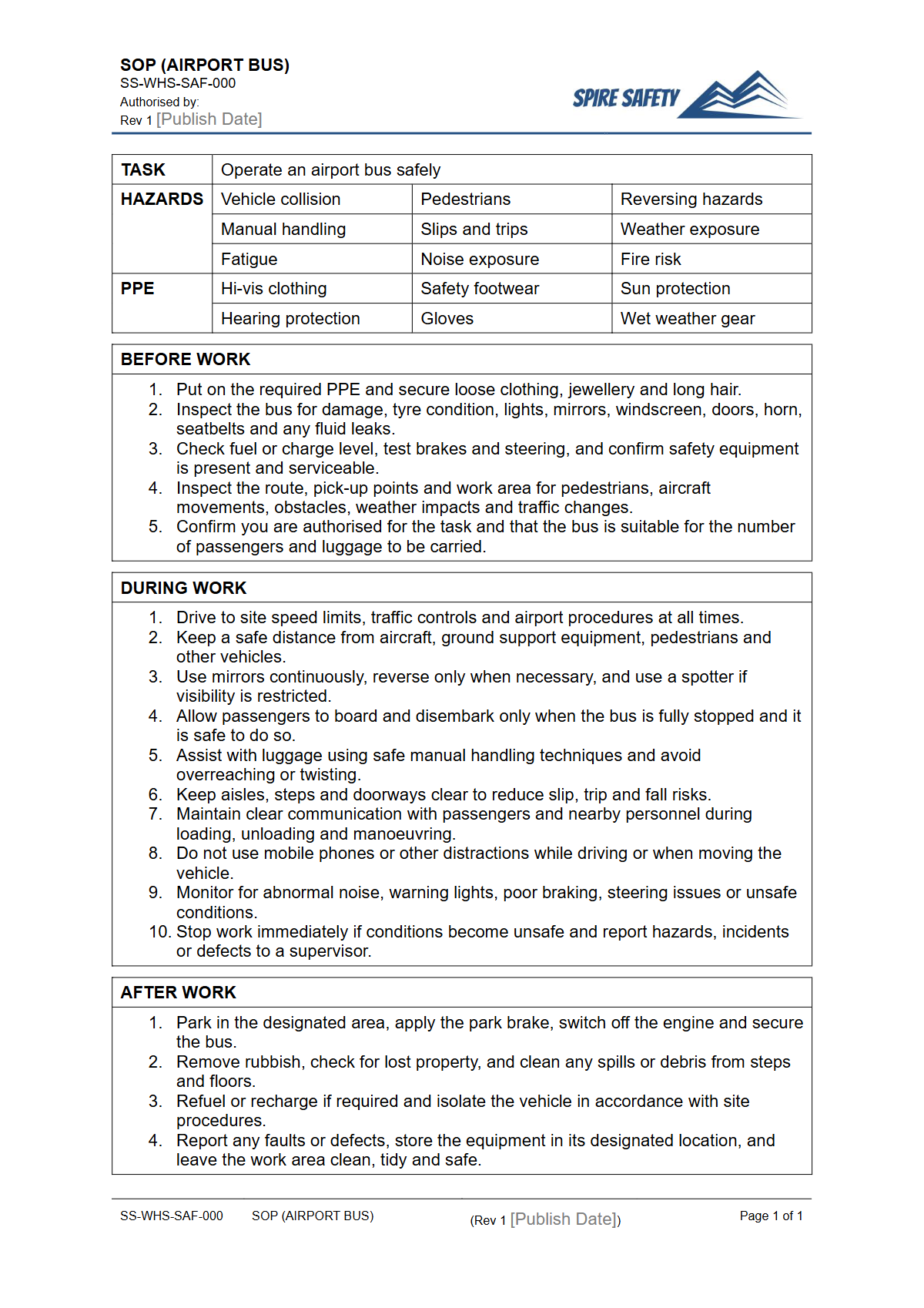
Purpose of the Free Safe Operating Procedure (Airport Bus) Template
Operating an airport bus involves a unique set of risks, from managing passenger movements to navigating complex, high-traffic airside and landside environments. This Free Safe Operating Procedure (Airport Bus) Template provides a structured starting point for documenting the required steps to ensure driver, passenger, and public safety.
It is designed to help your organisation control hazards associated with airport bus operations, formalise your processes, and provide a clear, repeatable guide for workers.
A comprehensive Safe Operating Procedure (SOP) is a critical tool for managing WHS duties. This template prompts you to detail pre-operational checks, safe driving practices specific to airport environments (including awareness of jet blast, ground support equipment, and restricted areas), passenger assistance protocols, and emergency procedures.
By defining these steps, you create a baseline for safe work performance and worker training. Similar principles of vehicle inspection and operational safety are also covered in our safe operating procedure for body trucks.
Video walkthrough
How to use the Free Safe Operating Procedure (Airport Bus) Template
To get started, simply download the template in your preferred format (DOCX for easy editing or PDF). The document is structured with key headings that are essential for a thorough SOP, such as required PPE, risk assessment, and a step-by-step procedure breakdown.
Your task is to adapt this content to the specific buses, routes, and operational realities of your workplace.
Important: This document is a template, not a finished procedure. To be effective, you must customise it to reflect your specific equipment and work environment.
We strongly recommend a consultation process involving your drivers and safety personnel to ensure the final SOP is practical, accurate, and reflects how the work is actually done. A well-written SOP is a cornerstone of effective safety management and integrates directly into broader WHS management systems, helping to demonstrate a systematic approach to risk control.
When to use a Safe Operating Procedure
A Safe Operating Procedure for an airport bus should be a living document used consistently throughout your operations. It is not just for inductions.
It serves as a primary reference during initial and ongoing driver training, helping to standardise performance expectations from day one. Supervisors can use it for job observations and to confirm that correct procedures are being followed during daily tasks.
Furthermore, the SOP becomes an essential tool following a near miss or incident; it should be reviewed and updated as part of the investigation process to prevent recurrence. The effectiveness of your SOPs and their implementation can be verified through regular WHS compliance audits.
Who should use this Airport Bus SOP
This SOP is relevant to several roles within an organisation. It is primarily for the drivers who perform the task daily, providing them with clear instructions on how to work safely.
Supervisors and Managers are responsible for implementing the SOP, ensuring workers are trained on its contents, and monitoring its use. Persons Conducting a Business or Undertaking (PCBUs) must ensure that safe systems of work, such as SOPs, are in place to meet their duties under WHS law.
Finally, WHS Officers and Safety Professionals will use this template as a tool to document risk controls and integrate them into the organisation’s overall safety framework. If your team needs assistance in developing and implementing robust safety documentation, consider our WHS consulting services.
By establishing and communicating clear standards, this SOP helps everyone understand their role in maintaining a safe environment for passengers, staff, and the public. You can find many other helpful documents in our free WHS resources library to support your safety efforts.
Common mistakes
Common mistakes to avoid
- Using a generic SOP 'as is' without customising it for specific vehicles, routes, and airport rules.
- Failing to consult with experienced drivers during the drafting and review process, leading to an impractical document.
- Not providing adequate training on the SOP's contents, assuming workers will simply read and understand it.
- Treating the SOP as a static document that is filed away and never reviewed or updated after an incident or change in operations.
Legal references
Legal considerations
The following legal requirements may be relevant to this type of work.
- Work Health and Safety Act (Harmonised) — Provides the primary duties for protecting workers and other people from work health and safety risks.
- Work Health and Safety Regulations (Harmonised) — Sets out requirements supporting the management of workplace hazards and risks.
The following codes may be relevant to this type of work.
- Managing WHS Risks Code of Practice — Provides practical guidance on identifying hazards, assessing risks and applying effective controls.
- Work Health and Safety Consultation, Cooperation and Coordination Code of Practice — Provides practical guidance on consulting workers and coordinating with other duty holders.
- Managing the Work Environment and Facilities Code of Practice — Provides practical guidance on safe work environments, workplace facilities and related controls.
Did you know
Airport-Specific Hazards
Airport environments present unique hazards not found on public roads, such as foreign object debris (FOD), powerful jet blast from aircraft engines, and complex interactions with specialised ground support equipment (GSE).
Fatigue Management
Driver fatigue is a significant risk in the transport industry. Fatigue management plans, often mandated under the National Heavy Vehicle Law, are a critical component of ensuring bus driver fitness for duty.
FAQ
Frequently asked questions
01What should an airport bus SOP include?
02How often should a Safe Operating Procedure be reviewed?
03Is an SOP a legal requirement in Australia?
04Who is responsible for training workers on the SOP?
Share this resource
Free Safe Operating Procedure (Airport Bus) Template
Browse Categories
How To Use It
- 1Download and open in Word or PDF.
- 2Replace the placeholders with your business details.
- 3Get it reviewed by a WHS specialist before rollout.
Need it customised?
Our WHS consultants can adapt this template to your site, run a gap analysis, or audit what you already have in place.
Book a Free Consultation WHS consulting servicesor call 1300 156 382
Related templates
- Free Safe Operating Procedure (Airside Baggage Transfer) Template
- Free Safe Operating Procedure (Airside Cabin Supplies) Template
- Free Safe Operating Procedure (Airside Catering Delivery) Template
- Free Safe Operating Procedure (Airside Equipment Clean) Template
- Free Safe Operating Procedure (Airside FOD Inspection) Template
- Free Safe Operating Procedure (Airside GSE Parking) Template