
Free Safe Operating Procedure (Airside GSE Parking) Template
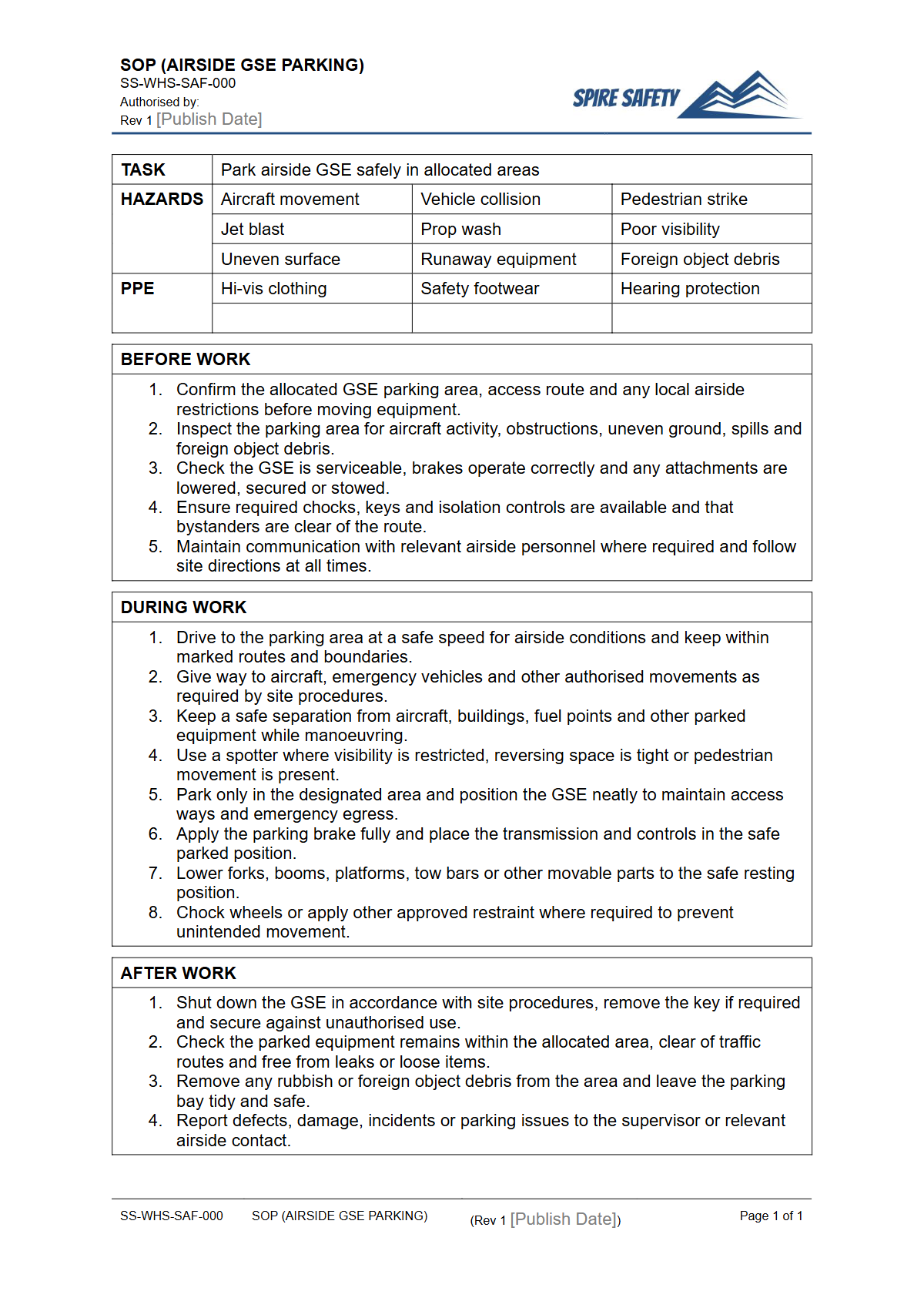
Download our free Safe Operating Procedure (SOP) template for airside Ground Support Equipment (GSE) parking.
Free Safe Operating Procedure (Airside GSE Parking) Template
DOCX • 126 KB + PDF
Updated Oct 2026
No signup required
Purpose of the Free Safe Operating Procedure (Airside GSE Parking) Template
The airside environment of an airport is a complex and high-risk workplace. This free Safe Operating Procedure (Airside GSE Parking) Template provides a structured starting point for documenting the process of safely parking Ground Support Equipment (GSE) on aprons, tarmacs, and other operational areas.
A documented procedure is a critical control measure to prevent collisions with aircraft, other vehicles, and personnel, thereby minimising the risk of serious injury and costly equipment or infrastructure damage. Properly implemented, this SOP helps demonstrate your organisation's commitment to managing operational risks.
This procedure should form an integral part of your overall safety framework. Developing robust documentation is a key element of effective WHS management systems, ensuring that safe work practices are consistently communicated and applied across your entire ground operations team.
Video walkthrough
How to use the Free Safe Operating Procedure (Airside GSE Parking) Template
This document is provided as a template in both DOCX and PDF formats. It is intended to be adapted to the specific requirements of your airport and the types of GSE you operate. To use it effectively:
- Download the DOCX file and save it to your local system.
- Review the content with your WHS committee, ground operations managers, and frontline workers who use the equipment daily.
- Customise the procedure by adding your company branding, specific site details (e.g., bay numbers, designated parking zones), and procedures for each type of GSE in your fleet.
- Pay special attention to emergency procedures, communication protocols, and reporting requirements.
Important: This is a template only and must be customised to your specific workplace. We are not responsible for the outcomes of its use.
You must consult with your workers and other stakeholders to ensure the final document is relevant and reflects the actual risks and control measures at your site. For example, your overall parking procedure might be supplemented by specific instructions detailed in a FREE Telehandler SOP Template for that particular piece of equipment.
When to use a Safe Operating Procedure for GSE Parking
A formal SOP for GSE parking should be a living document, used consistently throughout your operations. It is particularly important in the following scenarios:
- Worker Induction and Training: Use the SOP as a core training tool for all new ground crew, baggage handlers, and maintenance staff.
- Refresher Training: Conduct periodic reviews of the procedure with experienced staff to prevent complacency and reinforce safe behaviour.
- Post-Incident: The SOP should be immediately reviewed and updated following any incident or near-miss involving GSE parking.
- Introduction of New Equipment: When new types of GSE are introduced, the SOP must be updated to include their specific parking requirements.
Regularly verifying that these procedures are being followed correctly on the ground is also essential. This can be achieved through routine supervisor checks or more formal WHS compliance auditing activities that observe ground crew in their normal work environment.
Who should use this Safe Operating Procedure
This SOP is relevant to a wide range of personnel within the airport environment. Key users include:
- WHS and Safety Managers: Responsible for developing, implementing, and reviewing the procedure as part of the wider safety management system.
- Ground Operations Managers: Accountable for ensuring the procedure is followed by their teams on a day-to-day basis.
- Ground Crew and Baggage Handlers: The primary users of the procedure, who must understand and adhere to the specified steps for parking dollies, tugs, and belt loaders.
- Aircraft Maintenance Engineers: Who operate and park specialised maintenance equipment around aircraft.
For any heavy or specialised vehicles operating airside, ensure operators have the correct training and competency. This may involve referencing vehicle-specific procedures, such as those found in a FREE Body Truck SOP (Safe Operating Procedure) Template, to complement the general parking rules.
If you need expert assistance in tailoring this or other procedures, Spire Safety offers specialist WHS consulting to help you meet your obligations. You can also explore our full free WHS resources library for other useful templates and guides.
Common mistakes
Common mistakes to avoid
- Using the template without customising it for site-specific layouts and equipment types.
- Failing to adequately train all ground crew, including contractors, on the specific procedures.
- Not clearly painting or maintaining designated GSE parking zones on the apron.
- Neglecting to include procedures for non-standard situations like equipment breakdowns or adverse weather.
Legal references
Legal considerations
The following legal requirements may be relevant to this type of work.
- Work Health and Safety Act (Harmonised) — Provides the primary duties for protecting workers and other people from work health and safety risks.
- Work Health and Safety Regulations (Harmonised) — Sets out requirements supporting the management of workplace hazards and risks.
The following codes may be relevant to this type of work.
- Managing WHS Risks Code of Practice — Provides practical guidance on identifying hazards, assessing risks and applying effective controls.
- Work Health and Safety Consultation, Cooperation and Coordination Code of Practice — Provides practical guidance on consulting workers and coordinating with other duty holders.
- Managing the Work Environment and Facilities Code of Practice — Provides practical guidance on safe work environments, workplace facilities and related controls.
Did you know
Ramp Rash
"Ramp rash" is aviation industry slang for minor to moderate damage caused to aircraft when they are struck by Ground Support Equipment. These seemingly small incidents can cost airlines millions in repairs, flight delays, and lost revenue.
Designated Parking
To minimise risk, GSE must be parked within clearly marked designated areas, known as GSE Restraint Lines or Equipment Parking Zones, ensuring clearance for taxiing aircraft and emergency vehicles.
FAQ
Frequently asked questions
01What is GSE and why is its parking so strictly controlled?
02Does this SOP template cover all types of Ground Support Equipment?
03Who is responsible for enforcing GSE parking procedures at an Australian airport?
04How often should our airside GSE parking SOP be reviewed?
Share this resource
Free Safe Operating Procedure (Airside GSE Parking) Template
Browse Categories
How To Use It
- 1Download and open in Word or PDF.
- 2Replace the placeholders with your business details.
- 3Get it reviewed by a WHS specialist before rollout.
Need it customised?
Our WHS consultants can adapt this template to your site, run a gap analysis, or audit what you already have in place.
Book a Free Consultation WHS consulting servicesor call 1300 156 382
Related templates
- Free Safe Operating Procedure (Airside Vehicle Driving) Template
- Free Safe Operating Procedure (Airside Waste Collection) Template
- Free Safe Operating Procedure (Alarm Panel Check) Template
- Free Safe Operating Procedure (Alarm Response Check) Template
- Free Safe Operating Procedure (Allergen Ingredient Setup) Template
- Free Safe Operating Procedure (Allergen Segregation) Template