
Free Safe Operating Procedure (Alarm Panel Check) Template
Download our free Safe Operating Procedure (Alarm Panel Check) template.
Free Safe Operating Procedure (Alarm Panel Check) Template
DOCX • 126 KB + PDF
Updated Oct 2026
No signup required
Purpose of the Free Safe Operating Procedure (Alarm Panel Check) Template
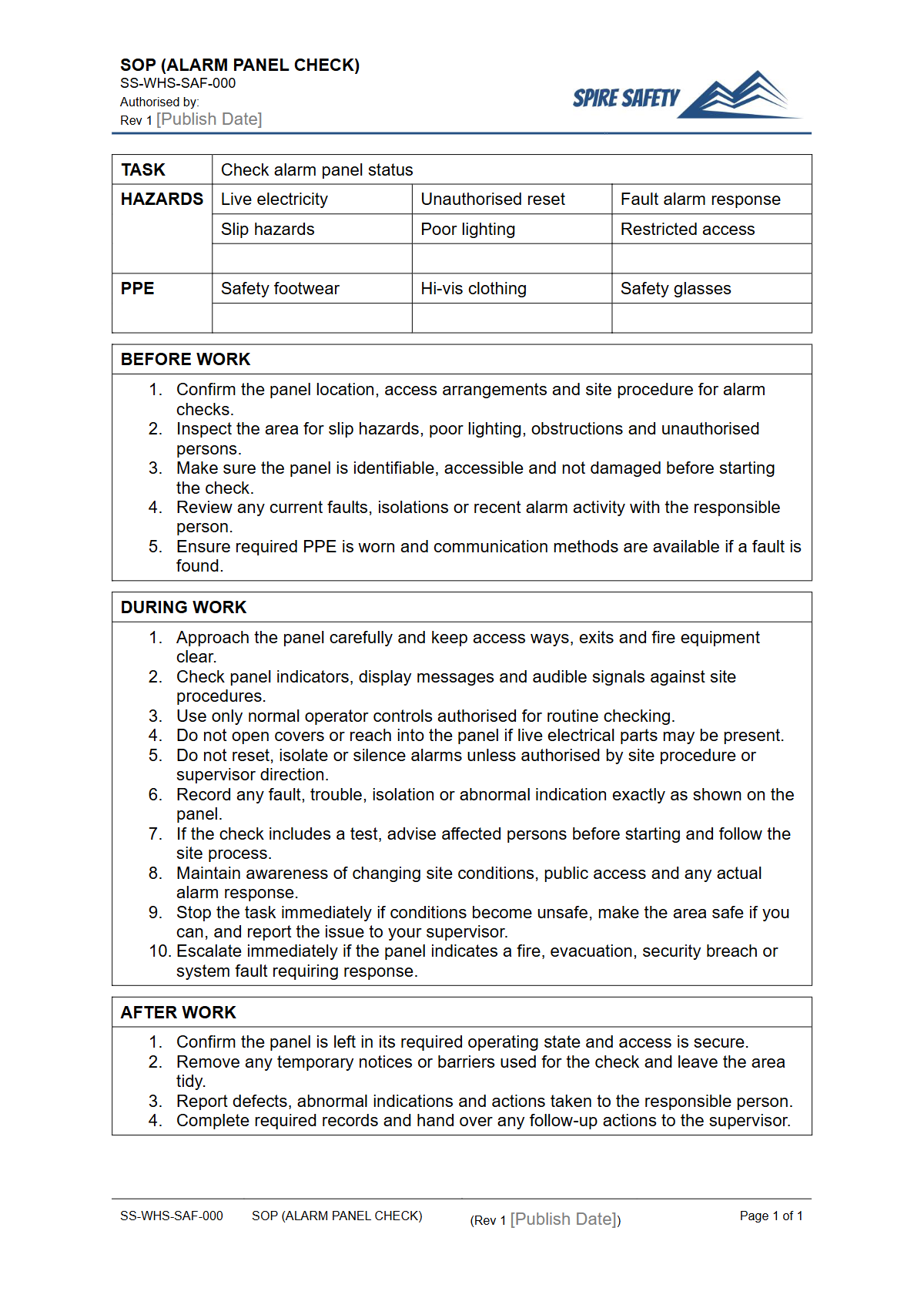
A functional alarm system is a critical component of your workplace emergency plan. This free Safe Operating Procedure (Alarm Panel Check) template provides a structured framework for documenting the routine checks required to ensure your fire, security, or other critical alarm panels are operational.
Using a standardised procedure helps verify that safety systems will function as intended during an emergency, minimising risks to people and property. It establishes a clear, repeatable process for personnel to follow, ensuring consistency and accountability for these essential safety tasks.
Implementing this SOP demonstrates a commitment to proactive safety management. The procedure should be integrated into your broader WHS management system, ensuring it is regularly reviewed, updated, and included in staff training programs.
It serves as documented evidence that you are taking reasonably practicable steps to maintain critical safety equipment.
Video walkthrough
How to use the Free Safe Operating Procedure (Alarm Panel Check) Template
To effectively use the free Safe Operating Procedure (Alarm Panel Check) Template, download the DOCX file and adapt it to the specific requirements of your workplace. A generic document is not sufficient for compliance; customisation is essential. Review each section and replace the placeholder text with information specific to your site, including:
- The exact make, model, and location of the alarm panel(s).
- A sequential list of steps for performing the check (e.g., checking for faults, testing indicators, silencing alarms).
- Contact details for the alarm monitoring company and emergency services.
- Site-specific personal protective equipment (PPE) requirements.
- Procedures for recording check results in a logbook.
Important: We have provided this template as a starting point. You must customise it to reflect the specific equipment, hazards, and control measures unique to your organisation and its operations. Regular verification that these procedures are being followed correctly is a key part of maintaining safety standards, often confirmed through a formal WHS compliance audit.
When to use this Safe Operating Procedure
This Safe Operating Procedure should be used as a guide for all scheduled alarm panel inspections. The frequency of these checks is often dictated by Australian Standards, manufacturer recommendations, or your organisation's internal risk assessments—typically ranging from weekly to monthly.
It is also essential to perform the checks outlined in the SOP after any maintenance, repairs, or modifications to the alarm system to verify its correct function.
Furthermore, the procedure is a valuable tool during emergency drills to simulate real-world actions and is an integral part of the induction and training process for any new employees or contractors responsible for building safety and maintenance. The principles of documenting systematic checks are transferable across various systems.
Whether it's the main fire alarm or the control console for specific machinery, like those detailed in our plasma cutter SOP, the logic of sequential checks remains consistent.
Who should use this Safe Operating Procedure
This document is intended for any person responsible for the maintenance, inspection, and safety of workplace facilities. This typically includes:
- Facilities Managers: For overseeing the maintenance schedule and ensuring compliance.
- Maintenance Personnel: As a direct guide for performing the physical checks.
- WHS/OHS Officers: For integrating the procedure into the overall safety system and using it for training and auditing purposes.
- Security Staff: Who may be the first responders to an alarm or are responsible for routine patrols and checks.
When performing the check, personnel must consider all associated risks, not just those related to the alarm system itself. For example, if a panel is located at height, workers must follow correct procedures for access, as detailed in documents like a step ladder SOP, to prevent falls.
Just as with other essential plant, a standardised procedure is vital for safe operation and maintenance. You can browse our free WHS resources library for other templates to help manage different types of equipment and tasks.
Common mistakes
Common mistakes to avoid
- Forgetting to notify the alarm monitoring company before starting a test, potentially causing an unnecessary emergency response.
- Failing to document the check's completion, date, and any faults found in a dedicated logbook.
- Neglecting to check or replace backup batteries according to the manufacturer's specified schedule.
- Using a generic procedure without customising it for the specific panel model and site conditions.
Legal references
Legal considerations
The following legal requirements may be relevant to this type of work.
- Work Health and Safety Act (Harmonised) — Provides the primary duties for protecting workers and other people from work health and safety risks.
- Work Health and Safety Regulations (Harmonised) — Sets out requirements supporting the management of workplace hazards and risks.
The following codes may be relevant to this type of work.
- Managing WHS Risks Code of Practice — Provides practical guidance on identifying hazards, assessing risks and applying effective controls.
- Work Health and Safety Consultation, Cooperation and Coordination Code of Practice — Provides practical guidance on consulting workers and coordinating with other duty holders.
- Managing the Work Environment and Facilities Code of Practice — Provides practical guidance on safe work environments, workplace facilities and related controls.
Did you know
Australian Standards
Australian Standard AS 1670.1 sets out the mandatory requirements for the design, installation, and commissioning of fire detection and alarm systems, forming a key reference for compliance in most Australian buildings.
False Alarm Prevention
A significant portion of false fire alarm callouts are due to system faults or a lack of proper maintenance. Regular checks, as outlined in an SOP, can help identify and rectify issues before they trigger a false alarm.
FAQ
Frequently asked questions
01How often should alarm panel checks be performed?
02What's the difference between an alarm panel check and a full system test?
03Can this SOP be used for any brand of alarm panel?
04Who is responsible for training staff on this Safe Operating Procedure?
Share this resource
Free Safe Operating Procedure (Alarm Panel Check) Template
Browse Categories
How To Use It
- 1Download and open in Word or PDF.
- 2Replace the placeholders with your business details.
- 3Get it reviewed by a WHS specialist before rollout.
Need it customised?
Our WHS consultants can adapt this template to your site, run a gap analysis, or audit what you already have in place.
Book a Free Consultation WHS consulting servicesor call 1300 156 382
Related templates
- Free Safe Operating Procedure (Alarm Response Check) Template
- Free Safe Operating Procedure (Allergen Ingredient Setup) Template
- Free Safe Operating Procedure (Allergen Segregation) Template
- Free Safe Operating Procedure (Anchor Winch) Template
- Free Safe Operating Procedure (Anemometer) Template
- Free Safe Operating Procedure (Angle Drill) Template