
Free Safe Operating Procedure (Anemometer) Template
Formalise wind speed monitoring on your worksite with our free Safe Operating Procedure (Anemometer) template. Download the DOCX and PDF now.
Free Safe Operating Procedure (Anemometer) Template
DOCX • 126 KB + PDF
Updated Oct 2026
No signup required
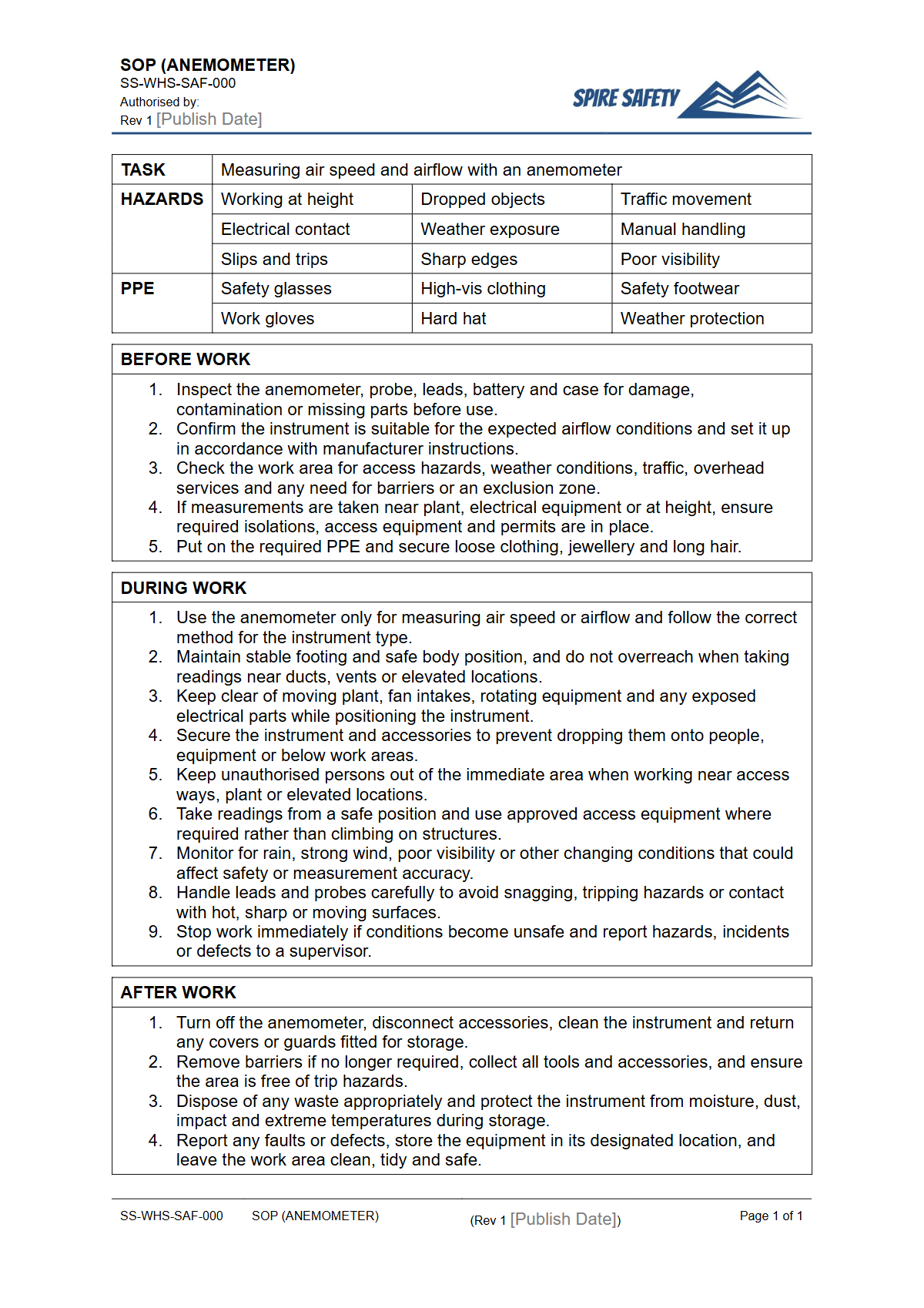
Purpose of the Free Safe Operating Procedure (Anemometer) Template
This Free Safe Operating Procedure (Anemometer) Template provides a structured framework for the safe use of anemometers (wind speed meters) in the workplace. Anemometers are critical safety tools for any task where high winds can introduce significant hazards, such as crane operations, work at height, or the erection of temporary structures.
Using this SOP helps persons conducting a business or undertaking (PCBUs) to establish and document clear, repeatable steps for measuring, recording, and acting on wind speed data, ensuring that operations are paused or modified before conditions become unsafe. It serves as a vital tool for risk management, forming a key part of your overall safety management system.
Video walkthrough
How to use the Free Safe Operating Procedure (Anemometer) Template
This template is provided in both DOCX and PDF formats for your convenience. The DOCX file is fully editable, allowing you to adapt the content to the specific needs of your workplace.
It is designed as a starting point, aligned with Australian WHS principles, to help you document a safe system of work for using anemometers.
IMPORTANT: This is a template, not a finished document. To be effective, you must customise it to reflect your specific equipment, site conditions, personnel, and legal obligations. Key areas for customisation include:
- Identifying the specific make and model of anemometer(s) in use.
- Defining site-specific action levels (e.g., wind speeds at which work must be monitored, altered, or stopped).
- Listing the persons responsible for taking measurements and making stop-work decisions.
- Detailing the procedure for recording measurements and communicating conditions to relevant workers.
- Integrating the SOP with other procedures, such as emergency plans.
A well-defined SOP is a cornerstone of effective WHS management systems, providing clarity for workers and evidence of your risk management processes.
When to use this Safe Operating Procedure
An SOP for anemometer use should be implemented whenever wind presents a potential hazard to a work activity. Its application is crucial for proactive risk management in various situations, including:
- Lifting operations involving cranes, telehandlers, or hoists.
- Work performed on elevating work platforms (EWPs) or scaffolding.
- Roofing, cladding, and other tasks performed at height. Procedures like a FREE Step Ladder SOP Template can also be influenced by high wind conditions.
- Erecting or dismantling temporary structures like stages, marquees, or signage.
- Any operations with plant that has manufacturer-specified wind speed limits, as documented in procedures like a FREE Boom Pump SOP (Safe Operating Procedure) Template.
- Activities that generate dust or other airborne particles where high winds could cause environmental or health issues.
Who should use it
This Safe Operating Procedure is intended for use by all personnel involved in planning, supervising, or executing tasks affected by wind speed. This includes, but is not limited to:
- Crane Operators, Riggers, and Doggers
- EWP and Plant Operators
- Site Supervisors, Forepersons, and Project Managers
- Workplace Health and Safety (WHS) Advisors and Officers
- Scaffolders and Construction Workers
- Drone (UAV) Pilots
- Event Managers and Crew
Regular reviews of this and other safety documents should be part of your operational rhythm. These checks can be formalised through scheduled WHS compliance auditing to ensure procedures remain current and effective.
For more safety documentation, you can explore our complete free WHS resources library for a wide range of templates and guides.
Common mistakes
Common mistakes to avoid
- Failing to calibrate the anemometer according to the manufacturer's schedule, leading to inaccurate readings.
- Taking wind speed measurements from a sheltered location instead of an area representative of the work zone.
- Not formally documenting wind speed readings, decisions made, and actions taken for auditing purposes.
- Using the template as-is without customising it with site-specific wind speed limits and emergency contacts.
Legal references
Legal considerations
The following legal requirements may be relevant to this type of work.
- Work Health and Safety Act (Harmonised) — Provides the primary duties for protecting workers and other people from work health and safety risks.
- Work Health and Safety Regulations (Harmonised) — Sets out requirements supporting the management of workplace hazards and risks.
The following codes may be relevant to this type of work.
- Managing WHS Risks Code of Practice — Provides practical guidance on identifying hazards, assessing risks and applying effective controls.
- Work Health and Safety Consultation, Cooperation and Coordination Code of Practice — Provides practical guidance on consulting workers and coordinating with other duty holders.
- Managing the Work Environment and Facilities Code of Practice — Provides practical guidance on safe work environments, workplace facilities and related controls.
Did you know
The Beaufort Scale
Before anemometers were common, Admiral Sir Francis Beaufort created the Beaufort Wind Scale in 1805. It estimates wind speed based on observable conditions on land and at sea, from 'Calm' (Force 0) to 'Hurricane' (Force 12).
FAQ
Frequently asked questions
01What is the main purpose of a Safe Operating Procedure for an anemometer?
02Do I need to train workers on this SOP?
03How often should an anemometer be calibrated?
04Can I use this template for any type of anemometer?
Share this resource
Free Safe Operating Procedure (Anemometer) Template
Browse Categories
How To Use It
- 1Download and open in Word or PDF.
- 2Replace the placeholders with your business details.
- 3Get it reviewed by a WHS specialist before rollout.
Need it customised?
Our WHS consultants can adapt this template to your site, run a gap analysis, or audit what you already have in place.
Book a Free Consultation WHS consulting servicesor call 1300 156 382
Related templates
- Free Safe Operating Procedure (Angle Drill) Template
- Free Safe Operating Procedure (Animal Crush) Template
- Free Safe Operating Procedure (Animal Watering) Template
- Free Safe Operating Procedure (Annular Cutter) Template
- Free Safe Operating Procedure (Anodising) Template
- Free Safe Operating Procedure (Apartment Handover Clean) Template