
Free Safe Operating Procedure (Animal Watering) Template
Download our free Safe Operating Procedure (Animal watering) template. A customisable DOCX & PDF to help manage risks when watering livestock or other animals.
Free Safe Operating Procedure (Animal Watering) Template
DOCX • 126 KB + PDF
Updated Oct 2026
No signup required
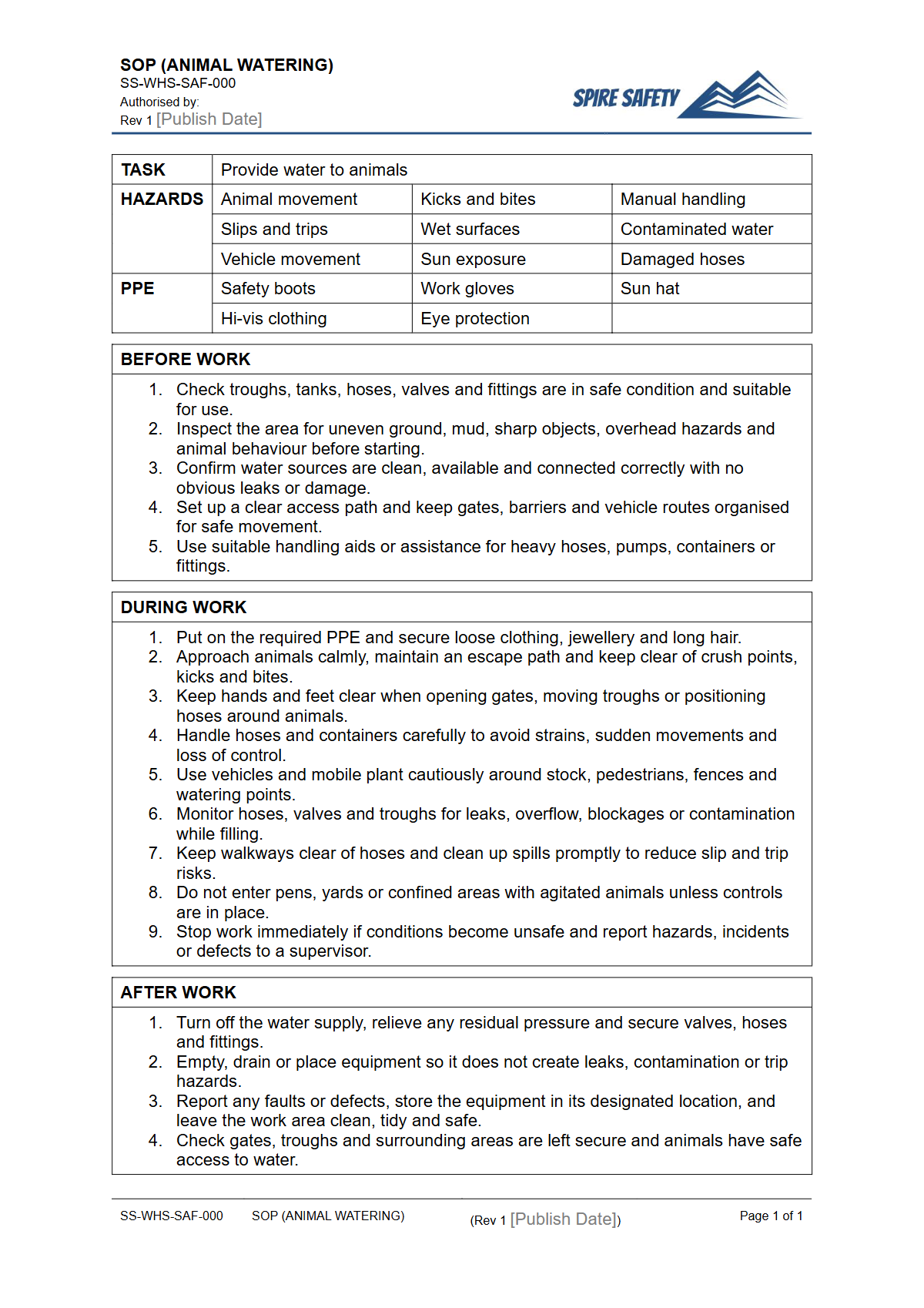
Purpose of the Free Safe Operating Procedure (Animal Watering) Template
This Free Safe Operating Procedure (Animal Watering) Template provides a structured framework for documenting the safe methods required to provide water to livestock, domestic animals, or wildlife. Properly watering animals is a critical daily task in many industries, from agriculture to zookeeping, and it carries specific risks that must be managed.
Using this SOP helps your organisation meet its duty of care under Australian WHS laws by clearly defining procedures, outlining potential hazards, and specifying control measures to protect workers.
A well-defined SOP ensures that all workers, including new or temporary staff, understand the established safe process for watering animals, using associated equipment, and responding to incidents. It serves as a vital training tool and a reference point for consistent, safe work practices.
For tasks involving heavy machinery around water sources, such as moving large troughs, a specific Telehandler Safe Operating Procedure may also be required to manage plant-related risks effectively.
Video walkthrough
How to use the Free Safe Operating Procedure (Animal Watering) Template
This document is a template designed to be a starting point. To make it effective, you must customise it with information specific to your workplace, equipment, and the types of animals you manage.
The template includes sections for you to detail pre-operational checks, step-by-step procedures for the watering task, and post-operational clean-up.
To complete the SOP, walk through the animal watering process at your site. Identify the specific equipment used (e.g., brand of pump, type of hose), the location of water points, and the unique behaviours of the animals involved.
You should also consult with the workers who perform the task daily to ensure the documented procedure reflects the practical realities of the job. For assistance in tailoring this document or developing more complex safety procedures, consider engaging expert WHS consulting services.
Important Note on Customisation
This is a template and not a complete Safe Operating Procedure. It is essential that you consult with your team and adapt this document to the specific hazards, equipment, and context of your workplace.
We are not responsible for any incidents that may occur from the use of this document.
When to use an Animal Watering SOP
An SOP for animal watering should be used as a primary reference for all personnel involved in the task. It is particularly crucial in several situations: during the induction and training of new employees, as a refresher for existing staff, or when procedures change due to new equipment or different animal management strategies.
It forms an integral part of a broader WHS management system, providing clear instructions that support risk assessments and incident investigations.
This SOP should also be readily available at or near the work area for easy reference. Supervisors can use it to conduct pre-start briefings, observe work practices, and confirm that safety controls are being correctly applied.
It is a living document that should be reviewed and updated regularly, especially after an incident or near-miss.
Who should use this SOP
This Safe Operating Procedure is intended for all workers responsible for providing water to animals, regardless of their experience level. This includes farmhands, livestock managers, station hands, zookeepers, and veterinary staff.
Supervisors and managers should also use the SOP to ensure they are providing a safe system of work and to verify that procedures are being followed correctly.
Training in the SOP is essential for competency. Workers must not only read the document but also demonstrate they can perform the task safely as described.
In agricultural settings where tasks overlap, workers may need to be familiar with multiple SOPs. For example, a worker who also performs earthworks to maintain dams or water channels might need training on a Dozer SOP for earthmoving tasks.
Key Hazards in Animal Watering
Effectively managing safety requires a thorough understanding of the hazards involved. Key risks associated with animal watering include:
- Manual Handling: Lifting heavy buckets of water, moving portable troughs, or carrying awkward hoses can lead to musculoskeletal injuries.
- Slips, Trips, and Falls: Wet or muddy ground around troughs, algae growth on concrete, and trailing hoses create significant fall hazards.
- Animal Behaviour: Unpredictable actions such as kicking, biting, charging, or crushing can cause serious injury, particularly when working in confined spaces like pens or yards.
- Water Quality and Contamination: Exposure to contaminated water can lead to zoonotic diseases. Stagnant water can also attract pests like mosquitos.
- Equipment Hazards: Faulty pumps can pose electrical risks, while high-pressure hoses can cause injury if not handled correctly. Damaged troughs may have sharp edges. When accessing elevated tanks, it's vital to follow procedures for the safe use of step ladders.
- Remote Work: Workers watering animals in isolated locations may face additional risks related to communication, emergency response, and environmental exposure.
Control Measures to Implement
To mitigate the identified hazards, a combination of control measures should be implemented. Start by aiming to eliminate the hazard where possible, such as by automating watering systems to reduce manual handling. Where elimination isn't feasible, implement controls such as:
- Engineering Controls: Install automated or reticulated water systems. Ensure troughs are designed to be easily cleaned and have non-slip surfaces around them.
- Administrative Controls: Develop and enforce this SOP. Provide comprehensive training on animal behaviour and safe handling techniques. Implement a regular schedule for water quality testing and equipment maintenance. Ensure clear communication protocols are in place for remote workers.
- Personal Protective Equipment (PPE): Mandate the use of appropriate PPE, such as non-slip, steel-capped boots, gloves when handling equipment or cleaning troughs, and eye protection if there is a risk of splashing.
Regularly reviewing the effectiveness of these controls is a key part of maintaining a safe workplace. Formal WHS compliance audits can help verify that your procedures are robust and being followed correctly.
You can find more templates and checklists in our free WHS resources library to support your safety management efforts.
Common mistakes
Common mistakes to avoid
- Ignoring animal behaviour and the risk of crushing, kicking, or biting.
- Failing to regularly test water quality, posing a risk of disease to both animals and workers.
- Using damaged or poorly maintained equipment, such as frayed electrical cords on pumps or cracked hoses.
- Underestimating manual handling risks associated with carrying heavy water containers or moving troughs.
Legal references
Legal considerations
The following legal requirements may be relevant to this type of work.
- Work Health and Safety Act (Harmonised) — Provides the primary duties for protecting workers and other people from work health and safety risks.
- Work Health and Safety Regulations (Harmonised) — Sets out requirements supporting the management of workplace hazards and risks.
The following codes may be relevant to this type of work.
- Managing WHS Risks Code of Practice — Provides practical guidance on identifying hazards, assessing risks and applying effective controls.
- Work Health and Safety Consultation, Cooperation and Coordination Code of Practice — Provides practical guidance on consulting workers and coordinating with other duty holders.
- Managing the Work Environment and Facilities Code of Practice — Provides practical guidance on safe work environments, workplace facilities and related controls.
Did you know
Water Consumption
A single dairy cow can drink over 100 litres of water per day, especially in hot weather. Efficient and safe watering systems are crucial for both animal welfare and farm productivity.
Zoonotic Risks
Zoonotic diseases are illnesses that can be transmitted from animals to humans. Contaminated water sources are a common pathway for pathogens like Leptospirosis and E. coli, making water quality management a critical WHS issue.
FAQ
Frequently asked questions
01What should be included in an SOP for animal watering?
02Is this template suitable for all types of animals?
03How often should an Animal Watering SOP be reviewed?
04Who is responsible for implementing the SOP on a farm?
Share this resource
Free Safe Operating Procedure (Animal Watering) Template
Browse Categories
How To Use It
- 1Download and open in Word or PDF.
- 2Replace the placeholders with your business details.
- 3Get it reviewed by a WHS specialist before rollout.
Need it customised?
Our WHS consultants can adapt this template to your site, run a gap analysis, or audit what you already have in place.
Book a Free Consultation WHS consulting servicesor call 1300 156 382
Related templates
- Free Safe Operating Procedure (Annular Cutter) Template
- Free Safe Operating Procedure (Anodising) Template
- Free Safe Operating Procedure (Apartment Handover Clean) Template
- Free Safe Operating Procedure (Apron Cone Placement) Template
- Free Safe Operating Procedure (Apron Driving) Template
- Free Safe Operating Procedure (Apron Equipment Staging) Template