
Free Safe Operating Procedure (Apron Equipment Staging) Template
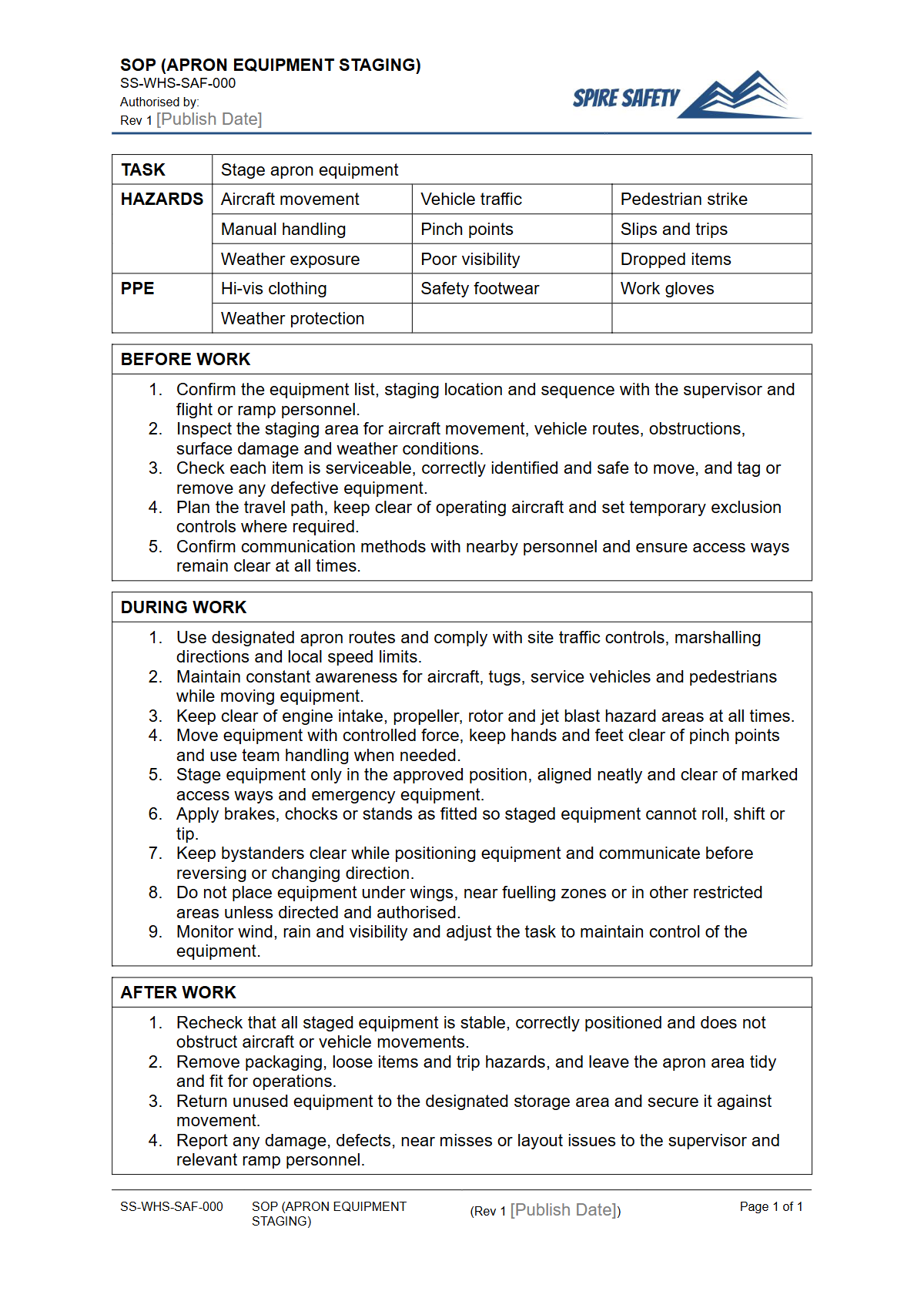
Download our free Safe Operating Procedure (SOP) for apron equipment staging. This template provides a clear framework for managing risks.
Free Safe Operating Procedure (Apron Equipment Staging) Template
DOCX • 126 KB + PDF
Updated Oct 2026
No signup required
Purpose of the Free Safe Operating Procedure (Apron Equipment Staging) Template
This Free Safe Operating Procedure (Apron Equipment Staging) Template provides a structured framework for outlining the safe methods required to position ground support equipment (GSE) and other vehicles on an airport apron. The aviation environment is high-risk, and the correct staging of equipment is critical to prevent collisions with aircraft, other vehicles, and personnel.
A documented procedure helps manage hazards such as jet blast, propeller wash, Foreign Object Debris (FOD), and noise exposure. Using this SOP helps ensure that tasks are performed consistently and safely by all ground crew, reducing the risk of costly aircraft damage and serious injuries.
It forms a key component of your overall WHS management systems by formalising expectations and control measures.
Video walkthrough
How to use the Free Safe Operating Procedure (Apron Equipment Staging) Template
To effectively implement this Safe Operating Procedure, download the DOCX or PDF file and integrate it into your existing safety framework. The document serves as a comprehensive starting point, designed to be adapted to the specific context of your aerodrome and operations.
It is essential to conduct a thorough risk assessment of your apron environment and consult with ground crew, supervisors, and other relevant personnel to ensure the procedure reflects your actual work practices and equipment. This collaborative approach is vital for creating a procedure that is both practical and effective.
Important: This is a template only. We have provided a solid foundation based on Australian WHS principles, but you must customise this document with your site-specific details, equipment models, airport layout, local regulations, and control measures.
Its effectiveness is entirely dependent on how well you adapt and implement it within your organisation.
What is a Safe Operating Procedure?
A Safe Operating Procedure (SOP), sometimes called a Safe Work Procedure (SWP), is a document that provides step-by-step instructions on how to perform a work task safely. It identifies potential hazards associated with the task and outlines the control measures required to eliminate or minimise the risk of injury or illness.
Unlike some mobile equipment tasks, apron staging involves coordinating multiple vehicles and personnel in a dynamic environment. The principles, however, remain the same, whether documenting a procedure for heavy machinery or a simpler task covered by our FREE Step Ladder SOP (Safe Operating Procedure) Template.
When to use this Safe Operating Procedure
This SOP should be the primary reference document for any task involving the staging of equipment on an airport apron. It should be used during:
- Worker Training and Induction: As a core training tool for new ground crew to ensure they understand the established safety protocols from day one.
- Pre-Task Planning: By supervisors and team leaders to brief crews before commencing operations, especially in non-routine situations.
- Refresher Training: For periodic retraining to reinforce safe work habits and introduce any updates to the procedure.
- Incident Investigation: As a benchmark to determine if procedural deviations contributed to a near miss or incident. Regular reviews, often as part of WHS compliance auditing, ensure the SOP remains current.
Who should use this Safe Operating Procedure
This procedure is intended for all personnel involved in airport ground operations. Key users include:
- Ground Crew / Ramp Agents: The primary users who perform the day-to-day tasks of moving and staging equipment. They must be trained in and follow the SOP precisely.
- Baggage Handlers: Personnel operating baggage carts, loaders, and other GSE must understand their role in the overall staging plan.
- Aircraft Maintenance Engineers: When positioning maintenance stands, power units, or other engineering equipment near an aircraft. Their work often involves specific vehicle movements similar to those in our FREE Body Truck SOP (Safe Operating Procedure) Template, but with unique aviation-specific hazards.
- Supervisors and Duty Managers: Responsible for ensuring the SOP is implemented, crews are adequately trained, and compliance is maintained on the apron.
- WHS Managers and Personnel: For use in risk assessments, training development, and auditing processes. Navigating complex aviation regulations may require expert guidance, which is where specialised WHS consulting can provide significant value.
By defining clear steps and responsibilities, this Safe Operating Procedure for apron equipment staging helps create a safer, more organised, and efficient work environment for everyone on the ramp. For more templates covering a wide range of tasks and equipment, browse our complete free WHS resources library.
Common mistakes
Common mistakes to avoid
- Failing to account for specific airport markings, taxiway lines, and no-go zones.
- Not conducting mandatory pre-use operational checks on Ground Support Equipment (GSE).
- Inadequate communication and use of hand signals between ground crew, flight crew, and marshallers.
- Assuming a generic SOP is sufficient without site-specific customisation and worker consultation.
Legal references
Legal considerations
The following legal requirements may be relevant to this type of work.
- Work Health and Safety Act (Harmonised) — Provides the primary duties for protecting workers and other people from work health and safety risks.
- Work Health and Safety Regulations (Harmonised) — Sets out requirements supporting the management of workplace hazards and risks.
The following codes may be relevant to this type of work.
- Managing WHS Risks Code of Practice — Provides practical guidance on identifying hazards, assessing risks and applying effective controls.
- Work Health and Safety Consultation, Cooperation and Coordination Code of Practice — Provides practical guidance on consulting workers and coordinating with other duty holders.
- Managing the Work Environment and Facilities Code of Practice — Provides practical guidance on safe work environments, workplace facilities and related controls.
Did you know
Ground Damage Costs
Ground damage to aircraft is a significant cost to the aviation industry, with global estimates running into the billions of dollars annually, much of which is preventable through robust procedures.
FOD Hazard
Foreign Object Debris (FOD) on an apron, such as loose tools or equipment parts, can be ingested by jet engines, potentially causing catastrophic failure and posing a severe safety risk to aircraft and personnel.
FAQ
Frequently asked questions
01What specific hazards should an Apron Equipment Staging SOP address?
02Is this SOP template suitable for all types of airport aprons?
03How often should an SOP for apron equipment staging be reviewed?
04Who is responsible for enforcing the Apron Equipment Staging SOP?
Share this resource
Free Safe Operating Procedure (Apron Equipment Staging) Template
Browse Categories
How To Use It
- 1Download and open in Word or PDF.
- 2Replace the placeholders with your business details.
- 3Get it reviewed by a WHS specialist before rollout.
Need it customised?
Our WHS consultants can adapt this template to your site, run a gap analysis, or audit what you already have in place.
Book a Free Consultation WHS consulting servicesor call 1300 156 382
Related templates
- Free Safe Operating Procedure (Apron Feeder) Template
- Free Safe Operating Procedure (Aquatic Weed Removal) Template
- Free Safe Operating Procedure (Arbor Mulching) Template
- Free Safe Operating Procedure (Arbor Press) Template
- Free Safe Operating Procedure (Arc Gouging) Template
- Free Safe Operating Procedure (Artificial Turf Care) Template