
Free Safe Operating Procedure (Artificial Turf Care) Template
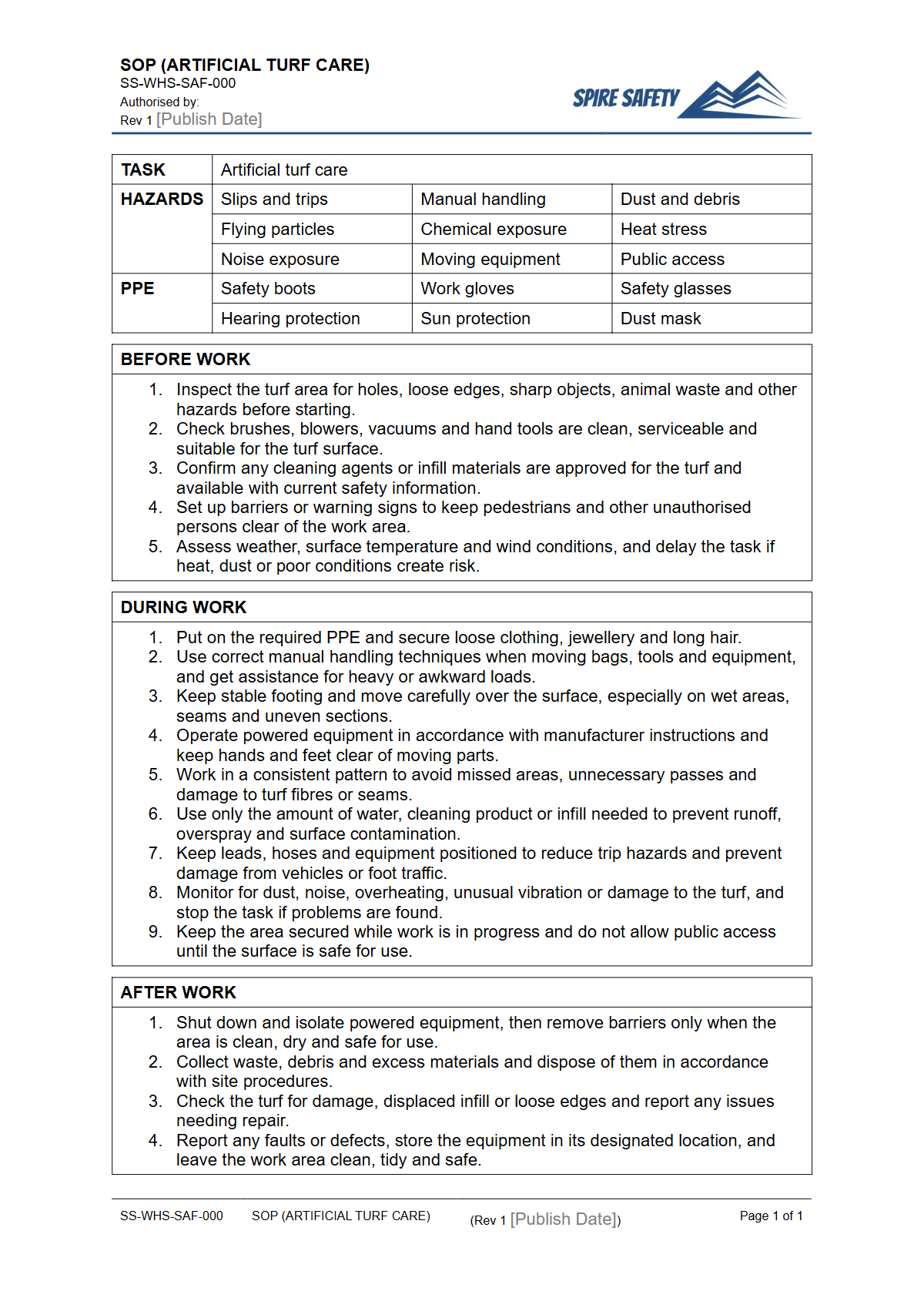
Download our free Safe Operating Procedure (Artificial Turf Care) template. This DOCX and PDF resource helps you outline safety steps for turf maintenance.
Free Safe Operating Procedure (Artificial Turf Care) Template
DOCX • 126 KB + PDF
Updated Oct 2026
No signup required
Purpose of the Free Safe Operating Procedure (Artificial Turf Care) Template
Maintaining artificial turf surfaces is essential for safety, aesthetics, and longevity, but the tasks involved come with specific workplace health and safety risks. This Free Safe Operating Procedure (Artificial Turf Care) Template provides a structured framework for documenting the safest way to perform maintenance activities.
It helps your organisation meet its duty of care by outlining step-by-step instructions to control hazards associated with turf care, such as manual handling, chemical exposure, and machinery operation. Using a clear SOP helps standardise your processes, ensuring every worker performs the task with the same level of safety awareness.
An SOP is a key component of a robust safety framework, detailing the practical application of your risk management strategies. It translates your risk assessment findings into actionable, repeatable steps that minimise the chance of injury or incident.
Integrating clear procedures like this one is a fundamental part of building effective WHS management systems that protect your workers and your business.
Video walkthrough
How to use the Free Safe Operating Procedure (Artificial Turf Care) Template
Our template is provided in both DOCX and PDF formats for your convenience. To use it effectively, download the DOCX file and adapt it to the specific context of your workplace.
This is not a finished document; it is a starting point designed to be customised.
Important: You must consult with your workers and other relevant stakeholders during the customisation process. Review the template against your site-specific risk assessments, the particular type of turf you maintain, the equipment you use, and the cleaning chemicals you have on-site.
Add or remove steps to ensure the final SOP accurately reflects your operational reality. If you need expert guidance to tailor this or other safety documents, consider engaging professional WHS consulting services.
When to use this Safe Operating Procedure
A Safe Operating Procedure for artificial turf care should be used consistently as a control measure for identified risks. It serves as a primary reference tool in several key situations, including during worker training and induction to ensure new team members understand the established safe method from day one.
It should also be readily available at the point of work for operators to reference before starting a task.
The SOP is also a critical document for refresher training and for post-incident investigations to review and improve existing processes. Regular use reinforces safe work habits and ensures procedural consistency across your team. This proactive approach to safety is just as important for grounds maintenance as it is for more obvious hazards, like those covered in our FREE Step Ladder SOP Template.
Who should use this SOP
This SOP is intended for any person involved in the maintenance and care of artificial turf surfaces. This includes groundskeepers, maintenance staff, landscapers, and facility management personnel.
It is also a vital tool for supervisors and managers who are responsible for providing training, overseeing work, and ensuring safe practices are followed. Persons Conducting a Business or Undertaking (PCBUs) can use this template to help fulfil their WHS obligations to provide and maintain a safe system of work.
Volunteers at sports clubs or community facilities who are tasked with turf maintenance will also find this document invaluable for establishing a baseline of safe behaviour. For a wider selection of safety documentation, you can browse our complete free WHS resources library.
What to Include in Your Customised SOP
When customising this template, ensure it comprehensively covers all aspects of the task. Your final document should be a complete guide that leaves no room for ambiguity. Pay close attention to the following sections:
Personal Protective Equipment (PPE)
Specify the exact PPE required for each phase of the task. This might include UV-rated long-sleeved clothing, non-slip enclosed footwear, safety glasses (especially when using blowers or spreading infill), and chemical-resistant gloves when handling cleaning agents or adhesives.
Pre-Operational Checks
Detail the safety checks required for all powered equipment before use, such as turf groomers, power brooms, or blowers. This includes checking for fuel or oil leaks, ensuring guards are in place, and verifying that controls are functioning correctly.
Just as you would document checks for workshop equipment using a resource like our free Air Compressor SOP template, your turf care equipment needs similar attention.
Step-by-Step Procedure
This is the core of the SOP. Break down the entire maintenance process into logical, sequential steps.
Cover tasks like removing debris, brushing the turf fibres, de-compacting and topping up infill, cleaning stains, and performing minor repairs. Be clear and concise with your instructions.
Emergency Procedures
Outline the immediate actions to take in case of an emergency, such as equipment malfunction, chemical spill, or personal injury. Include contact numbers for first aid officers and emergency services, and the location of safety equipment like first aid kits and spill kits.
Integrating the SOP into Your WHS System
An SOP is most effective when it is part of a holistic safety management system. It should not exist in isolation.
Ensure the procedure is supported by comprehensive worker training, with records kept to document who has been trained and when. The SOP should be directly informed by a thorough risk assessment for artificial turf care tasks.
Furthermore, your safety system should include a schedule for regular review of all SOPs, typically annually or following any change in equipment, chemicals, or work processes. This continuous improvement cycle ensures your safety documentation remains relevant and effective.
Periodic checks, such as those performed during a WHS compliance auditing program, can help identify gaps and ensure your SOPs are being implemented correctly.
Common mistakes
Common mistakes to avoid
- Using incorrect cleaning chemicals that can damage the turf backing or fibres.
- Neglecting to regularly de-compact and top up infill material, leading to a hard, unsafe surface.
- Failing to adequately train workers on the specific operation of turf grooming machinery.
- Treating the SOP as a 'set-and-forget' document instead of reviewing and updating it regularly.
Legal references
Legal considerations
The following legal requirements may be relevant to this type of work.
- Work Health and Safety Act (Harmonised) — Provides the primary duties for protecting workers and other people from work health and safety risks.
- Work Health and Safety Regulations (Harmonised) — Sets out requirements supporting the management of workplace hazards and risks.
The following codes may be relevant to this type of work.
- Managing WHS Risks Code of Practice — Provides practical guidance on identifying hazards, assessing risks and applying effective controls.
- Work Health and Safety Consultation, Cooperation and Coordination Code of Practice — Provides practical guidance on consulting workers and coordinating with other duty holders.
- Managing the Work Environment and Facilities Code of Practice — Provides practical guidance on safe work environments, workplace facilities and related controls.
Did you know
Infill is Critical
Maintaining correct infill levels is not just for playability; it's a critical safety factor that provides cushioning, supports the turf fibres, and helps reduce the risk of player injuries.
UV Damage
Ultraviolet (UV) radiation from the sun is a primary cause of artificial turf degradation, making the fibres brittle over time. Some maintenance procedures and cleaning agents are designed to mitigate this effect.
FAQ
Frequently asked questions
01What is the difference between a Safe Operating Procedure (SOP) and a Safe Work Method Statement (SWMS)?
02How often should our Artificial Turf Care SOP be reviewed?
03Is this SOP suitable for all types of artificial turf?
04Do I need a separate SOP for each piece of equipment used in turf care?
Share this resource
Free Safe Operating Procedure (Artificial Turf Care) Template
Browse Categories
How To Use It
- 1Download and open in Word or PDF.
- 2Replace the placeholders with your business details.
- 3Get it reviewed by a WHS specialist before rollout.
Need it customised?
Our WHS consultants can adapt this template to your site, run a gap analysis, or audit what you already have in place.
Book a Free Consultation WHS consulting servicesor call 1300 156 382
Related templates
- Free Safe Operating Procedure (Asphalt Paver) Template
- Free Safe Operating Procedure (Athletics Pit Raking) Template
- Free Safe Operating Procedure (Athletics Track Care) Template
- Free Safe Operating Procedure (Auger Operation) Template
- Free Safe Operating Procedure (Autoclave) Template
- Free Safe Operating Procedure (Automated Guided Vehicle) Template