
Free Safe Operating Procedure (Athletics Pit Raking) Template
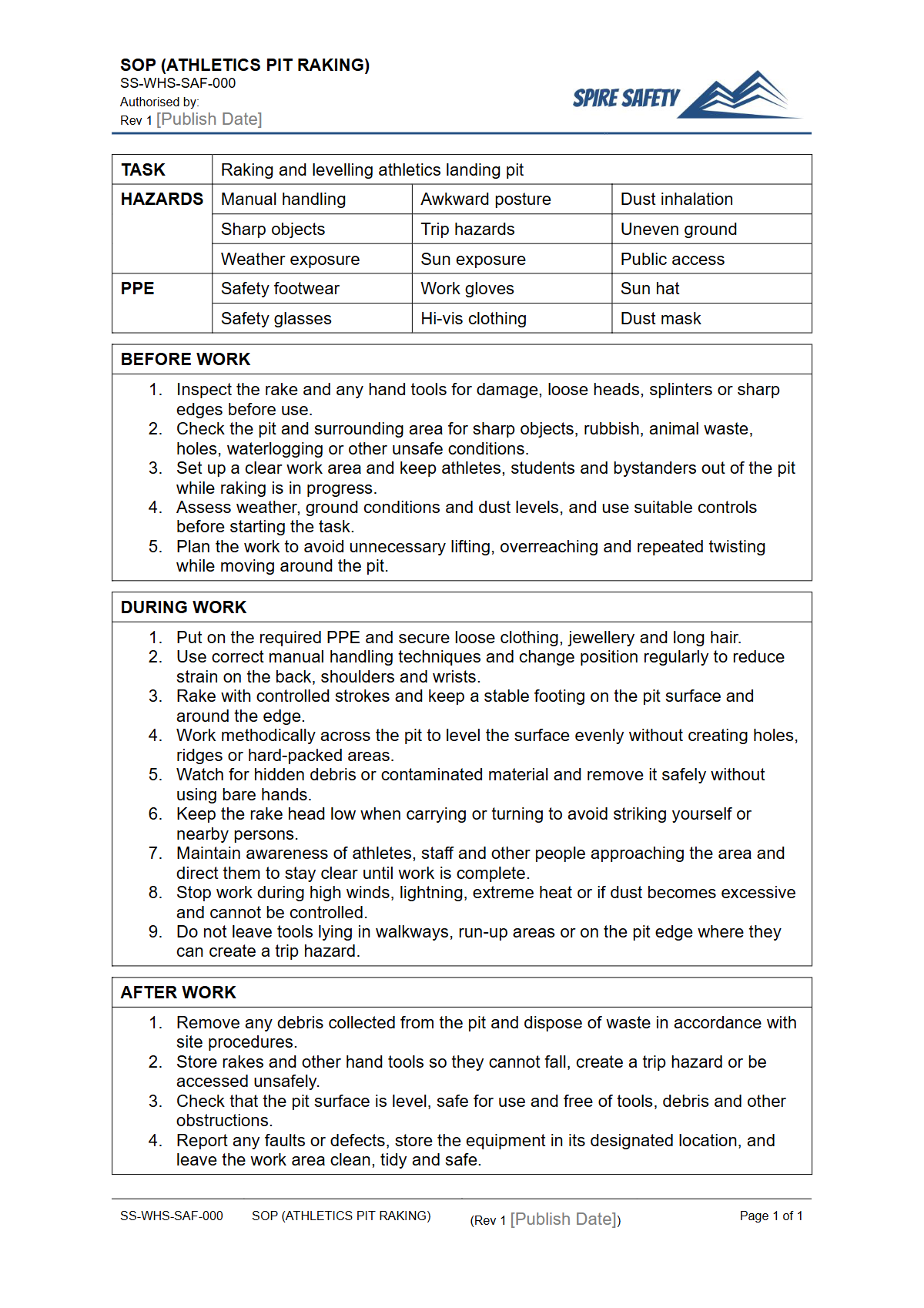
Download our Free Safe Operating Procedure (Athletics Pit Raking) Template.
Free Safe Operating Procedure (Athletics Pit Raking) Template
DOCX • 126 KB + PDF
Updated Oct 2026
No signup required
Purpose of the Free Safe Operating Procedure (Athletics Pit Raking) Template
Even seemingly straightforward tasks like raking a long jump or triple jump pit carry inherent risks. This Free Safe Operating Procedure (Athletics Pit Raking) Template provides a structured framework for documenting the safest way to perform this common task at sports facilities, schools, and athletics clubs.
Using a formal SOP helps a Person Conducting a Business or Undertaking (PCBU) meet their primary duty of care by clearly outlining hazards and control measures. It standardises the process, ensuring everyone performs the task consistently and safely, reducing the risk of injuries related to manual handling, slips, trips, and dust exposure.
A documented procedure is a critical component of a compliant safety framework. It serves as an essential training tool for new workers or volunteers and acts as a benchmark for performance and supervision.
Implementing task-specific SOPs demonstrates a commitment to proactive risk management and forms a key part of your overall WHS management systems, ensuring that safety is integrated into daily operations rather than being an afterthought.
Video walkthrough
How to use the Free Safe Operating Procedure (Athletics Pit Raking) Template
This template is available for download in both DOCX and PDF formats. The DOCX version is fully editable, allowing you to tailor it to the unique circumstances of your workplace.
To effectively use this resource, you should methodically work through each section, replacing the placeholder text with information specific to your site. This includes detailing the exact type of rakes used, the composition of the pit material (e.g., sand, synthetic granules), the specific location, and emergency procedures relevant to your facility.
Please note: This document is a template, not a finished Safe Operating Procedure. We have designed it to be a comprehensive starting point, but you must customise it to reflect the specific hazards, equipment, and environment of your workplace.
We strongly recommend consulting with the workers who actually perform the raking task, as their direct experience is invaluable for identifying practical risks and effective controls. Once customised, the SOP should be approved by a competent person before being issued.
When to use this Safe Operating Procedure
The SOP for athletics pit raking should be used as a primary reference document before the task is ever performed. It is a foundational tool for worker induction and training, ensuring that all personnel, including casuals and volunteers, understand the established safe method from day one.
It should also be readily accessible in the work area for quick reference. Furthermore, the SOP serves as a valuable resource for toolbox talks or pre-start meetings, helping to refresh workers' knowledge of hazards and controls.
Following an incident or near miss, the SOP must be reviewed to determine if any procedural changes are needed. It is also a key piece of evidence examined during a WHS compliance auditing process to verify that safe systems of work are documented and implemented.
Who should use it
This Safe Operating Procedure is intended for use by a range of personnel involved in sports facility management and maintenance. This includes full-time groundskeepers, facility managers, and maintenance staff who are directly responsible for the upkeep of athletic fields.
It is also highly relevant for WHS and Safety Officers who are tasked with developing and overseeing safety systems. In smaller organisations like local sports clubs, the SOP should be used by committee members and trained volunteers who are assigned the task of preparing the pits for training or competition.
Essentially, anyone who performs, supervises, or manages the task of raking athletics pits should be trained on and have access to this procedure. For organisations needing assistance with implementation, our WHS consulting services can provide expert guidance.
Key Hazards in Athletics Pit Raking
Your customised SOP must address all foreseeable hazards. The most significant is hazardous manual tasks, involving repetitive actions, awkward postures while bending, and the force required to pull a rake through compacted sand.
This can lead to musculoskeletal disorders. Other hazards include slips and trips on uneven ground or from discarded tools, exposure to airborne dust (silica sand) which can cause respiratory issues, and environmental factors like heat stress and UV exposure when working outdoors.
Your procedure should outline specific controls for each of these risks, such as mandatory break times, correct manual handling techniques, and required Personal Protective Equipment (PPE).
The principle of documenting procedures extends beyond this single task. Comprehensive site safety often involves managing risks across a variety of activities.
For example, general facility maintenance might require workers to follow a step ladder SOP when accessing storage or changing light globes. Similarly, if minor repairs to timber seating or structures are part of the groundskeeper's role, a FREE Circular Saw SOP (Safe Operating Procedure) Template would be essential to manage the high risks associated with power tools.
By developing a library of robust, task-specific SOPs, you create a safer, more predictable work environment. You can find more templates to build out your safety system in our free WHS resources library, covering a wide range of equipment and tasks.
Common mistakes
Common mistakes to avoid
- Using the generic template without customising it for site-specific tools and conditions.
- Failing to consult with and train workers on the finalised SOP.
- Not reviewing or updating the procedure after a near miss, incident, or change in process.
- Neglecting to specify appropriate PPE, such as P2-rated dust masks for silica sand or UV-rated clothing.
Legal references
Legal considerations
The following legal requirements may be relevant to this type of work.
- Work Health and Safety Act (Harmonised) — Provides the primary duties for protecting workers and other people from work health and safety risks.
- Work Health and Safety Regulations (Harmonised) — Sets out requirements supporting the management of workplace hazards and risks.
The following codes may be relevant to this type of work.
- Managing WHS Risks Code of Practice — Provides practical guidance on identifying hazards, assessing risks and applying effective controls.
- Work Health and Safety Consultation, Cooperation and Coordination Code of Practice — Provides practical guidance on consulting workers and coordinating with other duty holders.
- Managing the Work Environment and Facilities Code of Practice — Provides practical guidance on safe work environments, workplace facilities and related controls.
Did you know
Manual Task Risk
Sprains and strains from manual tasks are one of Australia's most common types of workplace injury, making documented procedures for physically demanding activities like raking crucial for prevention.
Silica Dust
Many long jump pits use sand containing crystalline silica. Inhaling fine silica dust is a serious long-term health hazard, which is why P2-rated respiratory protection is often specified in SOPs for this task.
FAQ
Frequently asked questions
01Is a Safe Operating Procedure legally required for raking an athletics pit?
02What should be included in an SOP for athletics pit raking?
03How often should this SOP be reviewed?
04Can I use this template for other groundskeeping tasks like lawn mowing?
Share this resource
Free Safe Operating Procedure (Athletics Pit Raking) Template
Browse Categories
How To Use It
- 1Download and open in Word or PDF.
- 2Replace the placeholders with your business details.
- 3Get it reviewed by a WHS specialist before rollout.
Need it customised?
Our WHS consultants can adapt this template to your site, run a gap analysis, or audit what you already have in place.
Book a Free Consultation WHS consulting servicesor call 1300 156 382
Related templates
- Free Safe Operating Procedure (Athletics Track Care) Template
- Free Safe Operating Procedure (Auger Operation) Template
- Free Safe Operating Procedure (Autoclave) Template
- Free Safe Operating Procedure (Automated Guided Vehicle) Template
- Free Safe Operating Procedure (Automatic Door Reset) Template
- Free Safe Operating Procedure (Automatic Door Service) Template