
Free Safe Operating Procedure (Auger Operation) Template
Download our free Safe Operating Procedure (Auger Operation) template. This DOCX & PDF resource helps document safe work practices for auger use.
Free Safe Operating Procedure (Auger Operation) Template
DOCX • 164 KB + PDF
Updated Oct 2026
No signup required
Purpose of the Free Safe Operating Procedure (Auger Operation) Template
Operating an auger, whether a handheld post-hole digger or a larger earth drill attachment, presents significant health and safety risks. These include entanglement with the rotating shaft, soil collapse in unstable ground, manual handling injuries, and the catastrophic danger of striking underground utilities.
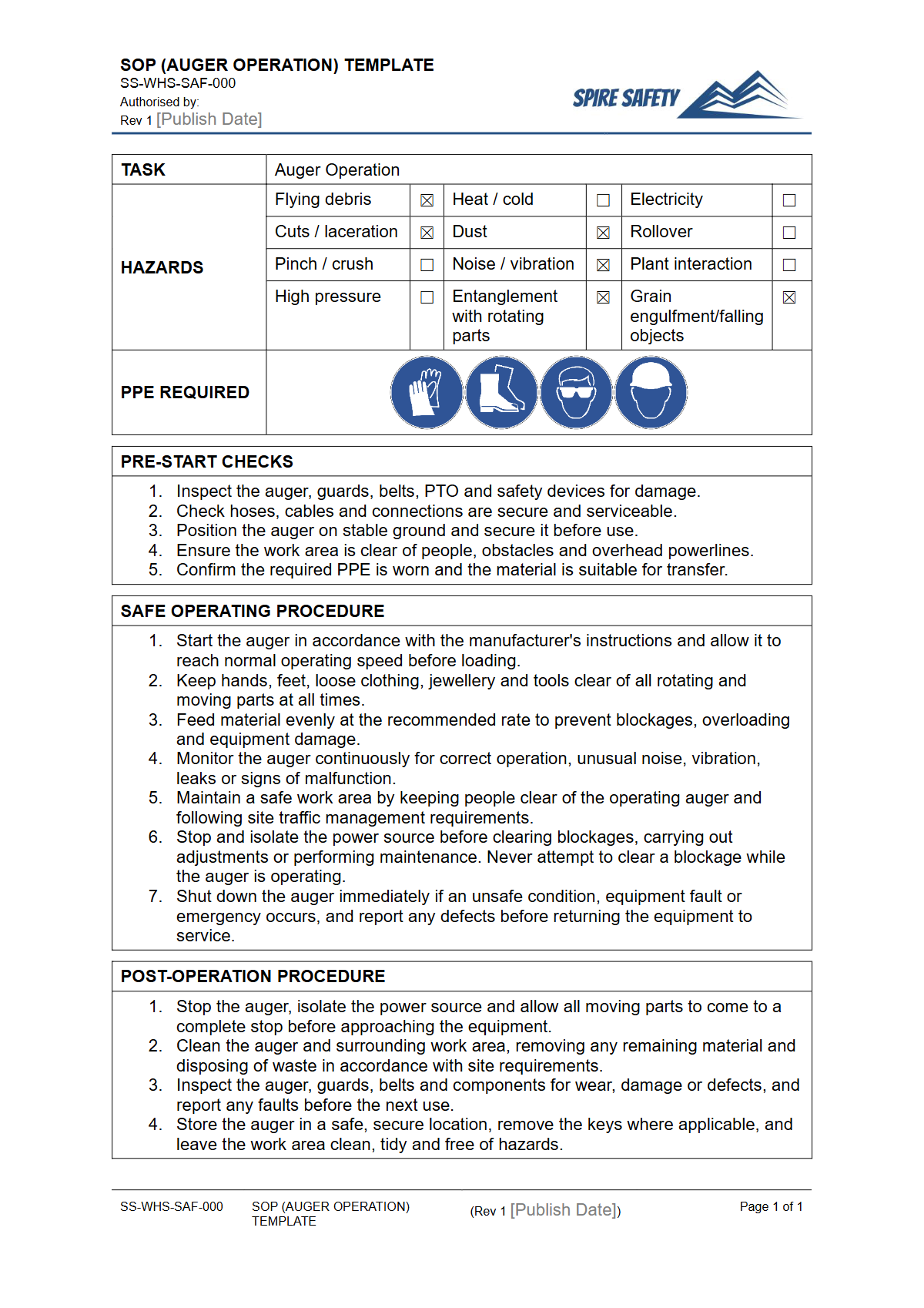
This Free Safe Operating Procedure (Auger Operation) Template provides a structured framework for documenting the required steps to perform the task safely. It helps organisations establish and communicate clear, repeatable instructions to manage hazards and minimise risks.
Using a documented SOP is a practical method for a Person Conducting a Business or Undertaking (PCBU) to meet their primary duty of care under Australian WHS laws. This template serves as a starting point for developing a comprehensive procedure that outlines pre-start checks, operational steps, required Personal Protective Equipment (PPE), and emergency response actions.
It forms a critical component of a site's overall safety management system.
Video walkthrough
How to use the Free Safe Operating Procedure (Auger Operation) Template
This template is designed for easy customisation to reflect the specific machinery and conditions at your workplace. After downloading the DOCX or PDF file, you must adapt it by adding site-specific information.
This includes the exact make and model of the auger, details about the work environment, specific ground conditions, and the names and contact details for supervisors and first aid officers.
A thorough risk assessment should be completed before finalising the document. The SOP should detail the control measures identified in that assessment, such as exclusion zones, spotter requirements, and procedures for refuelling.
This document is a key part of a broader safety framework; for businesses looking to formalise their processes further, integrating SOPs into a certified WHS management system can provide a robust structure for continuous improvement.
Important: This is a template, not a finished document. We have provided a structured starting point, but you must adapt the content to address the specific augers, tasks, ground conditions, and risks present in your workplace.
Failure to customise this SOP may leave critical site-specific risks uncontrolled.
When to use an Auger Operation Safe Operating Procedure
An SOP for auger operation should be implemented before any drilling work commences. It is a fundamental tool for worker training, induction, and competency verification, ensuring that all operators understand the approved, safe method for completing the task.
The SOP should be readily available at the work site for easy reference during operations.
It should be reviewed as part of pre-start meetings or toolbox talks, especially when conditions change (e.g., after heavy rain) or when new operators join the team. It is also a critical reference document following any incident or near-miss, helping to inform the investigation and identify any procedural gaps.
Often, auger use is part of a larger project, and this procedure should integrate with others, such as a front end loader SOP for clearing the area or preparing the site.
Who should use this Safe Operating Procedure
This document is intended for use by several key personnel within an organisation. PCBUs and managers are responsible for ensuring safe systems of work are in place, making this template a vital tool for fulfilling that obligation.
Supervisors must use the SOP to direct work, train staff, and monitor adherence to safe practices on the ground.
Operators are the primary end-users, as the SOP provides them with clear, step-by-step guidance on how to perform their tasks safely. It empowers them to identify and control hazards and to stop work if conditions deviate from those outlined in the procedure.
Similarly, workers operating other heavy equipment on site, such as those guided by a Dozer SOP, should be aware of the auger's operational zones and safety requirements. The SOP can also be used by WHS officers and auditors to verify that correct procedures are being followed. For more specialised agricultural applications, this document complements other machinery procedures like our free Tractor SOP template.
If you require expert assistance in developing and implementing site-specific safety documentation, Spire Safety offers professional WHS consulting services to help ensure your procedures are practical and effective. For more templates and safety guides, you can browse our complete free WHS resources library.
Common mistakes
Common mistakes to avoid
- Failing to identify and mark underground services before starting any drilling.
- Wearing loose clothing, standard gloves, or jewellery that can become entangled in the rotating shaft.
- Not establishing and maintaining a clear exclusion zone around the operating area.
- Using the generic template without customising it for the specific auger model, attachments, and site conditions.
Legal references
Legal considerations
The following legal requirements may be relevant to this type of work.
- Work Health and Safety Act (Harmonised) — Provides the primary duties for protecting workers and other people from work health and safety risks.
- Work Health and Safety Regulations (Harmonised) — Sets out requirements supporting the management of workplace hazards and risks.
The following codes may be relevant to this type of work.
- Managing WHS Risks Code of Practice — Provides practical guidance on identifying hazards, assessing risks and applying effective controls.
- Work Health and Safety Consultation, Cooperation and Coordination Code of Practice — Provides practical guidance on consulting workers and coordinating with other duty holders.
- Managing the Work Environment and Facilities Code of Practice — Provides practical guidance on safe work environments, workplace facilities and related controls.
Did you know
Entanglement Hazard
The rotating shaft of an auger is a major entanglement risk. Loose clothing, long hair, or even gloves can be caught in seconds, leading to severe or fatal injuries.
Underground Dangers
Before drilling, it is a legal and critical safety requirement in Australia to identify and locate underground utilities. Using services like 'Dial Before You Dig' is essential to prevent striking gas, water, or electrical lines.
FAQ
Frequently asked questions
01What should be included in an Auger Operation SOP?
02Is a Safe Operating Procedure a legal requirement in Australia?
03How often should an auger SOP be reviewed?
04Can this template be used for all types of augers?
Share this resource
Free Safe Operating Procedure (Auger Operation) Template
Browse Categories
How To Use It
- 1Download and open in Word or PDF.
- 2Replace the placeholders with your business details.
- 3Get it reviewed by a WHS specialist before rollout.
Need it customised?
Our WHS consultants can adapt this template to your site, run a gap analysis, or audit what you already have in place.
Book a Free Consultation WHS consulting servicesor call 1300 156 382
Related templates
- Free Safe Operating Procedure (Autoclave) Template
- Free Safe Operating Procedure (Automated Guided Vehicle) Template
- Free Safe Operating Procedure (Automatic Door Reset) Template
- Free Safe Operating Procedure (Automatic Door Service) Template
- Free Safe Operating Procedure (Automatic Gate Reset) Template
- Free Safe Operating Procedure (Aviation Fuel Sampling) Template