
Free Safe Operating Procedure (Automated Guided Vehicle) Template
Download our free Safe Operating Procedure (AGV) template.
Free Safe Operating Procedure (Automated Guided Vehicle) Template
DOCX • 126 KB + PDF
Updated Oct 2026
No signup required
Purpose of the Free Safe Operating Procedure (Automated Guided Vehicle) Template
Automated Guided Vehicles (AGVs) are transforming warehouses, manufacturing plants, and logistics centres across Australia by automating material transport. While they improve efficiency, they also introduce unique workplace hazards like collisions, crushing, and unexpected movements.
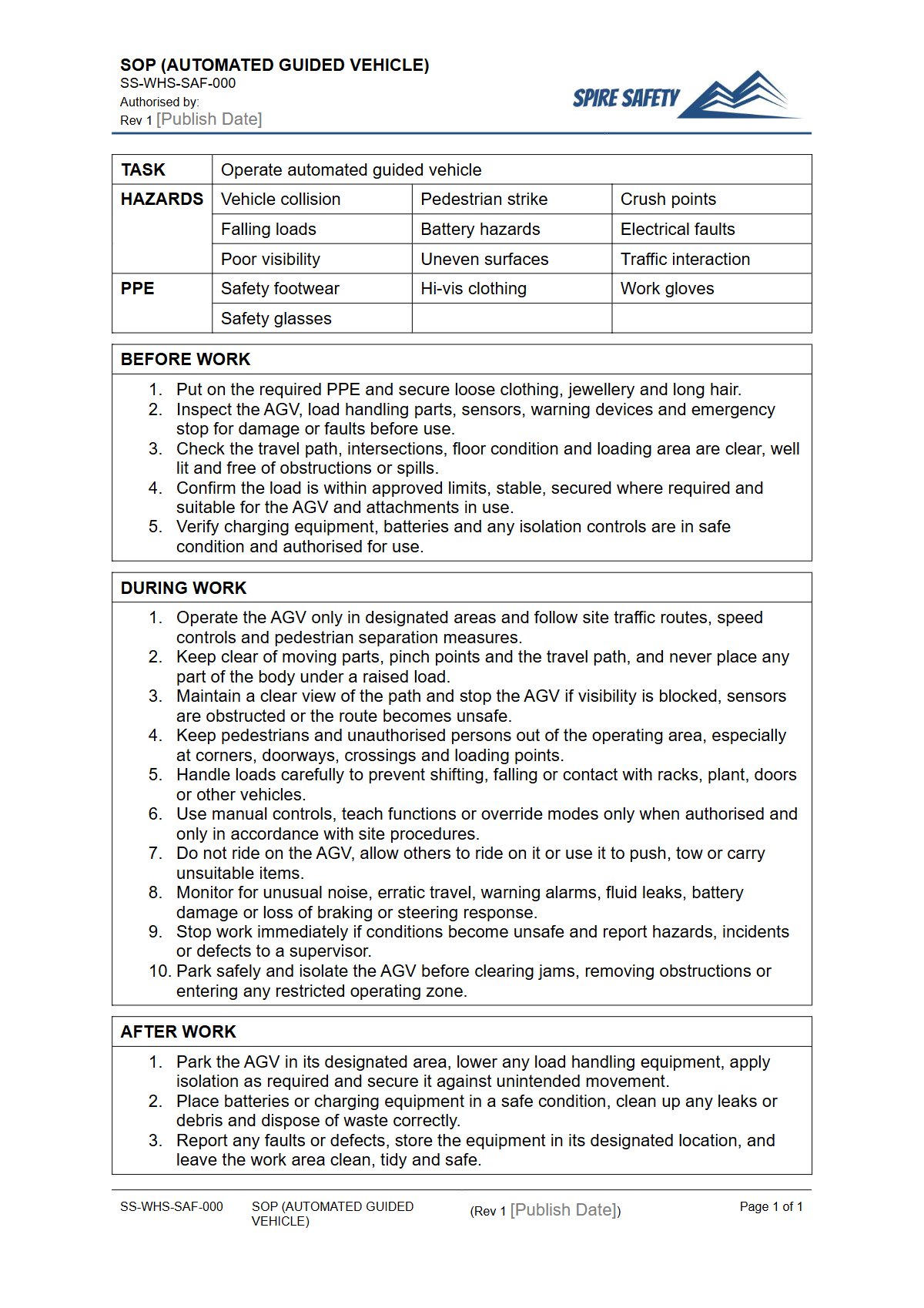
This Free Safe Operating Procedure (Automated Guided Vehicle) Template provides a structured starting point for documenting the essential safety steps and controls needed to manage these risks effectively. An SOP ensures that all interactions with AGVs—from operation and maintenance to working alongside them—are performed in a consistent and safe manner.
Developing a documented procedure is a key part of managing workplace risks associated with mobile plant. The principles of managing AGV movements share similarities with controlling other equipment in a busy environment, such as those outlined in a Telehandler SOP. This template helps your organisation define clear, actionable instructions for workers, which is fundamental to fostering a proactive safety culture and meeting your WHS duties.
Video walkthrough
How to use the Free Safe Operating Procedure (Automated Guided Vehicle) Template
This template is a comprehensive starting point, designed to be adapted to your specific operational environment. It includes sections for pre-operational checks, step-by-step operating instructions, shutdown procedures, and emergency responses.
To use it effectively, you must conduct a thorough, site-specific risk assessment for your AGV systems and the areas where they operate. The findings from your risk assessment should be used to add, remove, and modify the content of the template.
Note: This document must be customised to suit the specific AGV models, software, layout, and work practices of your organisation. We strongly recommend consulting with operators, supervisors, and safety personnel during its development.
Integrating the completed SOP into your broader WHS management systems ensures it is used as part of your overall safety framework, not just as a standalone document.
Key Elements of an AGV Safe Operating Procedure
A robust AGV SOP should be clear, concise, and easy for all relevant personnel to understand. It should comprehensively address the entire lifecycle of the equipment's use in a typical shift. Key sections to include are:
- Required PPE: Specifies any personal protective equipment required for personnel interacting with or working near AGVs, such as high-visibility clothing.
- Pre-Start Safety Checks: A checklist of inspections to be performed before operation, including checking sensors, navigation systems, audible alarms, warning lights, and emergency stop buttons.
- Operational Guidelines: Detailed rules for safe operation, including designated AGV pathways, pedestrian exclusion zones, speed limits, load stability requirements, and procedures for interacting with AGVs at pick-up/drop-off points.
- Emergency Procedures: Clear instructions on how to respond to common emergency scenarios, such as AGV malfunction, collision, battery fire, or unexpected stops. This includes activation of emergency stops and reporting protocols.
- Maintenance and Cleaning: Outlines routine maintenance schedules and safe procedures for cleaning, servicing, and battery charging or replacement.
The structured approach to pre-start checks is a common feature in procedures for complex machinery, whether it's an AGV or a device covered by a FREE CNC Machine SOP (Safe Operating Procedure) Template.
Implementation and Training
A documented SOP is only effective if it is properly implemented. All personnel who work with or around AGVs, including operators, maintenance staff, supervisors, and pedestrians who share the space, must receive training on the procedure's contents.
Training should cover the specific hazards of the AGVs in use, the control measures detailed in the SOP, and the required emergency responses. Records of this training should be maintained.
Regular toolbox talks are an excellent way to reinforce the key safety messages from the SOP. If your team requires support in developing or rolling out training programs based on your customised procedures, our WHS consulting services can provide tailored assistance and expert advice to ensure your procedures are effectively embedded into daily practice.
Review and Continuous Improvement
Safe work procedures are living documents. Your AGV SOP should be reviewed regularly—at least annually—and whenever there is a change to the workplace, equipment, or processes.
It must also be reviewed after any incident or near miss involving an AGV. This review process should involve consultation with your workers to capture their firsthand experience and suggestions for improvement.
Keeping procedures current is critical for all heavy and mobile equipment, not just automated systems. The same review principles apply to tasks covered by a FREE Body Truck SOP (Safe Operating Procedure) Template. By systematically managing the risks associated with AGVs, organisations can harness their significant operational benefits while protecting their people.
Explore our full free WHS resources library for more templates and guides to support your safety objectives.
Common mistakes
Common mistakes to avoid
- Failing to customise the template for the specific AGV model and workplace layout.
- Neglecting to provide comprehensive training to all workers, including pedestrians who share the workspace.
- Not establishing clear traffic management rules for zones where AGVs and people interact.
- Forgetting to review and update the SOP after an incident, near miss, or system modification.
Legal references
Legal considerations
The following legal requirements may be relevant to this type of work.
- Work Health and Safety Act (Harmonised) — Provides the primary duties for protecting workers and other people from work health and safety risks.
- Work Health and Safety Regulations (Harmonised) — Sets out requirements supporting the management of workplace hazards and risks.
The following codes may be relevant to this type of work.
- Managing WHS Risks Code of Practice — Provides practical guidance on identifying hazards, assessing risks and applying effective controls.
- Work Health and Safety Consultation, Cooperation and Coordination Code of Practice — Provides practical guidance on consulting workers and coordinating with other duty holders.
- Managing the Work Environment and Facilities Code of Practice — Provides practical guidance on safe work environments, workplace facilities and related controls.
Did you know
Mixed Traffic Hazards
One of the greatest safety challenges with AGVs is managing 'mixed traffic' environments where both automated vehicles and human-operated vehicles or pedestrians share the same space. Clear demarcation, traffic rules, and sensor technology are critical.
Market Growth
The global market for AGVs and Autonomous Mobile Robots (AMRs) is projected to grow significantly, with Australian warehouses and manufacturing facilities increasingly adopting this technology to improve productivity and supply chain resilience.
FAQ
Frequently asked questions
01What should be included in an SOP for an Automated Guided Vehicle?
02How often should an AGV SOP be reviewed?
03Who is responsible for training workers on the AGV SOP?
04Can a generic SOP be used for all types of AGVs in a workplace?
Share this resource
Free Safe Operating Procedure (Automated Guided Vehicle) Template
Browse Categories
How To Use It
- 1Download and open in Word or PDF.
- 2Replace the placeholders with your business details.
- 3Get it reviewed by a WHS specialist before rollout.
Need it customised?
Our WHS consultants can adapt this template to your site, run a gap analysis, or audit what you already have in place.
Book a Free Consultation WHS consulting servicesor call 1300 156 382
Related templates
- Free Safe Operating Procedure (Automatic Door Reset) Template
- Free Safe Operating Procedure (Automatic Door Service) Template
- Free Safe Operating Procedure (Automatic Gate Reset) Template
- Free Safe Operating Procedure (Aviation Fuel Sampling) Template
- Free Safe Operating Procedure (Avocado Harvesting) Template
- Free Safe Operating Procedure (Awning Maintenance) Template