
Free Safe Operating Procedure (Automatic Gate Reset) Template
Download a free Safe Operating Procedure (Automatic Gate Reset) template.
Free Safe Operating Procedure (Automatic Gate Reset) Template
DOCX • 126 KB + PDF
Updated Oct 2026
No signup required
Purpose of the Free Safe Operating Procedure (Automatic Gate Reset) Template
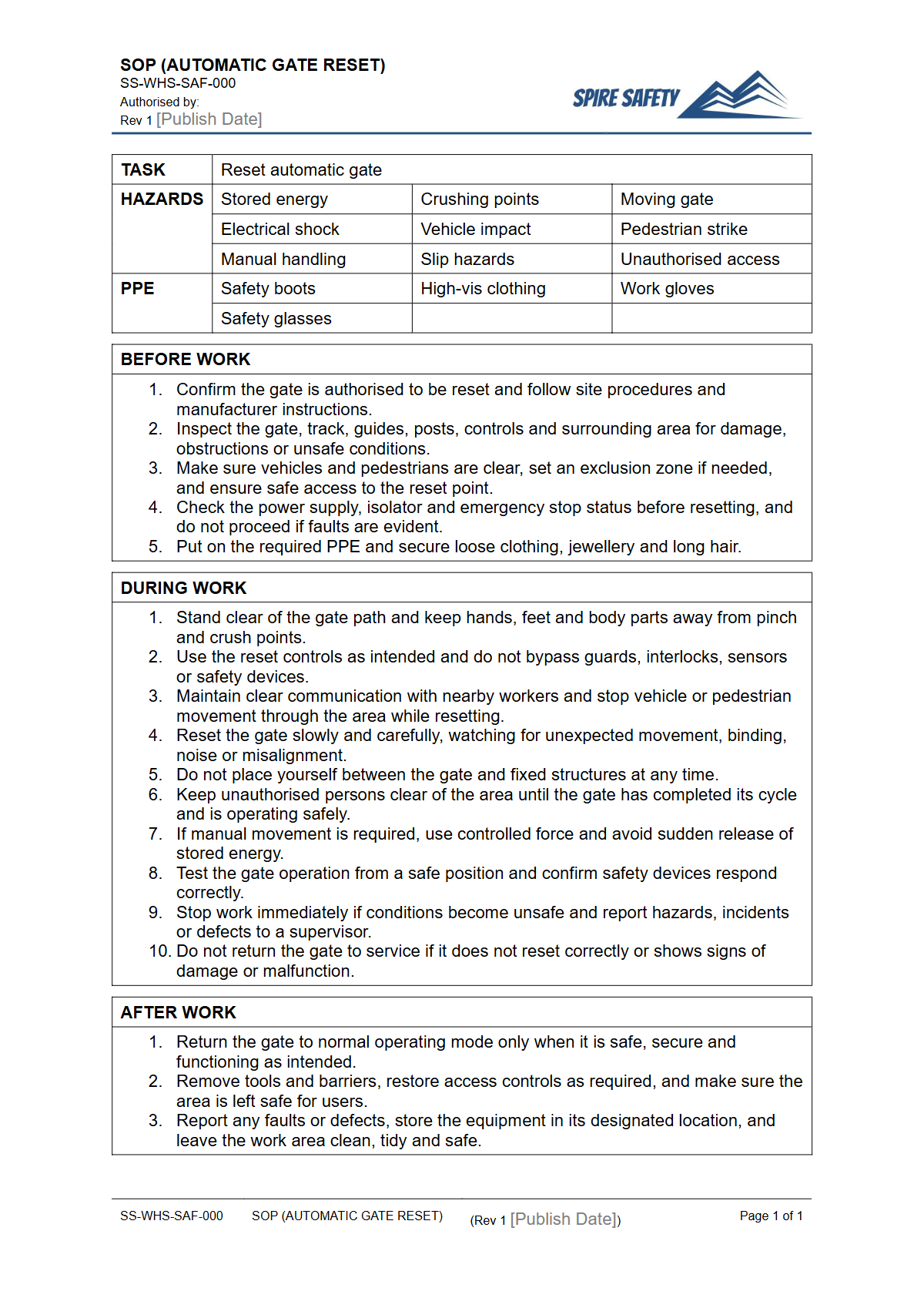
This Free Safe Operating Procedure (Automatic Gate Reset) Template provides a structured framework for documenting the steps required to safely reset automated gate systems. Automatic gates, while essential for security and access control, introduce significant risks if not managed correctly.
Resetting a gate after a power failure, obstruction, or fault condition is a non-routine task that can expose workers to hazards like crushing, shearing, entrapment, and electrical shock. This SOP helps organisations to formally outline a consistent, safe method for the task, meeting their duty of care under Australian WHS laws.
The primary goal is to minimise risk by providing clear, step-by-step instructions. A documented procedure ensures that all personnel performing the task follow a pre-approved, safe sequence of actions.
It serves as a vital tool for training, competency assessment, and incident investigation. By implementing this procedure, you establish a clear standard of work that helps protect your team and ensures operational continuity without compromising safety.
This document forms a critical part of your overall safety management approach.
Video walkthrough
How to use the Free Safe Operating Procedure (Automatic Gate Reset) Template
This document is a starting point, not a finished product. To use it effectively, you must customise it to reflect the specific make, model, and installation of your automatic gate system.
Download the DOCX file and systematically work through each section, adding or removing steps based on your site-specific risk assessment and the manufacturer’s operating manual. It is critical that the final SOP is a practical and accurate guide for your workplace.
Important: We have created this template as a guide. It is your responsibility to ensure it is adapted to your specific plant, tasks, and operational environment.
You must consult with workers and other relevant stakeholders during its development. An effective SOP is a core component of comprehensive WHS management systems, providing clear instructions that are integrated with your other safety processes like training and incident reporting.
When to use this Safe Operating Procedure
This SOP should be used whenever an authorised person needs to perform a manual reset of an automatic gate system. This includes situations following a power outage, an emergency stop activation, or when the gate has faulted due to an obstruction.
It is also a critical training document for new employees or maintenance personnel who will be responsible for this task. Furthermore, the SOP should be referenced during regular safety meetings or toolbox talks to reinforce correct procedure and awareness of associated hazards.
Regular reviews are also essential, particularly after any incidents or near misses, to ensure its continued effectiveness.
Supervisors can also use the document as a checklist during work observations or safety spot-checks. The existence and proper use of such procedures are often a key focus during a formal WHS compliance auditing process, demonstrating a commitment to proactive risk management.
Who should use it
This Safe Operating Procedure is intended for use by trained and authorised personnel only. This typically includes facility maintenance staff, specialist technicians, or designated supervisors who have received specific training on the gate's mechanics, electrical systems, and emergency features.
Competency is key; no one should attempt to reset a gate without having demonstrated their understanding of the procedure and its associated risks. The SOP serves to standardise the method used by all authorised individuals, ensuring consistency and safety regardless of who performs the task. This standardisation is vital for all critical tasks, much like it is for operating other machinery covered by our free Air Compressor SOP template.
Key Hazards in Automatic Gate Operation
When developing your SOP, a thorough hazard identification process is crucial. The most severe risks associated with automatic gates are mechanical.
These include crushing or shearing points between the moving gate and a fixed structure, and the risk of entrapment. Electrical hazards are also present within control boxes and motors, requiring strict isolation procedures.
Depending on the gate's location, you must also manage the risks associated with vehicle and pedestrian traffic during the reset operation. This may require temporary barriers, spotters, or specific communication protocols to be included in your SOP.
Additionally, consider hazards related to accessing the gate's manual release or control panel. If a worker needs to use access equipment to reach components, the risks associated with that task must also be managed.
Referencing a specific procedure like our FREE Step Ladder SOP Template can help address these secondary risks effectively. A single task can often involve multiple hazard types, similar to the procedures outlined in our FREE Plasma Cutter SOP (Safe Operating Procedure) Template, which covers electrical, fume, and radiation hazards.
Integrating SOPs into Your Safety System
A Safe Operating Procedure is most effective when it is part of a broader, living safety system. This single document should be supported by a risk assessment that justifies the controls you have listed.
It should also be linked to your training records to show who is competent to perform the task. Furthermore, any maintenance, inspection, or repairs on the gate should be logged, with the SOP being reviewed and updated if the equipment is modified.
This holistic approach ensures that your safety documentation is not just paperwork, but a dynamic tool for managing risk in the workplace. For more tools to build out your safety system, browse our complete free WHS resources library.
Common mistakes
Common mistakes to avoid
- Failing to electrically isolate the gate's power supply before beginning any manual intervention.
- Not managing pedestrian and vehicle traffic in the area during the reset process.
- Using a generic SOP without customising it for the specific gate model, site layout, and associated hazards.
- Neglecting to review and update the SOP after an incident, near miss, or modification to the gate system.
Legal references
Legal considerations
The following legal requirements may be relevant to this type of work.
- Work Health and Safety Act (Harmonised) — Provides the primary duties for protecting workers and other people from work health and safety risks.
- Work Health and Safety Regulations (Harmonised) — Sets out requirements supporting the management of workplace hazards and risks.
The following codes may be relevant to this type of work.
- Managing WHS Risks Code of Practice — Provides practical guidance on identifying hazards, assessing risks and applying effective controls.
- Work Health and Safety Consultation, Cooperation and Coordination Code of Practice — Provides practical guidance on consulting workers and coordinating with other duty holders.
- Managing the Work Environment and Facilities Code of Practice — Provides practical guidance on safe work environments, workplace facilities and related controls.
Did you know
Entrapment Risks
The majority of serious injuries involving powered gates are caused by crushing or entrapment. Australian Standard AS 5007 outlines specific requirements for force limitation systems and safety devices to mitigate these exact risks.
FAQ
Frequently asked questions
01What is a Safe Operating Procedure (SOP)?
02Why is an SOP needed for resetting an automatic gate?
03Can I use this template for any type of automatic gate?
04Who is responsible for writing the SOP for an automatic gate reset?
Share this resource
Free Safe Operating Procedure (Automatic Gate Reset) Template
Browse Categories
How To Use It
- 1Download and open in Word or PDF.
- 2Replace the placeholders with your business details.
- 3Get it reviewed by a WHS specialist before rollout.
Need it customised?
Our WHS consultants can adapt this template to your site, run a gap analysis, or audit what you already have in place.
Book a Free Consultation WHS consulting servicesor call 1300 156 382
Related templates
- Free Safe Operating Procedure (Aviation Fuel Sampling) Template
- Free Safe Operating Procedure (Avocado Harvesting) Template
- Free Safe Operating Procedure (Awning Maintenance) Template
- Free Safe Operating Procedure (Backflow Device Check) Template
- Free Safe Operating Procedure (Bag Dump Station) Template
- Free Safe Operating Procedure (Baggage Belt Cleanup) Template