
Free Safe Operating Procedure (Baggage Belt Cleanup) Template
Download our free Safe Operating Procedure (Baggage Belt Cleanup) Template. This structured Word & PDF doc helps outline safe work steps. Get your copy.
Free Safe Operating Procedure (Baggage Belt Cleanup) Template
DOCX • 126 KB + PDF
Updated Oct 2026
No signup required
Purpose of the Free Safe Operating Procedure (Baggage Belt Cleanup) Template
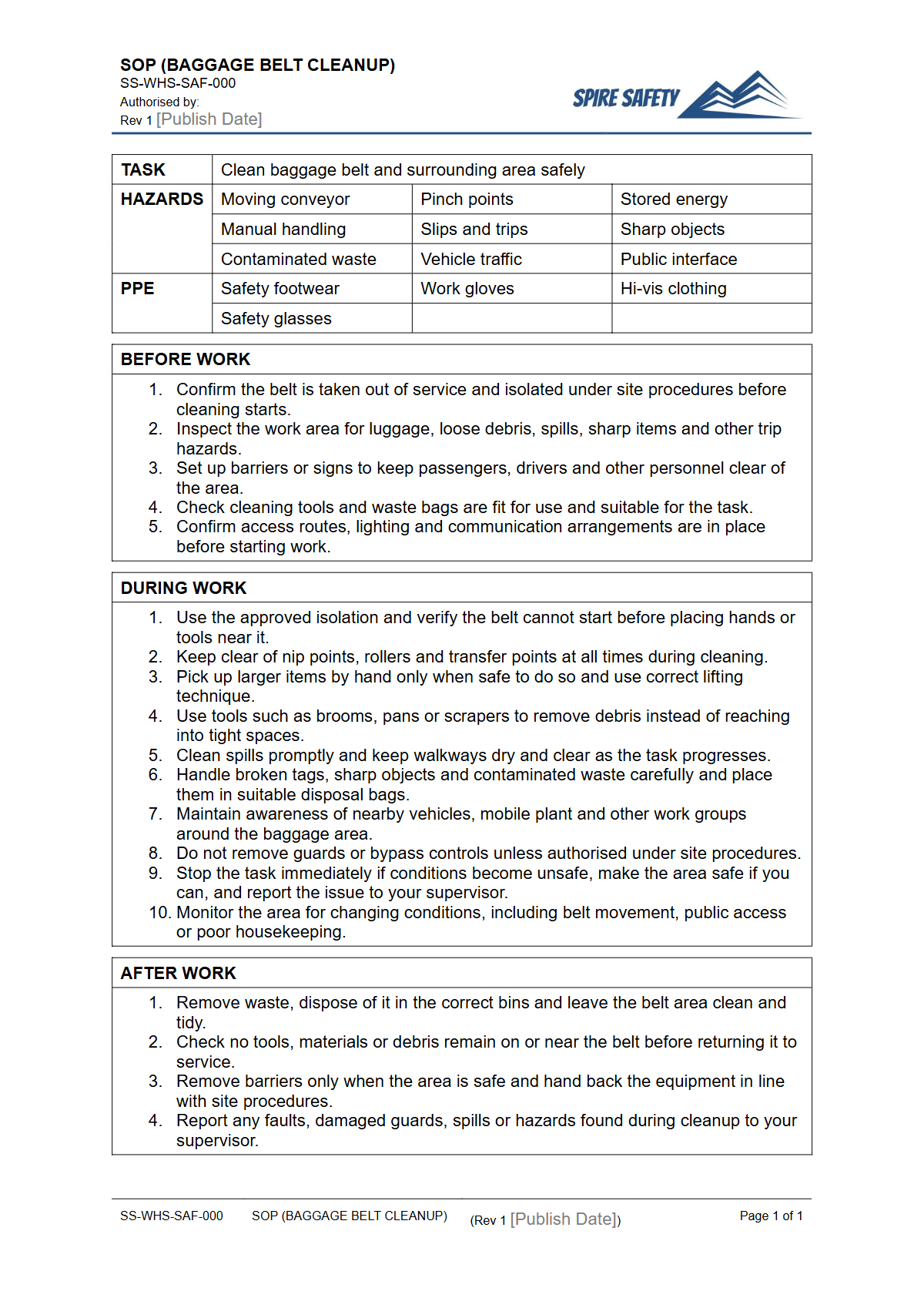
Effectively managing work health and safety in environments like airports, distribution centres, and logistics hubs requires clear, documented processes. Our Free Safe Operating Procedure (Baggage Belt Cleanup) Template provides a structured foundation for outlining the step-by-step process for safely cleaning baggage belts and carousels.
Cleaning these systems, while routine, introduces significant risks including entanglement in moving parts, electrical hazards from water ingress, and manual handling injuries from awkward postures. A documented SOP ensures that a consistent, safe method is communicated to all workers, helping to meet your WHS obligations and prevent serious incidents.
This document is designed as a starting point to formalise your safety processes. It prompts consideration of potential hazards and the critical control measures needed to mitigate them, such as isolation, lockout/tagout (LOTO), and the use of appropriate personal protective equipment (PPE).
For a broader understanding of conveyor systems, our Safe Operating Procedure for conveyor belt operation provides complementary guidance on general use.
Video walkthrough
How to use the Free Safe Operating Procedure (Baggage Belt Cleanup) Template
This Safe Operating Procedure template is provided in both DOCX and PDF formats for your convenience. The DOCX version is fully editable, allowing you to tailor the content directly to your workplace's specific equipment, environment, and existing safety protocols.
To use it effectively, download the file and systematically work through each section. Engage with supervisors and workers who perform the task to ensure the procedure reflects the practical realities of the job.
You will need to detail the specific make and model of your baggage handling system, list the exact PPE required, and outline your unique emergency procedures.
It's crucial to remember that this is a template. We have not been to your site or assessed your specific equipment and risks.
You must adapt this document to your unique operational environment, incorporating information from your own risk assessments. If you require assistance tailoring procedures to your site or need a comprehensive review of your current processes, consider engaging professional WHS consulting services.
When to use a Safe Operating Procedure
A Safe Operating Procedure for baggage belt cleanup should be a core part of your safety management system. It should be used as an instructional tool during the induction and training of new baggage handlers, ground crew, or cleaning staff.
It also serves as a critical reference document for periodic refresher training to prevent procedural drift and ensure standards are maintained. The SOP must be readily accessible to all relevant workers at all times. Furthermore, the document should be reviewed and potentially updated following any incident or near miss, when new equipment is introduced, or as part of scheduled WHS compliance audits.
Who should use this Safe Operating Procedure
This SOP is intended for use by several key groups within an organisation. Primarily, it is for the workers who directly perform the cleaning tasks, providing them with clear, unambiguous instructions to follow.
Supervisors and team leaders should use the document to oversee the task, conduct pre-start checks, and ensure the specified control measures are in place and effective. WHS managers and personnel can use the template to standardise safety documentation across different sites or teams.
Using standardised documents like this one is a key part of developing a WHS management system that is consistent and easy for workers to understand.
Key Elements of the SOP
A comprehensive Safe Operating Procedure for this task typically includes several key sections which are outlined in our template:
- Pre-Operational Checks: A checklist of actions to be completed before any cleaning begins. This includes inspecting the area for slip and trip hazards, checking the condition of the equipment, and, most importantly, confirming the successful isolation and lockout of the machinery.
- Step-by-Step Procedure: A logical sequence of tasks that breaks down the cleaning process from start to finish. This section details the safe application of cleaning agents, the correct tools to use (e.g., non-conductive handles, appropriate brushes), and techniques to avoid awkward postures.
- Emergency Procedures: Clear instructions on what to do in case of an emergency. This covers the location of emergency stops, procedures for responding to an injury, and contact details for first aid officers and emergency services.
- PPE Requirements: A specific list of the Personal Protective Equipment that must be worn to perform the task safely. This may include items like cut-resistant gloves, non-slip waterproof footwear, safety glasses or goggles, and high-visibility clothing. While this SOP covers baggage belts, other equipment used in logistics and airport environments, such as those covered in our telehandler safe operating procedure, also require documented safe systems of work.
Common mistakes
Common mistakes to avoid
- Failing to properly isolate and lock out the belt's power source before starting cleaning.
- Using a generic procedure that doesn't account for the specific model of baggage carousel or its unique hazards.
- Neglecting practical training on the SOP, assuming workers will understand the procedure just by reading it.
- Not providing, maintaining, or enforcing the use of the correct PPE, such as cut-resistant gloves or safety glasses.
Legal references
Legal considerations
The following legal requirements may be relevant to this type of work.
- Work Health and Safety Act (Harmonised) — Provides the primary duties for protecting workers and other people from work health and safety risks.
- Work Health and Safety Regulations (Harmonised) — Sets out requirements supporting the management of workplace hazards and risks.
The following codes may be relevant to this type of work.
- Managing WHS Risks Code of Practice — Provides practical guidance on identifying hazards, assessing risks and applying effective controls.
- Work Health and Safety Consultation, Cooperation and Coordination Code of Practice — Provides practical guidance on consulting workers and coordinating with other duty holders.
- Managing the Work Environment and Facilities Code of Practice — Provides practical guidance on safe work environments, workplace facilities and related controls.
Did you know
Energy Isolation is Key
A significant number of conveyor-related incidents occur during maintenance or cleaning because the equipment was not properly isolated from its energy source through a robust lockout/tagout procedure.
Manual Handling Risk
Musculoskeletal injuries from awkward postures and repetitive movements during cleaning are one of the most common, yet preventable, injuries for ground crew and logistics workers.
FAQ
Frequently asked questions
01What are the main hazards when cleaning a baggage belt?
02Is a Safe Operating Procedure a legal requirement for baggage belt cleaning?
03How often should we review our Baggage Belt Cleanup SOP?
04Can I just use this template as is without customising it?
Share this resource
Free Safe Operating Procedure (Baggage Belt Cleanup) Template
Browse Categories
How To Use It
- 1Download and open in Word or PDF.
- 2Replace the placeholders with your business details.
- 3Get it reviewed by a WHS specialist before rollout.
Need it customised?
Our WHS consultants can adapt this template to your site, run a gap analysis, or audit what you already have in place.
Book a Free Consultation WHS consulting servicesor call 1300 156 382
Related templates
- Free Safe Operating Procedure (Baggage Cart Loading) Template
- Free Safe Operating Procedure (Baggage Handling) Template
- Free Safe Operating Procedure (Baggage Reconciliation) Template
- Free Safe Operating Procedure (Baggage Transfer) Template
- Free Safe Operating Procedure (Baggage Tug) Template
- Free Safe Operating Procedure (Bagging Machine) Template