
Free Safe Operating Procedure (Baggage Cart Loading) Template
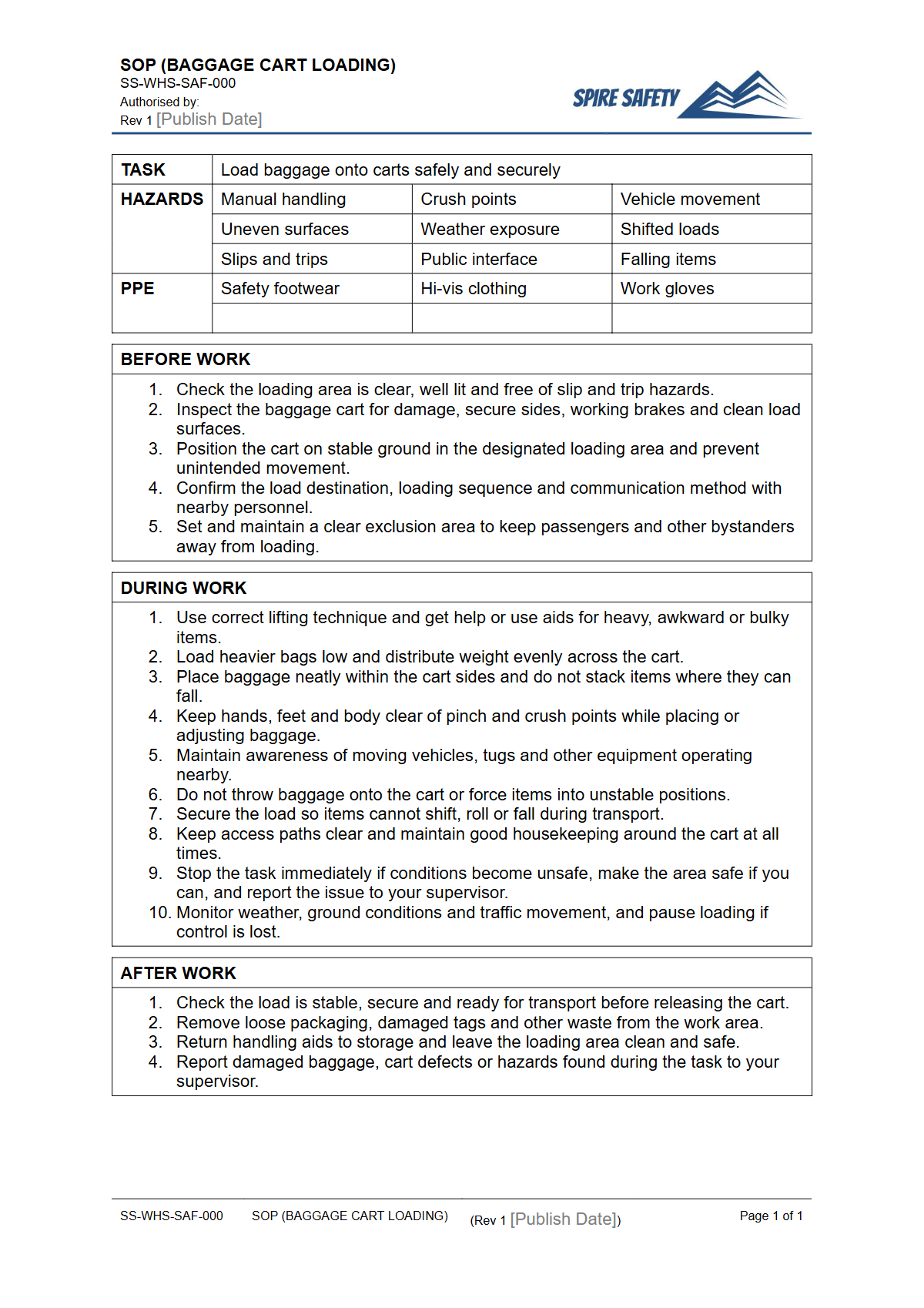
Download our free Safe Operating Procedure (Baggage Cart Loading) template. This customisable DOCX & PDF resource helps manage manual handling risks.
Free Safe Operating Procedure (Baggage Cart Loading) Template
DOCX • 126 KB + PDF
Updated Oct 2026
No signup required
Purpose of the Free Safe Operating Procedure (Baggage Cart Loading) Template
Loading baggage carts is a high-risk activity common in aviation, logistics, and transport industries. The task involves significant manual handling, vehicle movement, and time pressure, creating a high potential for injury.
This free Safe Operating Procedure (Baggage Cart Loading) Template provides a structured framework for documenting and standardising the safest method to perform this task. Its primary purpose is to help Persons Conducting a Business or Undertaking (PCBUs) control risks, particularly those related to musculoskeletal disorders (MSDs) from lifting, carrying, and twisting, as well as the risk of workers being struck by moving vehicles.
By clearly defining the step-by-step process, required personal protective equipment (PPE), and associated hazards, this SOP serves as a critical tool for worker training and competency verification. Implementing a documented procedure helps ensure operational consistency, reduces the likelihood of incidents, and demonstrates a commitment to workplace safety. This document is a foundational component of a hazard management strategy and integrates directly into broader, effective WHS management systems.
Video walkthrough
How to Use the Free Safe Operating Procedure (Baggage Cart Loading) Template
This template is provided as a starting point in both DOCX and PDF formats. To make it effective, you must customise it to reflect the specific circumstances of your workplace.
Start by downloading the DOCX file and consulting with workers who perform the task, as well as their supervisors and any health and safety representatives. During this consultation, walk through the procedure step-by-step, identifying any variations in equipment (types of carts, tugs), environment (ramp conditions, weather), and baggage types.
Update the document with site-specific details, including emergency procedures, names of responsible personnel, and the exact PPE required. Add photos of your equipment and work area to enhance clarity.
Once finalised and approved, the SOP should be used to formally train all relevant staff. Remember, this document is not a set-and-forget solution.
It requires regular review and updates.
Important: We have developed this template as a guide based on common industry practices and the model WHS framework. It is essential that you adapt this document to your specific equipment, operational context, and risk profile.
We are not liable for any incidents that may occur from the use of this template. For assistance in customising safety documentation, consider seeking expert WHS consulting.
When to Use a Baggage Cart Loading SOP
A Safe Operating Procedure for baggage cart loading should be a core part of your daily operations and safety management lifecycle. It should be used during the induction of new ground crew or baggage handlers to establish safe work habits from day one.
The SOP is also an essential tool for refresher training, especially if performance issues or unsafe behaviours are observed. Use it as the basis for toolbox talks to reinforce key safety messages, such as correct lifting techniques or blind spot awareness around vehicles.
Furthermore, this SOP must be reviewed and referenced after any incident or near miss involving baggage handling to identify procedural gaps. It is also critical when introducing new types of baggage carts, towing vehicles, or changes to the work environment.
In busy operational areas where multiple vehicle types are present, coordinating procedures is essential, which is why you may also need our Body Truck SOP to manage interaction risks.
Who Should Use This Safe Operating Procedure
This SOP is intended for a range of personnel within an organisation to ensure a consistent and safe approach to baggage handling. The primary users are the workers themselves—the baggage handlers and ground crew who physically perform the loading tasks.
They must be trained on and have easy access to the SOP at all times. Supervisors and team leaders should use the document to oversee work, conduct safety observations, and ensure procedures are being followed correctly.
WHS managers and safety officers will use this SOP as a key part of the risk register and safety management system. They are often responsible for developing, reviewing, and updating the procedure in consultation with the workforce.
Trainers and assessors will also use the SOP as a foundational document for developing training materials and conducting competency assessments. Periodically, the implementation and effectiveness of this SOP should be checked through WHS compliance audits.
By formalising procedures, you create a clear standard for everyone. For other common logistics and material handling tasks, consider using a resource like our free Telehandler SOP to ensure consistency across all high-risk activities.
You can explore our entire complete library of free WHS resources to build a comprehensive safety documentation suite for your organisation.
Common mistakes
Common mistakes to avoid
- Failing to customise the template for site-specific equipment and environmental conditions.
- Overloading carts beyond their rated capacity or encouraging unsafe lifting.
- Neglecting to consult with and train workers on the specific procedures outlined in the SOP.
- Not reviewing or updating the SOP after an incident or near miss occurs.
Legal references
Legal considerations
The following legal requirements may be relevant to this type of work.
- Work Health and Safety Act (Harmonised) — Provides the primary duties for protecting workers and other people from work health and safety risks.
- Work Health and Safety Regulations (Harmonised) — Sets out requirements supporting the management of workplace hazards and risks.
The following codes may be relevant to this type of work.
- Managing WHS Risks Code of Practice — Provides practical guidance on identifying hazards, assessing risks and applying effective controls.
- Work Health and Safety Consultation, Cooperation and Coordination Code of Practice — Provides practical guidance on consulting workers and coordinating with other duty holders.
- Managing the Work Environment and Facilities Code of Practice — Provides practical guidance on safe work environments, workplace facilities and related controls.
Did you know
Manual Handling Impact
Musculoskeletal disorders, often from hazardous manual tasks, consistently rank among the most common causes of serious workers' compensation claims in the Australian transport and storage industry.
Vehicle Interaction
Incidents involving people being hit by moving vehicles are a major risk in airport and freight environments, making documented traffic management plans and procedures essential for safety.
FAQ
Frequently asked questions
01What are the main hazards when loading baggage carts?
02How often should a Safe Operating Procedure be reviewed?
03Is training required after implementing a new baggage loading SOP?
04Can this SOP template be used for all types of baggage carts?
Share this resource
Free Safe Operating Procedure (Baggage Cart Loading) Template
Browse Categories
How To Use It
- 1Download and open in Word or PDF.
- 2Replace the placeholders with your business details.
- 3Get it reviewed by a WHS specialist before rollout.
Need it customised?
Our WHS consultants can adapt this template to your site, run a gap analysis, or audit what you already have in place.
Book a Free Consultation WHS consulting servicesor call 1300 156 382
Related templates
- Free Safe Operating Procedure (Baggage Handling) Template
- Free Safe Operating Procedure (Baggage Reconciliation) Template
- Free Safe Operating Procedure (Baggage Transfer) Template
- Free Safe Operating Procedure (Baggage Tug) Template
- Free Safe Operating Procedure (Bagging Machine) Template
- Free Safe Operating Procedure (Baghouse Cleaning) Template