
Free Safe Operating Procedure (Baggage Transfer) Template
Download our free Safe Operating Procedure (Baggage Transfer) template. A structured starting point for defining safe work methods in Australian workplaces.
Free Safe Operating Procedure (Baggage Transfer) Template
DOCX • 126 KB + PDF
Updated Oct 2026
No signup required
Purpose of the Free Safe Operating Procedure (Baggage Transfer) Template
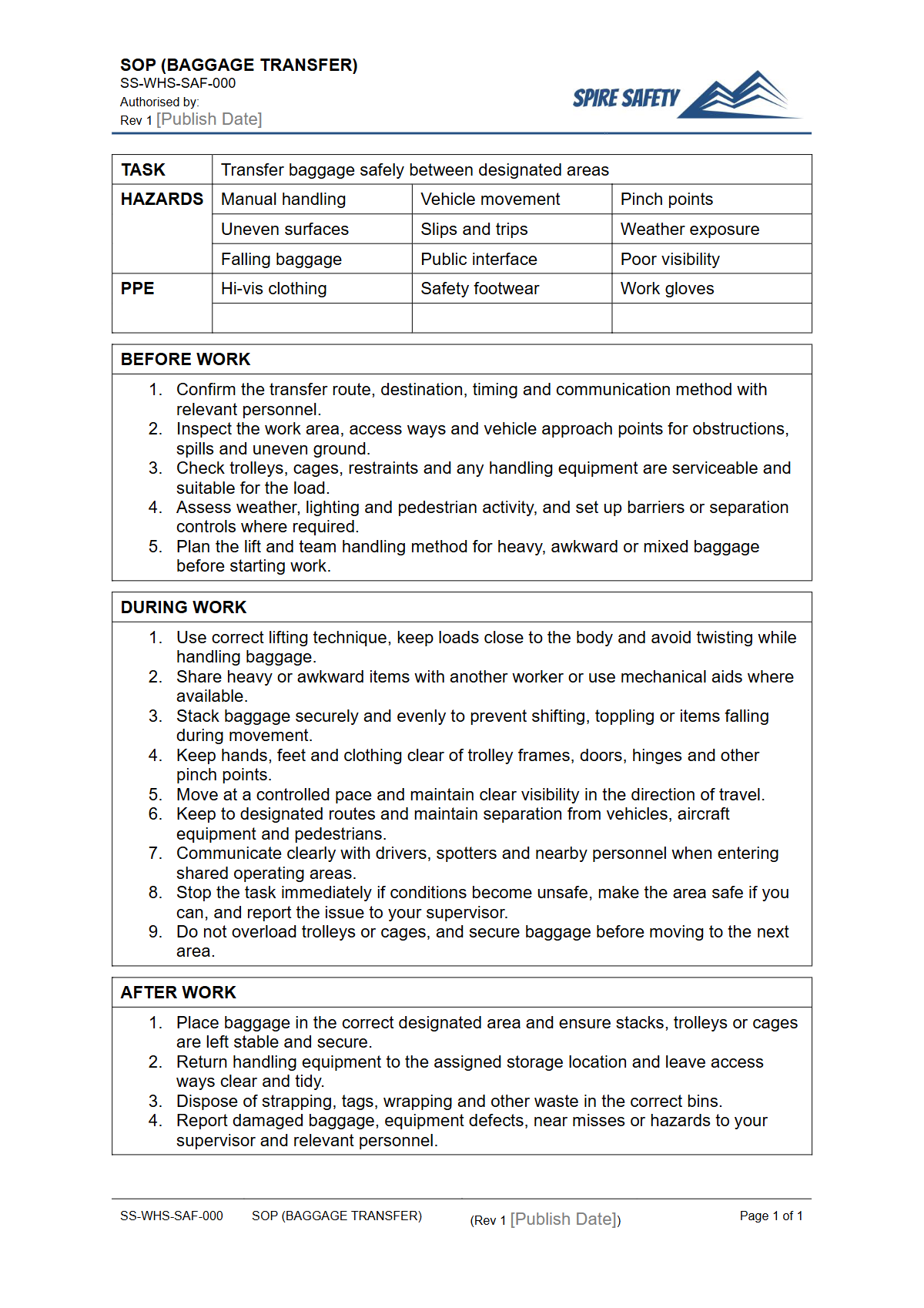
Baggage transfer operations, common in airports, transport hubs, and hotels, involve significant risks, including manual handling injuries, vehicle interactions, and crush hazards. This Free Safe Operating Procedure (Baggage Transfer) Template provides a structured starting point for documenting a safe system of work for these tasks.
Using a clear SOP helps your organisation meet its duty of care by identifying hazards, assessing risks, and implementing effective control measures. It standardises the procedure, ensuring all workers follow a consistent, safe method, which is a fundamental component of any robust safety framework.
Video walkthrough
How to use the Free Safe Operating Procedure (Baggage Transfer) Template
To effectively use this template, you must adapt it to the specific circumstances of your workplace. It is designed as a guide, not a finished document.
Successful implementation requires consultation with workers who perform the baggage transfer tasks, as their direct experience is invaluable for identifying practical hazards and controls. After downloading, follow these steps:
- Customise: Fill in the details specific to your site, including the exact equipment used (e.g., baggage tugs, conveyors, carts), workplace layout, and emergency contacts.
- Consult: Discuss the draft procedure with your team. Incorporate their feedback to ensure the SOP is practical and reflects how the work is actually done.
- Review and Approve: Have a competent person, such as a supervisor or WHS manager, review and formally approve the final SOP.
- Train: Ensure all relevant workers are trained on the contents of the new SOP and that they understand their responsibilities.
Important: This template provides a base structure aligned with Australian WHS practice. We are not WHS consultants, and to ensure your final document is fit for purpose, you must customise it for your specific machinery, operational needs, and risk profile.
Key Elements of a Baggage Transfer Safe Operating Procedure
A comprehensive baggage transfer SOP should cover several key areas to be effective. The template is structured to prompt you for this information, ensuring you address all critical safety aspects of the task.
Pre-Operational Checks
Before any work begins, equipment must be inspected. This includes checking vehicles like baggage tugs or carts for fuel/charge levels, brake function, lights, and audible warnings.
For tasks involving specific vehicles, a detailed procedure is essential; for example, our body truck SOP provides a detailed guide for pre-start inspections on that type of vehicle. Any faults identified must be reported and rectified before the equipment is used.
Step-by-Step Procedures
This is the core of the SOP. It should detail the entire baggage transfer process in a logical sequence, from picking up baggage to loading it onto aircraft or transport, and vice versa. It must include instructions on:
- Correct manual handling techniques (e.g., team lifting for heavy items).
- Safe operation of vehicles and equipment.
- Communication protocols between ground crew.
- Procedures for working near active aircraft or moving vehicles.
If the task requires working at height, even at low levels, a separate procedure may be required. For instance, you could adapt the principles from our step ladder SOP to address the risks of accessing raised platforms or sills.
Personal Protective Equipment (PPE)
The SOP must specify the mandatory PPE for the task. For baggage handlers, this typically includes high-visibility clothing, steel-capped safety boots, gloves, and, depending on the environment, hearing protection or safety glasses.
When to Use This Safe Operating Procedure
A baggage transfer SOP should be used consistently as a reference and training tool. It is not a document to be filed and forgotten. It should be actively used:
- During the induction and training of new workers.
- For refresher training sessions with existing staff.
- As a pre-start briefing tool before commencing a shift.
- When investigating an incident or near miss to identify procedural gaps.
Regular reviews and verification that the SOP is being followed are crucial for maintaining safety standards. These activities are often a key focus during internal and external WHS compliance audits.
Who Should Be Involved in Creating the SOP?
Developing a Safe Operating Procedure is a collaborative effort. It should involve the people who will be using it every day. Key personnel include:
- Workers & Health and Safety Representatives (HSRs): Those who perform the baggage transfer tasks. Their input is critical for ensuring the procedure is realistic and effective.
- Supervisors and Team Leaders: They are responsible for implementing the SOP and monitoring its use on a daily basis.
- WHS/OHS Professionals: They provide expertise on hazard identification, risk assessment, and control measures, ensuring the document aligns with legislative requirements and best practice.
By integrating this procedure into your overarching WHS management systems, you create a more resilient safety culture. For more guidance, browse our complete free WHS resources library or contact our team.
Common mistakes
Common mistakes to avoid
- Using the generic template without customising it for specific site equipment and layout.
- Failing to consult with workers who actually perform the baggage transfer tasks.
- Not providing adequate training on the finalised SOP and verifying understanding.
- Storing the SOP in a folder instead of using it as an active document for training and briefings.
Legal references
Legal considerations
The following legal requirements may be relevant to this type of work.
- Work Health and Safety Act (Harmonised) — Provides the primary duties for protecting workers and other people from work health and safety risks.
- Work Health and Safety Regulations (Harmonised) — Sets out requirements supporting the management of workplace hazards and risks.
The following codes may be relevant to this type of work.
- Managing WHS Risks Code of Practice — Provides practical guidance on identifying hazards, assessing risks and applying effective controls.
- Work Health and Safety Consultation, Cooperation and Coordination Code of Practice — Provides practical guidance on consulting workers and coordinating with other duty holders.
- Managing the Work Environment and Facilities Code of Practice — Provides practical guidance on safe work environments, workplace facilities and related controls.
Did you know
Manual Handling Risk
Musculoskeletal disorders, primarily from hazardous manual tasks, are the most common work-related injuries in the Australian transport and logistics industry, which includes airport ground operations.
Vehicle Interaction
A significant portion of serious incidents at airports involve collisions between ground support equipment (like baggage tugs) and people or other vehicles on the tarmac.
FAQ
Frequently asked questions
01What should be included in a baggage transfer SOP?
02Who is responsible for creating a baggage transfer SOP in a workplace?
03How often should a Safe Operating Procedure for baggage transfer be reviewed?
04Is a baggage transfer SOP a legal requirement in Australia?
Share this resource
Free Safe Operating Procedure (Baggage Transfer) Template
Browse Categories
How To Use It
- 1Download and open in Word or PDF.
- 2Replace the placeholders with your business details.
- 3Get it reviewed by a WHS specialist before rollout.
Need it customised?
Our WHS consultants can adapt this template to your site, run a gap analysis, or audit what you already have in place.
Book a Free Consultation WHS consulting servicesor call 1300 156 382
Related templates
- Free Safe Operating Procedure (Baggage Tug) Template
- Free Safe Operating Procedure (Bagging Machine) Template
- Free Safe Operating Procedure (Baghouse Cleaning) Template
- Free Safe Operating Procedure (Bain Marie) Template
- Free Safe Operating Procedure (Bakery Cooling Racks) Template
- Free Safe Operating Procedure (Bakery Rack Handling) Template