
Free Safe Operating Procedure (Baggage Tug) Template
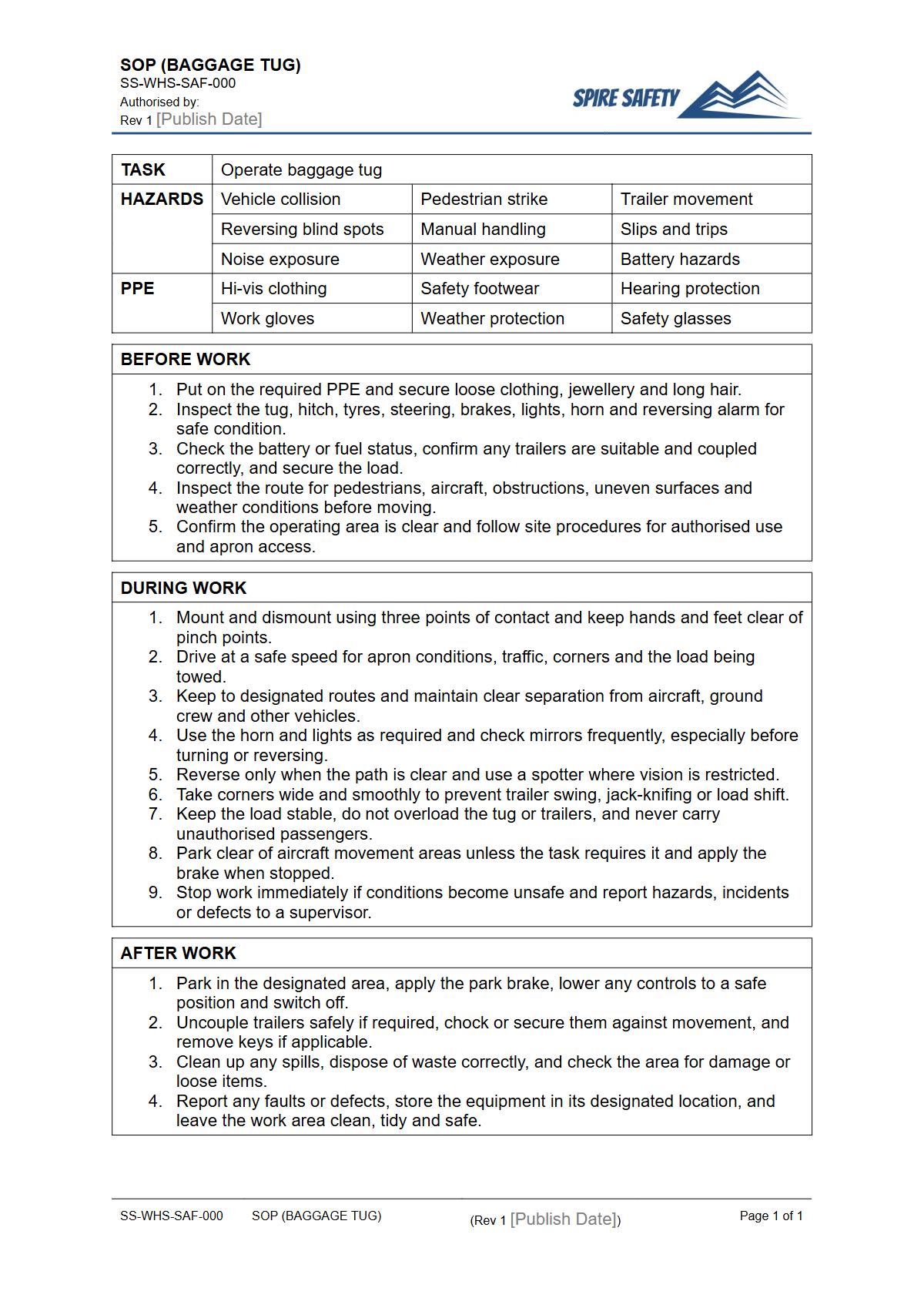
Download our free Safe Operating Procedure (Baggage Tug) template. This customisable DOCX & PDF helps manage risks in baggage tug operations.
Free Safe Operating Procedure (Baggage Tug) Template
DOCX • 126 KB + PDF
Updated Oct 2026
No signup required
Purpose of the Free Safe Operating Procedure (Baggage Tug) Template
Operating a baggage tug on an active airside or in a bustling logistics facility presents significant safety risks. This Free Safe Operating Procedure (Baggage Tug) Template provides a structured starting point for documenting the required safety measures to control these hazards.
A well-developed SOP is a critical administrative control that formalises the safest way to perform a task, helping to prevent incidents, injuries, and damage to aircraft and equipment.
Key hazards associated with baggage tug operations include collisions with aircraft, ground support equipment, and pedestrians; crush injuries during coupling and uncoupling of dollies; ergonomic strains from manual handling; and exposure to noise and fumes. This template guides you in outlining step-by-step instructions for pre-start checks, safe driving practices, and emergency responses, forming a vital part of your broader WHS management systems.
What is a Safe Operating Procedure?
A Safe Operating Procedure (SOP) is a written document that provides detailed, sequential instructions on how to safely perform a specific task or operate a piece of equipment. It is not just a training manual but a risk management tool that integrates hazard identification, risk assessment, and control measures into everyday work practices.
For tasks involving mobile plant like baggage tugs, an SOP is essential for ensuring all operators follow a consistent, safe, and efficient method of work.
Video walkthrough
How to use the Free Safe Operating Procedure (Baggage Tug) Template
Our template is available for immediate download in both DOCX and PDF formats. The DOCX file is fully editable, allowing you to tailor the content to your specific operational needs.
A comprehensive SOP is never a one-size-fits-all document; it must reflect the unique conditions of your workplace.
Please note: This is a template only. We have provided a structured starting point, but you must customise this document to reflect the specific baggage tug models, work environment, trolley types, and processes at your site. To effectively use this template, you should:
- Conduct a thorough, site-specific risk assessment for baggage tug operations.
- Consult with the workers who operate the tugs and their supervisors. Their practical experience is invaluable for identifying risks and developing workable controls.
- Incorporate make- and model-specific details for pre-start inspections, operating controls, and maintenance requirements.
- Define site-specific rules, including designated travel paths, speed limits, right-of-way protocols, and communication signals for your airfield or facility.
- Integrate your site's specific emergency procedures, including contacts for first aid, incident reporting, and equipment failure.
Documenting procedures for various types of mobile plant ensures consistency. For instance, the safety principles for operating a baggage tug share common ground with those in our free telehandler SOP template.
When to use a Safe Operating Procedure
An SOP for baggage tugs should be developed, implemented, and reviewed as a core part of your safety framework. It is a living document used consistently, not just filed away. Key times to use and refer to the SOP include:
- During the induction and training of new ground staff and operators.
- As a prerequisite for competency assessments and authorisations to operate.
- For regular refresher training to reinforce safe behaviours.
- As a key reference document during WHS compliance auditing and inspections.
- Following any incident, near miss, or reported hazard involving a baggage tug, triggering a review of the SOP's effectiveness.
- When new baggage tug models, trolley systems, or significant changes to the operating environment are introduced.
Who should use this SOP template
Creating and maintaining a safe workplace is a shared responsibility. Various personnel within an organisation should use or be involved in the development of this SOP:
- PCBU (Person Conducting a Business or Undertaking): To ensure they are meeting their primary duty of care to provide safe systems of work.
- WHS Managers and Safety Professionals: For drafting, formalising, and integrating the SOP into the organisation's overall safety management system.
- Supervisors and Ground Operations Managers: For training their teams, enforcing the procedure, and providing feedback for its improvement. Similar processes are often needed for other vehicles, as outlined in resources like our free Body Truck SOP template.
- Baggage Tug Operators: As the end-users, their active participation and consultation in the SOP's development is critical to ensure it is practical, accurate, and effective.
By involving all relevant parties, the organisation can create a robust procedure that is understood, respected, and followed. You can explore a wide range of similar documents in our free WHS resources library to support your other operational needs.
Common mistakes
Common mistakes to avoid
- Using a generic template without customising it for the specific site, equipment, and tasks.
- Failing to consult with the baggage tug operators during the development and review of the SOP.
- Neglecting to include specific procedures for coupling/uncoupling dollies, a common source of crush injuries.
- Treating the SOP as a document for compliance only, rather than an active tool for training and supervision.
Legal references
Legal considerations
The following legal requirements may be relevant to this type of work.
- Work Health and Safety Act (Harmonised) — Provides the primary duties for protecting workers and other people from work health and safety risks.
- Work Health and Safety Regulations (Harmonised) — Sets out requirements supporting the management of workplace hazards and risks.
The following codes may be relevant to this type of work.
- Managing WHS Risks Code of Practice — Provides practical guidance on identifying hazards, assessing risks and applying effective controls.
- Work Health and Safety Consultation, Cooperation and Coordination Code of Practice — Provides practical guidance on consulting workers and coordinating with other duty holders.
- Managing the Work Environment and Facilities Code of Practice — Provides practical guidance on safe work environments, workplace facilities and related controls.
Did you know
Turnaround Pressure
The intense pressure to maintain tight airline turnaround times is a significant contributing factor to ground handling incidents, often leading to procedural shortcuts and increased risk.
Musculoskeletal Risk
Musculoskeletal disorders are a primary cause of injury for ground handlers. While the tug itself is motorised, the associated tasks of connecting dollies and manual baggage handling create significant ergonomic risks.
FAQ
Frequently asked questions
01What key sections should be included in a baggage tug SOP?
02Is a Safe Operating Procedure legally required for baggage tugs in Australia?
03How often should we review our baggage tug SOP?
04Can a generic SOP be used for all types of baggage tugs?
Share this resource
Free Safe Operating Procedure (Baggage Tug) Template
Browse Categories
How To Use It
- 1Download and open in Word or PDF.
- 2Replace the placeholders with your business details.
- 3Get it reviewed by a WHS specialist before rollout.
Need it customised?
Our WHS consultants can adapt this template to your site, run a gap analysis, or audit what you already have in place.
Book a Free Consultation WHS consulting servicesor call 1300 156 382
Related templates
- Free Safe Operating Procedure (Bagging Machine) Template
- Free Safe Operating Procedure (Baghouse Cleaning) Template
- Free Safe Operating Procedure (Bain Marie) Template
- Free Safe Operating Procedure (Bakery Cooling Racks) Template
- Free Safe Operating Procedure (Bakery Rack Handling) Template
- Free Safe Operating Procedure (Bakery Tray Handling) Template