
Free Safe Operating Procedure (Bagging Machine) Template
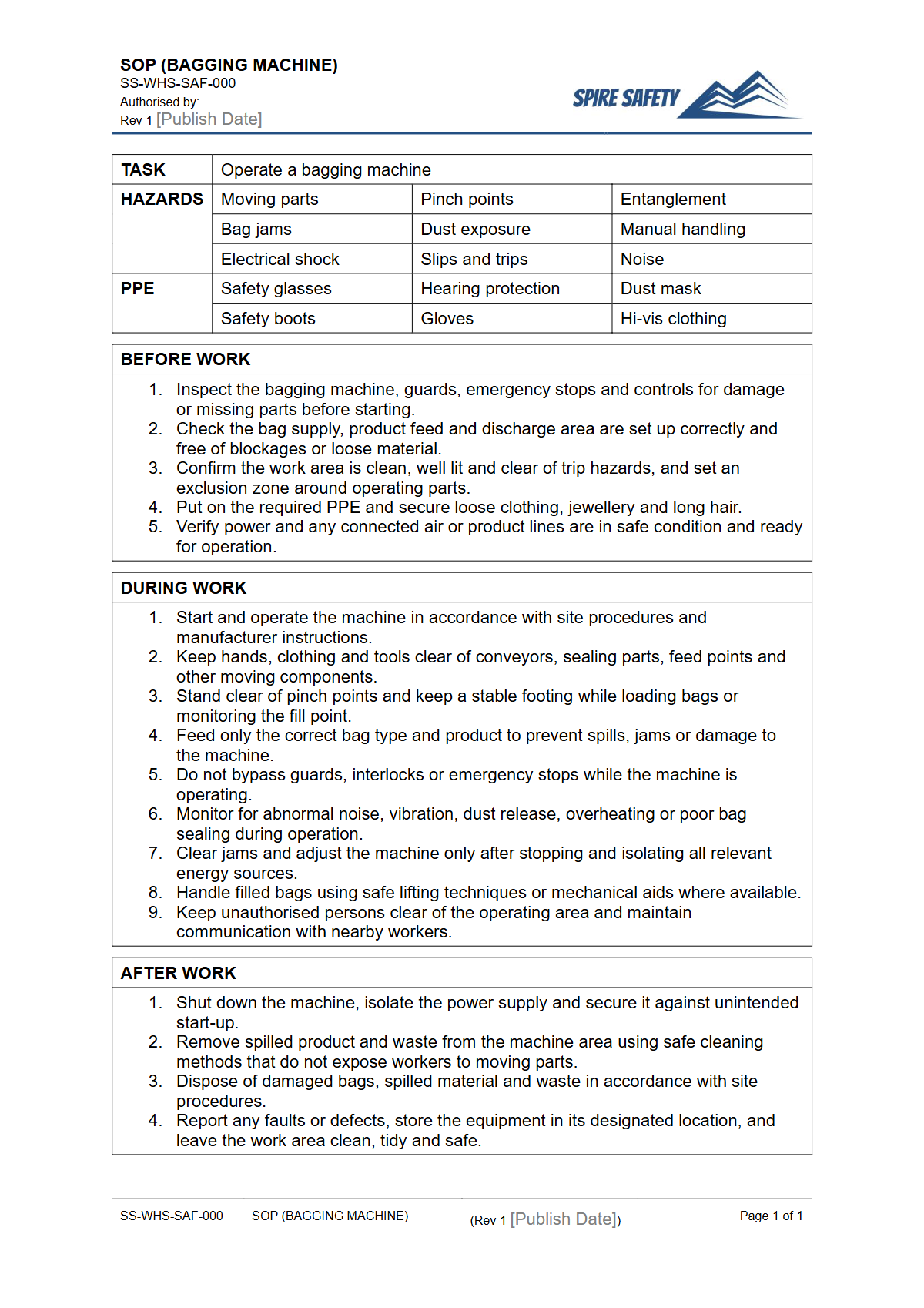
Download our free Safe Operating Procedure (Bagging Machine) template. This customisable DOCX and PDF resource helps outline safe work practices.
Free Safe Operating Procedure (Bagging Machine) Template
DOCX • 126 KB + PDF
Updated Oct 2026
No signup required
Purpose of the Free Safe Operating Procedure (Bagging Machine) Template
Operating any form of industrial machinery, including bagging machines, introduces significant workplace hazards. This Free Safe Operating Procedure (Bagging Machine) Template provides a structured starting point for documenting the safest method to perform this task.
A well-developed Safe Operating Procedure (SOP) is a critical administrative control used to manage risks like entanglement in moving parts, crushing injuries, ergonomic strains from manual handling, and exposure to dust. By clearly defining the required steps, safety checks, and personal protective equipment (PPE), an SOP helps ensure tasks are performed consistently and safely every time. It forms a vital component of your overall safety framework, demonstrating a commitment to proactive risk management and supporting the development of robust WHS management systems.
Video walkthrough
How to use the Free Safe Operating Procedure (Bagging Machine) Template
This template is provided in both DOCX and PDF formats for your convenience. After downloading, open the DOCX file and begin populating the fields with information specific to your workplace.
This includes adding your company name, the specific make and model of the bagging machine, its location, and the date of review. The document is intentionally designed to be a foundation; you must adapt it to reflect your unique operational context and the specific hazards of your equipment.
Note: This document must be customised to your workplace. We are not familiar with your specific machinery, operational environment, or personnel competency. As such, you are responsible for ensuring the final document is accurate, comprehensive, and suitable for your site-specific risks.
Work through each section, detailing the required PPE (e.g., safety glasses, gloves, respiratory protection), pre-operational safety checks, step-by-step operating instructions, and shutdown procedures. Involving experienced operators in this process is crucial to ensure the SOP is practical and reflects how the work is actually done.
This same process can be applied to other plant, such as by using our Free Air Compressor SOP (Safe Operating Procedure) Template for associated equipment.
When to use a Safe Operating Procedure
An SOP for a bagging machine is not a document to be filed away and forgotten. It is a practical tool used in day-to-day operations. Its primary uses include:
- Training and Induction: Forming the basis of training for new operators and a reference for refresher training.
- Pre-Task Planning: Reviewing the SOP before starting work helps reinforce safe practices.
- Supervision and Monitoring: Supervisors can use the SOP as a benchmark to assess correct and safe operator behaviour.
- Incident Investigation: If an incident occurs, the SOP provides a baseline to understand if procedures were followed and whether they need to be updated.
- Audits and Reviews: The document serves as evidence of your risk management processes during internal or external safety reviews, such as a formal WHS compliance auditing program.
Who should use it
A range of personnel within an organisation will use or refer to the bagging machine SOP. This includes:
- Machine Operators: The primary users who must be thoroughly trained on and follow the procedure.
- Supervisors and Team Leaders: Responsible for ensuring operators are competent and adhere to the SOP.
- Maintenance Staff: While they may have separate SOPs for maintenance tasks, they need to understand the operational procedure for safe handover and lockout/tagout processes. Some maintenance may involve working at height, requiring procedures detailed in a FREE Step Ladder SOP Template.
- WHS Managers and Advisors: Responsible for developing, reviewing, and managing the library of SOPs as part of the wider safety system.
- Trainers and Assessors: Use the SOP as a key training resource to ensure competency.
By defining and documenting a standardised process, you help create a safer, more predictable work environment for everyone. Developing clear procedures for all high-risk machinery, such as with a Free Brake Press SOP Template, is a cornerstone of good WHS practice. For more templates and guidance, explore our complete free WHS resources library.
Common mistakes
Common mistakes to avoid
- Using a generic SOP without customising it for the specific machine model and workplace.
- Failing to involve experienced operators in the drafting and review process.
- Treating the SOP as a 'set and forget' document instead of a living document that requires regular updates.
- Not providing practical training on the SOP, assuming workers will just read and understand it.
Legal references
Legal considerations
The following legal requirements may be relevant to this type of work.
- Work Health and Safety Act (Harmonised) — Provides the primary duties for protecting workers and other people from work health and safety risks.
- Work Health and Safety Regulations (Harmonised) — Sets out requirements supporting the management of workplace hazards and risks.
The following codes may be relevant to this type of work.
- Managing WHS Risks Code of Practice — Provides practical guidance on identifying hazards, assessing risks and applying effective controls.
- Work Health and Safety Consultation, Cooperation and Coordination Code of Practice — Provides practical guidance on consulting workers and coordinating with other duty holders.
- Managing the Work Environment and Facilities Code of Practice — Provides practical guidance on safe work environments, workplace facilities and related controls.
Did you know
Hierarchy of Control
SOPs are an 'administrative control', the fourth level in the hierarchy of control. They are essential for guiding safe behaviour but should always be used to support higher-level controls like engineering (e.g., machine guarding).
Dust Hazards
Many products handled by bagging machines can create combustible or respirable dust. A thorough risk assessment should consider the potential for dust explosions and the long-term health effects on workers from inhalation.
FAQ
Frequently asked questions
01What should be included in a Safe Operating Procedure for a bagging machine?
02How often should a bagging machine SOP be reviewed?
03Is a Safe Operating Procedure a legal requirement in Australia?
04Who is responsible for writing a bagging machine SOP?
Share this resource
Free Safe Operating Procedure (Bagging Machine) Template
Browse Categories
How To Use It
- 1Download and open in Word or PDF.
- 2Replace the placeholders with your business details.
- 3Get it reviewed by a WHS specialist before rollout.
Need it customised?
Our WHS consultants can adapt this template to your site, run a gap analysis, or audit what you already have in place.
Book a Free Consultation WHS consulting servicesor call 1300 156 382
Related templates
- Free Safe Operating Procedure (Baghouse Cleaning) Template
- Free Safe Operating Procedure (Bain Marie) Template
- Free Safe Operating Procedure (Bakery Cooling Racks) Template
- Free Safe Operating Procedure (Bakery Rack Handling) Template
- Free Safe Operating Procedure (Bakery Tray Handling) Template
- Free Safe Operating Procedure (Balcony Drain Clearing) Template