
Free Safe Operating Procedure (Baghouse Cleaning) Template
Download our free Safe Operating Procedure (Baghouse Cleaning) template.
Free Safe Operating Procedure (Baghouse Cleaning) Template
DOCX • 126 KB + PDF
Updated Oct 2026
No signup required
Purpose of the Free Safe Operating Procedure (Baghouse Cleaning) Template
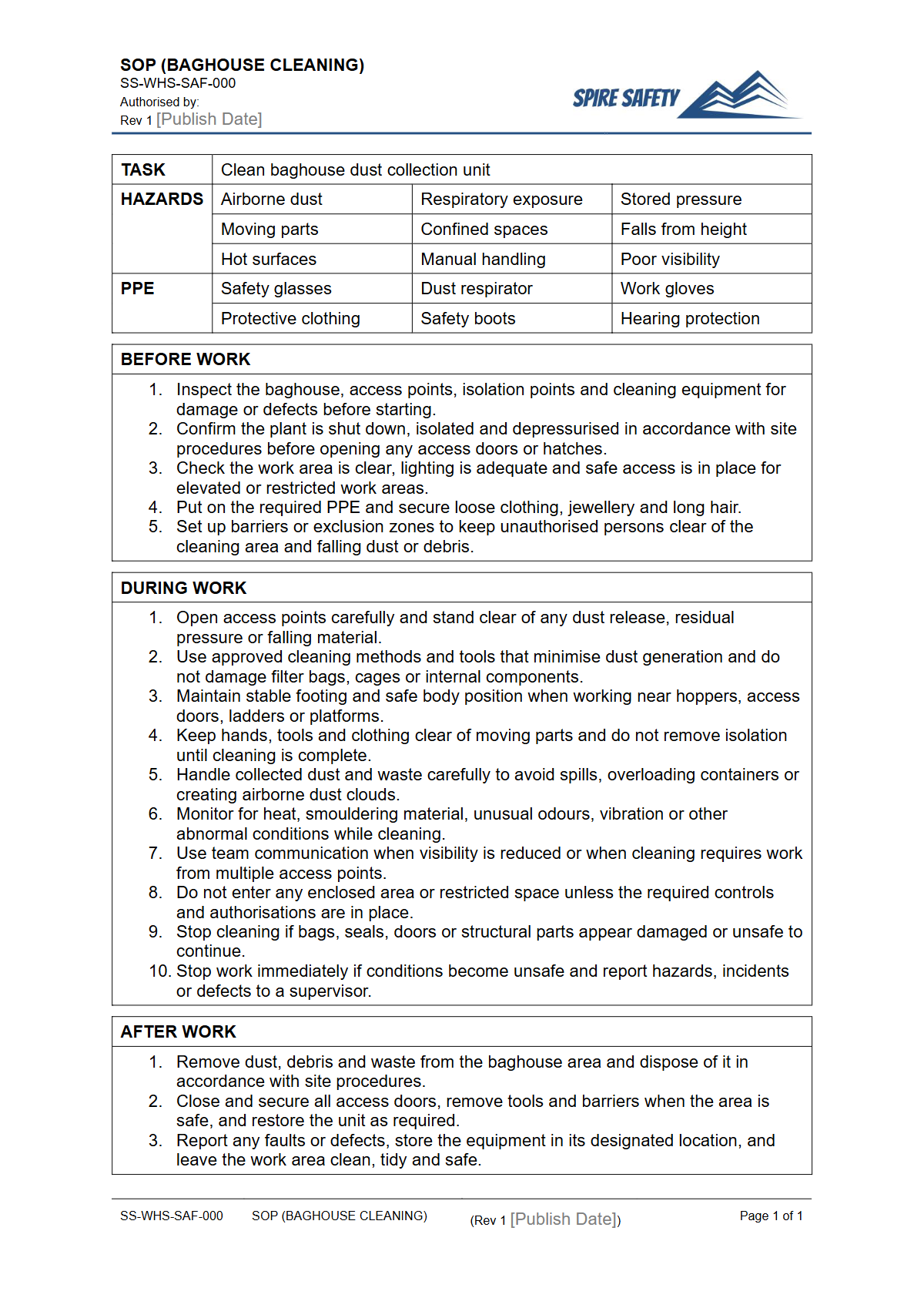
This Free Safe Operating Procedure (Baghouse Cleaning) Template provides a structured framework for documenting the safety requirements for cleaning industrial dust collection systems. Baghouse cleaning is a high-risk activity involving potential exposure to hazardous dusts, confined spaces, and interaction with energised plant.
A documented SOP ensures that a consistent, safe method is established, communicated, and followed by all personnel involved.
Using a standardised procedure helps your organisation meet its duties under WHS legislation by managing specific risks associated with the task. It forms a critical part of your risk management documentation and can be integrated into broader comprehensive WHS management systems. This template helps you clearly define required PPE, pre-operational checks, step-by-step cleaning instructions, and emergency procedures to protect your workers.
Video walkthrough
How to use the Free Safe Operating Procedure (Baghouse Cleaning) Template
To use this Safe Operating Procedure for baghouse cleaning, download the DOCX file and adapt it to the specific machinery, dust types, and environmental conditions at your site. The document is a starting point and must be customised to reflect your unique operational risks.
When customising the SOP, it is essential to conduct a site-specific risk assessment. This involves identifying all potential hazards, such as combustible dust, chemical exposure, electrical energy, and working at heights.
The control measures you identify in the risk assessment should be directly incorporated into the steps of the SOP.
Important: We have created this template as a guide. You must consult with your workers and other relevant stakeholders during its development to ensure it is practical and effective.
A generic procedure that has not been tailored to your workplace will not be effective in managing risks. The final, customised SOP should be reviewed and approved by a competent person before being implemented, and it should be a key document reviewed during any future WHS compliance audits.
Key Sections in the Template
The template is organised to guide you through the essential components of a robust SOP, including:
- Required Personal Protective Equipment (PPE)
- Hazard Identification and Risk Control
- Pre-operational Safety Checks (e.g., lockout-tagout)
- Step-by-step procedure for cleaning
- Post-cleaning Checks and Waste Disposal
- Emergency Response Procedures
When to use it
A Safe Operating Procedure for baghouse cleaning should be used every time the task is performed. It serves as a practical checklist for experienced operators and is an essential training tool for new or less experienced workers.
It should be readily available at or near the location of the equipment.
It's particularly important to review the SOP before scheduled major clean-downs, after any incident or near-miss, or when changes are made to the equipment or the type of dust being collected. This ensures the procedure remains current and effective.
It should be used alongside other relevant SOPs for associated plant, such as the Safe Operating Procedure for air compressors which often supply the pulse-jet cleaning systems.
Who should use it
This SOP should be used by several groups within an organisation:
- Workers/Operators: The primary users who perform the baghouse cleaning task. They must be trained on the SOP and follow it step-by-step.
- Supervisors and Managers: Responsible for ensuring workers are trained, competent, and adhere to the established procedure. They also use it for workplace inspections and incident investigations.
- WHS/HSE Professionals: Use the SOP as part of the overall safety management system, for risk assessments, and during safety audits.
Developing task-specific procedures is a fundamental safety practice, just like it is for operating other industrial equipment covered by our plasma cutter SOP.
Managing Specific Hazards
When customising your SOP, pay special attention to the hierarchy of controls. For instance, for dust inhalation, engineering controls like local exhaust ventilation during bag removal are superior to relying solely on PPE.
For electrical hazards, robust lockout-tagout procedures are non-negotiable. If access involves working from a height, your procedure must detail requirements for fall prevention, which may require a specific step ladder SOP or instructions for using elevated work platforms. For more documentation to support your safety systems, you can browse our complete free WHS resources library.
Common mistakes
Common mistakes to avoid
- Forgetting to isolate all energy sources (lockout-tagout) before starting work.
- Using incorrect personal protective equipment (PPE), especially inadequate respiratory protection for the specific dust type.
- Failing to conduct a risk assessment for combustible dust properties, leading to fire or explosion hazards.
- Not training workers on the specific, customised SOP before they perform the cleaning task.
Legal references
Legal considerations
The following legal requirements may be relevant to this type of work.
- Work Health and Safety Act (Harmonised) — Provides the primary duties for protecting workers and other people from work health and safety risks.
- Work Health and Safety Regulations (Harmonised) — Sets out requirements supporting the management of workplace hazards and risks.
The following codes may be relevant to this type of work.
- Managing WHS Risks Code of Practice — Provides practical guidance on identifying hazards, assessing risks and applying effective controls.
- Work Health and Safety Consultation, Cooperation and Coordination Code of Practice — Provides practical guidance on consulting workers and coordinating with other duty holders.
- Managing the Work Environment and Facilities Code of Practice — Provides practical guidance on safe work environments, workplace facilities and related controls.
Did you know
Dust Dangers
In Australia, approximately 6.5% of workers are exposed to respirable crystalline silica in the workplace, a common hazard in industries using baghouse filters like mining and manufacturing.
Pulse-Jet Cleaning
Many modern baghouses use a 'pulse-jet' method to clean the filter bags, where a high-pressure blast of compressed air dislodges the collected dust cake, causing it to fall into a hopper for collection.
FAQ
Frequently asked questions
01What is a baghouse and why is cleaning it hazardous?
02Does this SOP template cover combustible dust risks?
03Who is considered a 'competent person' to approve an SOP?
04How often should a Safe Operating Procedure be reviewed?
Share this resource
Free Safe Operating Procedure (Baghouse Cleaning) Template
Browse Categories
How To Use It
- 1Download and open in Word or PDF.
- 2Replace the placeholders with your business details.
- 3Get it reviewed by a WHS specialist before rollout.
Need it customised?
Our WHS consultants can adapt this template to your site, run a gap analysis, or audit what you already have in place.
Book a Free Consultation WHS consulting servicesor call 1300 156 382
Related templates
- Free Safe Operating Procedure (Bain Marie) Template
- Free Safe Operating Procedure (Bakery Cooling Racks) Template
- Free Safe Operating Procedure (Bakery Rack Handling) Template
- Free Safe Operating Procedure (Bakery Tray Handling) Template
- Free Safe Operating Procedure (Balcony Drain Clearing) Template
- Free Safe Operating Procedure (Bale Breaker) Template