
Free Safe Operating Procedure (Bakery Rack Handling) Template
Download our free Safe Operating Procedure for Bakery Rack Handling. This customisable template helps you manage manual handling risks in your workplace.
Free Safe Operating Procedure (Bakery Rack Handling) Template
DOCX • 126 KB + PDF
Updated Oct 2026
No signup required
Purpose of the Free Safe Operating Procedure (Bakery Rack Handling) Template
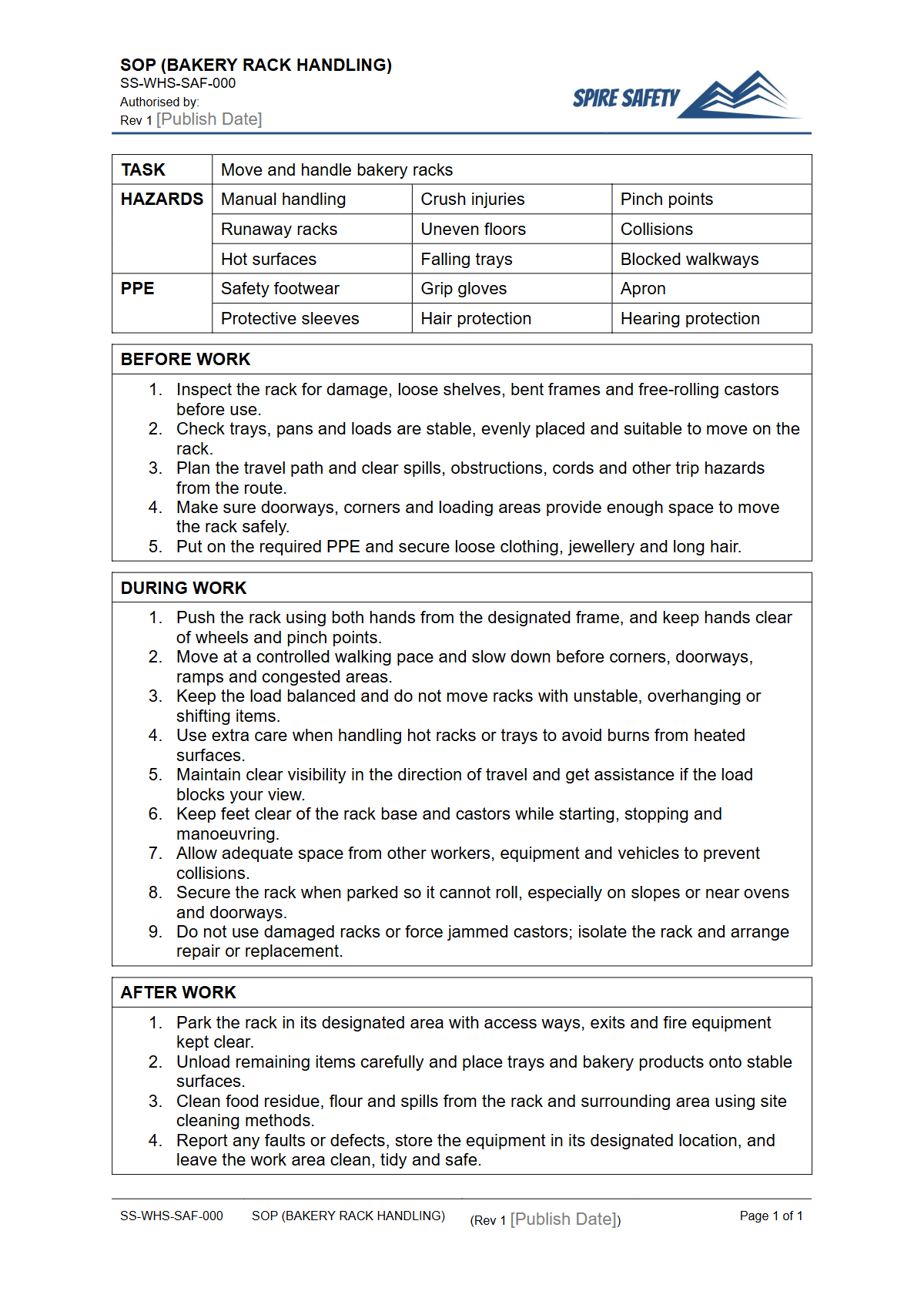
This Free Safe Operating Procedure (Bakery Rack Handling) Template provides a structured framework for outlining the hazards and control measures associated with moving bakery racks. Handling these racks, which are often heavy, tall, and awkward, presents significant risks of musculoskeletal injuries, including sprains and strains.
Implementing a documented SOP is a critical step in managing these hazardous manual tasks, ensuring workers follow a consistent, safe method for pushing, pulling, and positioning racks. A clear procedure helps to minimise the risk of injury from overexertion, awkward postures, and collisions.
This document is designed to be a core part of your broader WHS management system, demonstrating a commitment to proactive risk management.
What this Safe Operating Procedure covers:
- Essential pre-operational checks for bakery racks, including wheel and frame integrity.
- Step-by-step instructions for safely moving single and multiple racks.
- Control measures for common hazards like uneven floors, ramps, and congested areas.
- Personal Protective Equipment (PPE) requirements, such as non-slip footwear.
- Emergency procedures and maintenance protocols.
Video walkthrough
How to use the Free Safe Operating Procedure (Bakery Rack Handling) Template
Our template is provided in both DOCX and PDF formats for easy integration into your existing safety documentation. To effectively use this resource, you must tailor it to your specific operational context.
This involves conducting a risk assessment of your bakery or food production environment to identify unique hazards related to your equipment, layout, and workflow. Consult with your workers—the people who handle the racks daily—to ensure the procedure is practical and addresses the real-world challenges they face.
Their input is invaluable for creating a procedure that is both effective and likely to be followed.
Important: This is a template, not a finished document. We have developed it as a starting point, and it must be customised to accurately reflect your workplace's specific machinery, tasks, risks, and control measures.
Always ensure the final document is reviewed and approved by a competent person before implementation.
When to use a Bakery Rack Handling SOP
A Safe Operating Procedure for handling bakery racks should be used as a primary training and operational document. It is essential during the induction of new employees to establish safe work habits from day one.
It should also be a key reference for refresher training, especially if an incident or near-miss occurs. Furthermore, this SOP should be readily accessible in the work area for quick reference.
The procedure forms the basis for workplace inspections and observations, allowing supervisors to verify that safe practices, similar to those for other common tasks like using ladders, are consistently applied. For example, our FREE Step Ladder SOP Template details similar systematic checks.
Who should use this SOP
This Safe Operating Procedure is intended for all personnel involved in handling bakery racks. This includes bakers, kitchen hands, production staff, and cleaning crews.
Supervisors and managers are responsible for ensuring the SOP is implemented, understood, and followed by their teams. WHS advisors and safety officers will use this document to support their risk assessments, training programs, and safety audits.
The effectiveness of the controls outlined in this procedure can be verified through processes like WHS compliance auditing to ensure they remain effective over time.
Integrating this procedure with other task-specific SOPs ensures a comprehensive approach to safety across all operations. For businesses with integrated logistics, this might include procedures for tasks like loading a body truck with finished goods.
If this template isn't quite what you need, you can explore our complete free WHS resources library for other useful documents.
Common mistakes
Common mistakes to avoid
- Failing to customise the template to reflect the specific layout and rack types of the bakery.
- Not inspecting rack castors (wheels) for damage, debris, or stiffness before use.
- Overloading racks beyond their safe weight capacity, making them difficult and dangerous to move.
- Neglecting to train workers on the specific procedures outlined in the SOP.
Legal references
Legal considerations
The following legal requirements may be relevant to this type of work.
- Work Health and Safety Act (Harmonised) — Provides the primary duties for protecting workers and other people from work health and safety risks.
- Work Health and Safety Regulations (Harmonised) — Sets out requirements supporting the management of workplace hazards and risks.
The following codes may be relevant to this type of work.
- Managing WHS Risks Code of Practice — Provides practical guidance on identifying hazards, assessing risks and applying effective controls.
- Work Health and Safety Consultation, Cooperation and Coordination Code of Practice — Provides practical guidance on consulting workers and coordinating with other duty holders.
- Managing the Work Environment and Facilities Code of Practice — Provides practical guidance on safe work environments, workplace facilities and related controls.
Did you know
Manual Tasks are a Major Issue
According to Safe Work Australia, hazardous manual tasks are the leading cause of work-related injuries in Australia, with musculoskeletal disorders making up a significant portion of all serious workers' compensation claims.
FAQ
Frequently asked questions
01What is a Safe Operating Procedure for bakery racks?
02Why are bakery racks a WHS hazard?
03Who is responsible for creating and implementing this SOP?
04How often should our Bakery Rack Handling SOP be reviewed?
Share this resource
Free Safe Operating Procedure (Bakery Rack Handling) Template
Browse Categories
How To Use It
- 1Download and open in Word or PDF.
- 2Replace the placeholders with your business details.
- 3Get it reviewed by a WHS specialist before rollout.
Need it customised?
Our WHS consultants can adapt this template to your site, run a gap analysis, or audit what you already have in place.
Book a Free Consultation WHS consulting servicesor call 1300 156 382
Related templates
- Free Safe Operating Procedure (Bakery Tray Handling) Template
- Free Safe Operating Procedure (Balcony Drain Clearing) Template
- Free Safe Operating Procedure (Bale Breaker) Template
- Free Safe Operating Procedure (Bale Twine Removal) Template
- Free Safe Operating Procedure (Ball Court Cleaning) Template
- Free Safe Operating Procedure (Ball Joint Removal) Template