
Free Safe Operating Procedure (Ball Joint Removal) Template
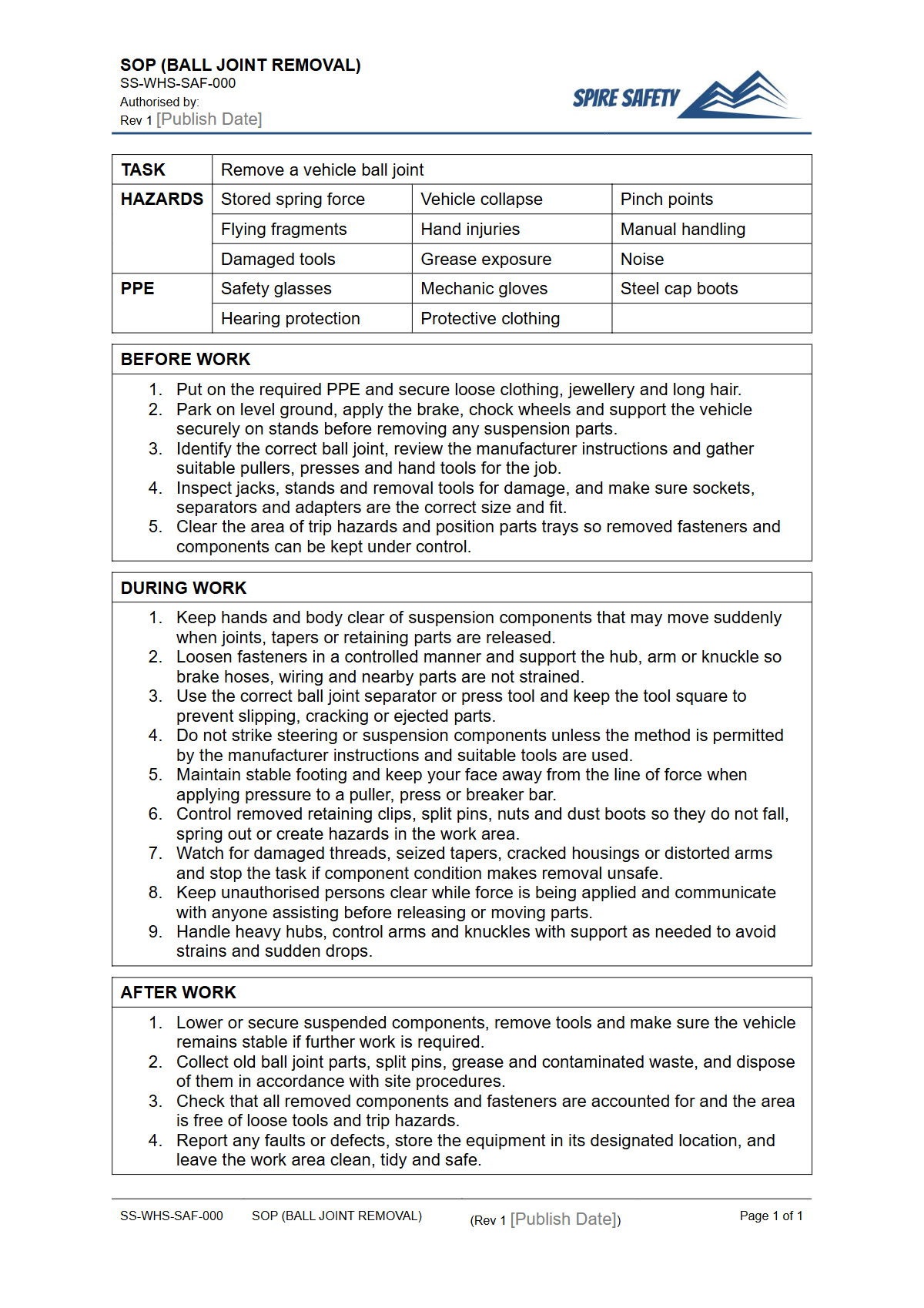
Need a Safe Operating Procedure for ball joint removal? Our free template provides a structured starting point for your workshop's safety documents.
Free Safe Operating Procedure (Ball Joint Removal) Template
DOCX • 126 KB + PDF
Updated Oct 2026
No signup required
Purpose of the Free Safe Operating Procedure (Ball Joint Removal) Template
Automotive workshops are dynamic environments filled with complex tasks. Removing and replacing ball joints is a common procedure, but one that carries significant risks if not performed correctly.
This Free Safe Operating Procedure (Ball Joint Removal) Template provides a structured framework for documenting the required steps, safety controls, and personal protective equipment (PPE) for this task. By establishing a clear, repeatable process, you can minimise the risk of musculoskeletal injuries, impact injuries from tool failure, or incidents related to uncontrolled release of stored energy from suspension components.
Formalising your process helps ensure every technician, from seasoned mechanics to apprentices, follows a consistent and safe method of work.
A well-defined SOP is a fundamental tool for managing workplace hazards. It serves as a key training document and a reference point for safe work practices.
Using this template helps your organisation meet its duty of care under Australian WHS legislation by implementing a formal safe system of work. It can be used alongside procedures for related equipment, such as our free Air Compressor SOP, to build a comprehensive safety system for your workshop.
Video walkthrough
How to use the Free Safe Operating Procedure (Ball Joint Removal) Template
This resource is available as a DOCX file for easy customisation and a PDF for straightforward printing and distribution. It is crucial to adapt this template to the specific context of your workplace.
Your procedures will vary based on the types of vehicles you service and the specific tools you use, such as hydraulic presses, C-frame separators, or pickle forks.
Important: This is a template, not a finished document. We have provided a structured starting point, but you must review, edit, and add site-specific details to ensure it accurately reflects your operational risks and control measures.
This includes listing the exact make and model of your equipment, specifying your workshop's emergency procedures, and referencing relevant vehicle manufacturer guidelines.
Key Sections to Customise
- Hazard Identification: Review the pre-filled hazards and add any others unique to your environment. Consider factors like workshop layout, lighting, and ventilation.
- Personal Protective Equipment (PPE): Adjust the PPE list to match your workshop's policy. Always mandate high-impact safety glasses or goggles for this task.
- Step-by-Step Procedure: This is the most critical section. Rewrite the steps to detail your specific process, from raising and securing the vehicle to pressing out the old joint and installing the new one. Include torque specifications where applicable.
- Emergency Procedures: Detail your workshop's first aid and emergency response protocols for injuries like crushing, fractures, or eye injuries.
Integrating customised SOPs like this one is a core part of developing a complete WHS management system that actively protects your team and demonstrates due diligence.
When to use a Safe Operating Procedure
An SOP for ball joint removal should be used consistently as the primary reference for the task. It is particularly important in several key situations:
- Training and Induction: Use the SOP to train new technicians or apprentices, ensuring they learn the correct, safe method from the start.
- Pre-Task Planning: Workers should review the SOP before beginning the job, especially if it is a task they do not perform frequently.
- Refresher Training: Periodically review the SOP with all relevant staff to reinforce safe practices and communicate any updates to the procedure.
- Incident Investigation: If an incident or near-miss occurs, the SOP should be reviewed as part of the investigation to determine if the procedure was followed and if it needs improvement.
Documented procedures are a key piece of evidence examined during WHS compliance audits, demonstrating that your business has systematic processes for managing high-risk tasks.
Who should use it
This SOP should be used by all personnel involved in vehicle suspension maintenance. This typically includes:
- Qualified Automotive Technicians/Mechanics: As the primary users, they will follow the procedure to perform the work safely.
- Apprentices: Must use the SOP under the direct supervision of a qualified technician. The document provides a critical learning tool that structures their approach.
- Workshop Supervisors and Managers: Responsible for ensuring the SOP is implemented, understood, and followed by all relevant staff. They also lead the review and update process.
Competency is key. Only individuals trained and assessed as competent in the task and the associated risks should perform ball joint removals.
For particularly stubborn or rusted components that may require cutting, additional procedures and risk assessments are necessary, which can be documented in a complementary document like a Plasma Cutter SOP template. If you require assistance in developing or customising complex procedures, consider seeking specialist WHS consulting to ensure all risks are adequately addressed. For more templates and guides, browse our complete free WHS resources library.
Common mistakes
Common mistakes to avoid
- Using an incorrect tool, such as a hammer ('pickle fork') instead of a proper ball joint press, increasing the risk of damage and sudden component release.
- Failing to adequately support the weight of the control arm and hub assembly before separating the joint.
- Neglecting to wear appropriate PPE, particularly high-impact safety glasses, to protect from metal shards or tool failure.
- Working on a vehicle that is not securely supported on correctly rated and positioned vehicle stands.
Legal references
Legal considerations
The following legal requirements may be relevant to this type of work.
- Work Health and Safety Act (Harmonised) — Provides the primary duties for protecting workers and other people from work health and safety risks.
- Work Health and Safety Regulations (Harmonised) — Sets out requirements supporting the management of workplace hazards and risks.
The following codes may be relevant to this type of work.
- Managing WHS Risks Code of Practice — Provides practical guidance on identifying hazards, assessing risks and applying effective controls.
- Work Health and Safety Consultation, Cooperation and Coordination Code of Practice — Provides practical guidance on consulting workers and coordinating with other duty holders.
- Managing the Work Environment and Facilities Code of Practice — Provides practical guidance on safe work environments, workplace facilities and related controls.
Did you know
Stored Energy
Vehicle suspension springs can store immense energy. An uncontrolled release during ball joint removal, if the control arm is not properly supported, is a primary cause of serious crushing and impact injuries in workshops.
Taper Fit
Many ball joints use a tapered stud that locks into the steering knuckle. This design creates a strong mechanical friction fit that often requires specialised separator tools to break loose safely and without damaging components.
FAQ
Frequently asked questions
01What are the biggest hazards when removing a ball joint?
02Does this SOP cover both press-in and bolt-in ball joints?
03Why is a Safe Operating Procedure needed for a common task like ball joint removal?
04Can I use this template for heavy vehicle ball joint replacement?
Share this resource
Free Safe Operating Procedure (Ball Joint Removal) Template
Browse Categories
How To Use It
- 1Download and open in Word or PDF.
- 2Replace the placeholders with your business details.
- 3Get it reviewed by a WHS specialist before rollout.
Need it customised?
Our WHS consultants can adapt this template to your site, run a gap analysis, or audit what you already have in place.
Book a Free Consultation WHS consulting servicesor call 1300 156 382
Related templates
- Free Safe Operating Procedure (Balustrade Cleaning) Template
- Free Safe Operating Procedure (Bandsaw - Meat Processing) Template
- Free Safe Operating Procedure (Banknote Counter) Template
- Free Safe Operating Procedure (Banquet Chair Handling) Template
- Free Safe Operating Procedure (Banquet Trolley Use) Template
- Free Safe Operating Procedure (Bar Glass Handling) Template