
Free Safe Operating Procedure (Banknote Counter) Template
Download our free Safe Operating Procedure (Banknote Counter) template.
Free Safe Operating Procedure (Banknote Counter) Template
DOCX • 126 KB + PDF
Updated Oct 2026
No signup required
Purpose of the Free Safe Operating Procedure (Banknote Counter) Template
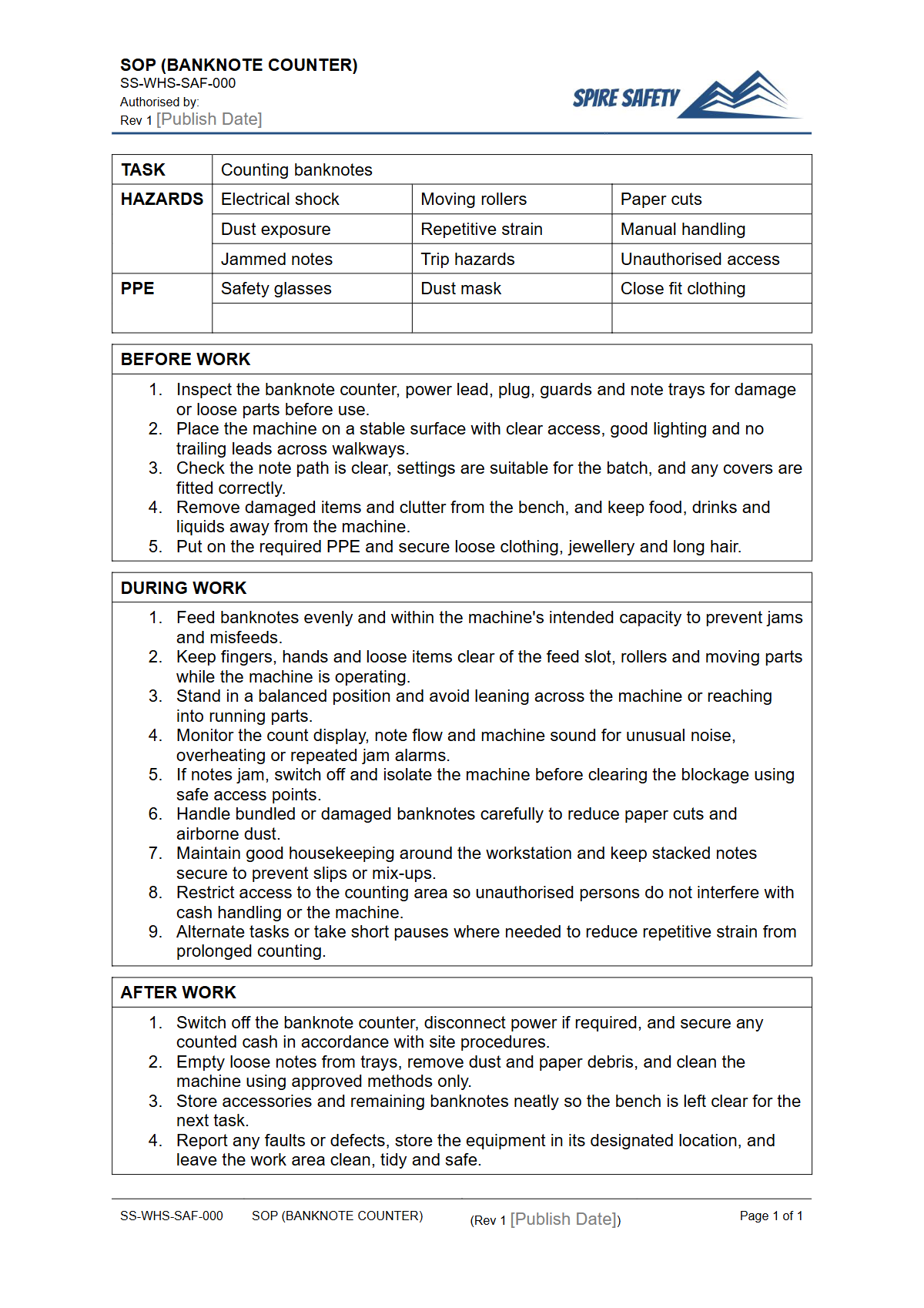
Streamline your cash handling safety protocols with this Free Safe Operating Procedure (Banknote Counter) Template. This document provides a structured starting point for creating a detailed guide to the safe use of banknote and currency counting machines in your workplace. It's designed to help you manage risks and ensure all operators are trained in consistent, safe work practices aligned with the Australian WHS framework.
Banknote counters, while common in retail, banking, and hospitality, present several workplace hazards. These include:
- Ergonomic Risks: Repetitive movements, awkward postures, and prolonged standing or sitting can lead to musculoskeletal disorders (MSDs).
- Electrical Hazards: Damaged cords, faulty internal wiring, or liquid spills can create a risk of electric shock.
- Mechanical Hazards: Moving parts within the machine can cause pinch or entanglement injuries, especially when clearing jams.
- Hygiene Risks: Banknotes can be carriers of bacteria and other contaminants. While the risk of illness is generally low, poor hygiene practices can increase exposure.
A documented SOP helps formalise the control measures for these risks, ensuring every operator understands how to perform their tasks safely. Even seemingly simple office equipment requires formal procedures to manage hazards, a principle that also applies to common items covered by a step-ladder SOP.
Video walkthrough
How to use the Free Safe Operating Procedure (Banknote Counter) Template
This Safe Operating Procedure is provided in DOCX format for easy editing and customisation. You can add your company logo, specify the exact models of banknote counters in use, and detail the specific personal protective equipment (PPE) required, such as gloves if deemed necessary by your risk assessment.
A PDF version is also available for straightforward distribution and printing once you have finalised your document. The template is structured with key sections including required PPE, pre-operational checks, step-by-step operating instructions, and procedures for cleaning and clearing jams.
Important Customisation Note
Before use, you must customise this template to reflect your specific workplace, equipment models, and control measures. We've provided a framework aligned with Australian WHS practice, but the final responsibility for creating a document that is accurate and suitable for your organisation rests with you.
When to use a Safe Operating Procedure
An SOP for a banknote counter should be a core part of your safety management system. It is used in several key situations:
- New Worker Induction: To train new employees on the correct and safe method of operating the equipment before they begin work.
- Refresher Training: For periodic retraining to reinforce safe behaviours and introduce any procedural updates.
- Pre-Operational Guidance: As a daily or pre-shift reference for operators to review safety checks.
- Incident Investigation: To assess whether correct procedures were followed after an incident or near miss.
Well-developed SOPs are foundational documents that support comprehensive WHS management systems, demonstrating a commitment to proactive risk management.
Who should use this SOP
This procedure is intended for all personnel involved with cash handling and processing. Key users include:
- Cashiers and Retail Staff: The primary operators of the equipment.
- Bank Tellers and Financial Staff: Frequent users in a banking environment.
- Supervisors and Managers: Responsible for overseeing operations, providing training, and ensuring procedures are followed.
- WHS Representatives: Involved in developing, reviewing, and monitoring the effectiveness of safety procedures.
During formal reviews, such as a WHS compliance auditing process, documented procedures are often a key piece of evidence demonstrating how risks are managed effectively. These pre-operational inspections are a fundamental safety step for any powered equipment, from office machines to those detailed in an Air Compressor SOP.
By implementing a clear SOP for banknote counters, you enhance safety and operational consistency. For more templates covering a wide range of tasks and equipment, browse our complete free WHS resources library.
Common mistakes
Common mistakes to avoid
- Using a generic SOP without customising it for specific machine models and workplace risks.
- Failing to adequately train all operators on the contents of the finalised procedure.
- Neglecting to schedule and document routine maintenance and cleaning as outlined in the SOP.
- Not including clear, safe instructions for common issues like clearing a note jam.
Legal references
Legal considerations
The following legal requirements may be relevant to this type of work.
- Work Health and Safety Act (Harmonised) — Provides the primary duties for protecting workers and other people from work health and safety risks.
- Work Health and Safety Regulations (Harmonised) — Sets out requirements supporting the management of workplace hazards and risks.
The following codes may be relevant to this type of work.
- Managing WHS Risks Code of Practice — Provides practical guidance on identifying hazards, assessing risks and applying effective controls.
- Work Health and Safety Consultation, Cooperation and Coordination Code of Practice — Provides practical guidance on consulting workers and coordinating with other duty holders.
- Managing the Work Environment and Facilities Code of Practice — Provides practical guidance on safe work environments, workplace facilities and related controls.
Did you know
Ergonomic Risk
Repetitive motions from manual cash handling or maintaining a poor posture while using a counting machine are leading causes of musculoskeletal disorders (MSDs) in cash-handling environments.
The Hidden Life of Banknotes
Studies have shown that banknotes can carry a significant number of microorganisms. While the risk of disease transmission is low, following the hygiene procedures in an SOP is a simple and effective precaution.
FAQ
Frequently asked questions
01What is a Safe Operating Procedure for a banknote counter?
02Why are SOPs important for simple equipment like cash counters?
03Is this Free Safe Operating Procedure (Banknote Counter) Template ready to use immediately?
04How often should we review our banknote counter SOP?
Share this resource
Free Safe Operating Procedure (Banknote Counter) Template
Browse Categories
How To Use It
- 1Download and open in Word or PDF.
- 2Replace the placeholders with your business details.
- 3Get it reviewed by a WHS specialist before rollout.
Need it customised?
Our WHS consultants can adapt this template to your site, run a gap analysis, or audit what you already have in place.
Book a Free Consultation WHS consulting servicesor call 1300 156 382
Related templates
- Free Safe Operating Procedure (Banquet Chair Handling) Template
- Free Safe Operating Procedure (Banquet Trolley Use) Template
- Free Safe Operating Procedure (Bar Glass Handling) Template
- Free Safe Operating Procedure (Bar Ice Well Cleaning) Template
- Free Safe Operating Procedure (Bar Keg Changeover) Template
- Free Safe Operating Procedure (Barber Chair Cleaning) Template