
Free Safe Operating Procedure (Bar Ice Well Cleaning) Template
Download our free Safe Operating Procedure (Bar Ice Well Cleaning) template. A structured starting point for hospitality venues to manage hygiene risks.
Free Safe Operating Procedure (Bar Ice Well Cleaning) Template
DOCX • 126 KB + PDF
Updated Oct 2026
No signup required
Purpose of the Free Safe Operating Procedure (Bar Ice Well Cleaning) Template
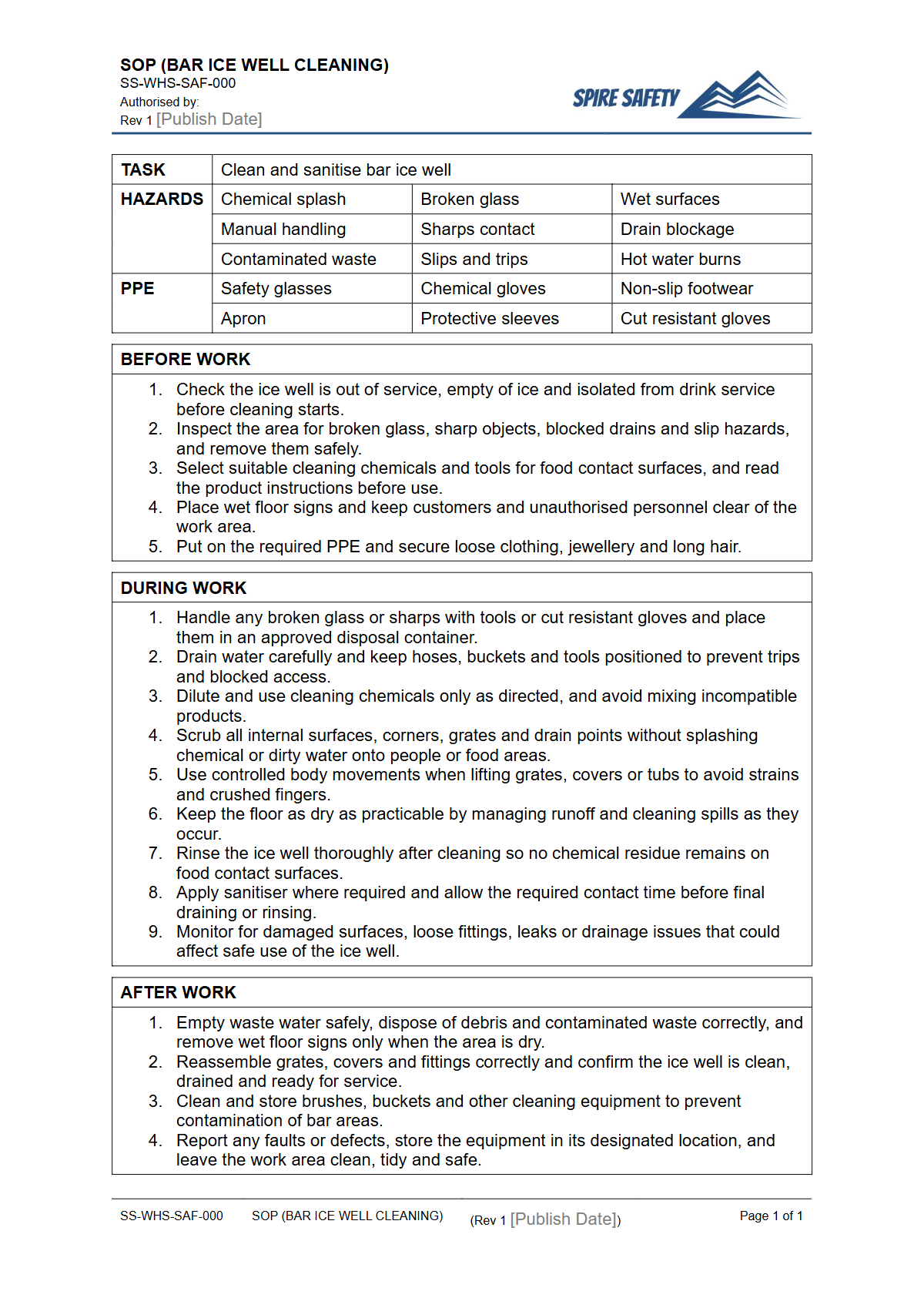
Maintaining a clean and hygienic bar is essential for customer safety and business reputation. Our Free Safe Operating Procedure (Bar Ice Well Cleaning) Template provides a structured framework for ensuring this critical task is performed safely and effectively every time.
This document helps persons conducting a business or undertaking (PCBUs) in the hospitality sector meet their work health and safety (WHS) obligations by providing a clear, step-by-step guide for workers.
The primary purpose of this SOP is to manage the various risks associated with cleaning ice wells. These include biological hazards from mould and bacteria, chemical hazards from cleaning agents, and physical hazards like slips, trips, and ergonomic strain from manual handling.
By documenting a standardised process, you create a safer work environment, supports your compliance efforts with food safety standards, and reduce the risk of incidents. Implementing clear SOPs is a fundamental part of building robust WHS management systems within your venue.
What this Safe Operating Procedure covers:
- Essential pre-operational checks and site preparation.
- A detailed, sequential guide to the cleaning and sanitising process.
- Required Personal Protective Equipment (PPE) based on chemical hazards.
- Post-cleaning checks and waste disposal guidelines.
- Emergency procedures in case of chemical spills or injury.
Video walkthrough
How to use the Free Safe Operating Procedure (Bar Ice Well Cleaning) Template
This downloadable Word document is designed as a user-friendly starting point. To make it effective for your workplace, you must adapt it to your specific environment, equipment, and the chemicals you use.
A generic procedure cannot account for every unique variable in your bar or restaurant.
Note: We have designed this template to be a starting point. You must customise it by consulting with your workers and incorporating your site-specific details, chemical products, and equipment.
A regular review of its effectiveness is also a vital part of the process.
Follow these steps to implement the SOP:
- Download: Get the template in your preferred format (DOCX or PDF).
- Customise: Add your company name, logo, and specific site details. Review the steps and update them to reflect your exact process. List the specific cleaning and sanitising chemicals used, cross-referencing their Safety Data Sheets (SDS) to specify correct PPE and first aid measures.
- Consult: Discuss the draft procedure with the staff who will be performing the task. Their feedback is invaluable for creating a practical and safe process.
- Train: Ensure all relevant employees are trained on the final SOP. Keep a record of this training. This documentation is often reviewed during a WHS compliance auditing process.
- Review: Schedule regular reviews of the SOP (e.g., annually or after any incident) to ensure it remains current and effective.
When to use it
This Safe Operating Procedure should be used consistently as part of your venue's operational routine. It is not a document to be filed away and forgotten. It should be readily accessible to staff near the work area and used for several key activities:
- Routine Cleaning: For all scheduled daily, weekly, or monthly deep cleaning of the ice well to maintain hygiene standards.
- Staff Training: As a primary training document for new employees to ensure they understand the correct and safe method from day one.
- Refresher Training: For existing staff to reinforce correct procedures and communicate any changes.
- Incident Investigation: As a benchmark to review against if a hygiene issue or safety incident occurs.
Beyond this specific task, documenting procedures is best practice for any hazardous activity in the workplace. For example, if staff need to access cleaning supplies stored at height, a separate procedure like our FREE Step Ladder SOP Template should be developed and implemented.
Who should use it
This SOP is intended for all personnel involved in the operation and supervision of bar services. Primary users include:
- Bar Staff and Cleaners: The employees who physically perform the cleaning task. The SOP guides their actions to ensure their safety and the effectiveness of the cleaning.
- Supervisors and Duty Managers: Those responsible for overseeing staff, providing training, and ensuring procedures are followed correctly. They use the SOP as a tool for monitoring and enforcement.
- Venue Managers and Owners: The PCBU or their officers, who hold the ultimate responsibility for providing a safe system of work. The SOP serves as critical documentation demonstrating how they manage specific workplace risks.
Developing and implementing a comprehensive suite of SOPs can be a complex task. If you require assistance in creating tailored safety documents or improving your overall safety framework, engaging professional WHS consulting services can provide expert guidance. For more templates and safety resources, feel free to browse our complete free WHS resources library.
Common mistakes
Common mistakes to avoid
- Using non-food-grade cleaning chemicals, which can contaminate the ice.
- Not allowing the ice well to air dry completely before refilling, promoting mould and bacteria growth.
- Forgetting to disconnect the power source for connected ice machines before cleaning begins.
- Failing to train new or casual staff on the correct procedure, leading to inconsistent and unsafe practices.
Legal references
Legal considerations
The following legal requirements may be relevant to this type of work.
- Work Health and Safety Act (Harmonised) — Provides the primary duties for protecting workers and other people from work health and safety risks.
- Work Health and Safety Regulations (Harmonised) — Sets out requirements supporting the management of workplace hazards and risks.
The following codes may be relevant to this type of work.
- Managing WHS Risks Code of Practice — Provides practical guidance on identifying hazards, assessing risks and applying effective controls.
- Work Health and Safety Consultation, Cooperation and Coordination Code of Practice — Provides practical guidance on consulting workers and coordinating with other duty holders.
- Managing the Work Environment and Facilities Code of Practice — Provides practical guidance on safe work environments, workplace facilities and related controls.
Did you know
Ice is Food
Under the Australia New Zealand Food Standards Code, ice is classified as a food. This means it must be handled with the same level of hygiene and care as any other food product to prevent contamination and illness.
GHS Pictograms
The diamond-shaped pictograms on chemical labels are part of the Globally Harmonized System (GHS) of Classification and Labelling of Chemicals. They provide a quick, universal reference for the specific hazards a chemical presents.
FAQ
Frequently asked questions
01What chemicals are safe for cleaning a bar ice well?
02How often should a bar ice well be cleaned?
03Is a Safe Operating Procedure a legal requirement for cleaning an ice well?
04What PPE is needed for cleaning an ice well?
Share this resource
Free Safe Operating Procedure (Bar Ice Well Cleaning) Template
Browse Categories
How To Use It
- 1Download and open in Word or PDF.
- 2Replace the placeholders with your business details.
- 3Get it reviewed by a WHS specialist before rollout.
Need it customised?
Our WHS consultants can adapt this template to your site, run a gap analysis, or audit what you already have in place.
Book a Free Consultation WHS consulting servicesor call 1300 156 382
Related templates
- Free Safe Operating Procedure (Bar Keg Changeover) Template
- Free Safe Operating Procedure (Barber Chair Cleaning) Template
- Free Safe Operating Procedure (Bare Root Planting) Template
- Free Safe Operating Procedure (Barrel Handling) Template
- Free Safe Operating Procedure (Basement Cleaning) Template
- Free Safe Operating Procedure (Basement Pump Check) Template