
Free Safe Operating Procedure (Barber Chair Cleaning) Template
Download our free Safe Operating Procedure (Barber Chair Cleaning) Template.
Free Safe Operating Procedure (Barber Chair Cleaning) Template
DOCX • 126 KB + PDF
Updated Oct 2026
No signup required
Purpose of the Free Safe Operating Procedure (Barber Chair Cleaning) Template
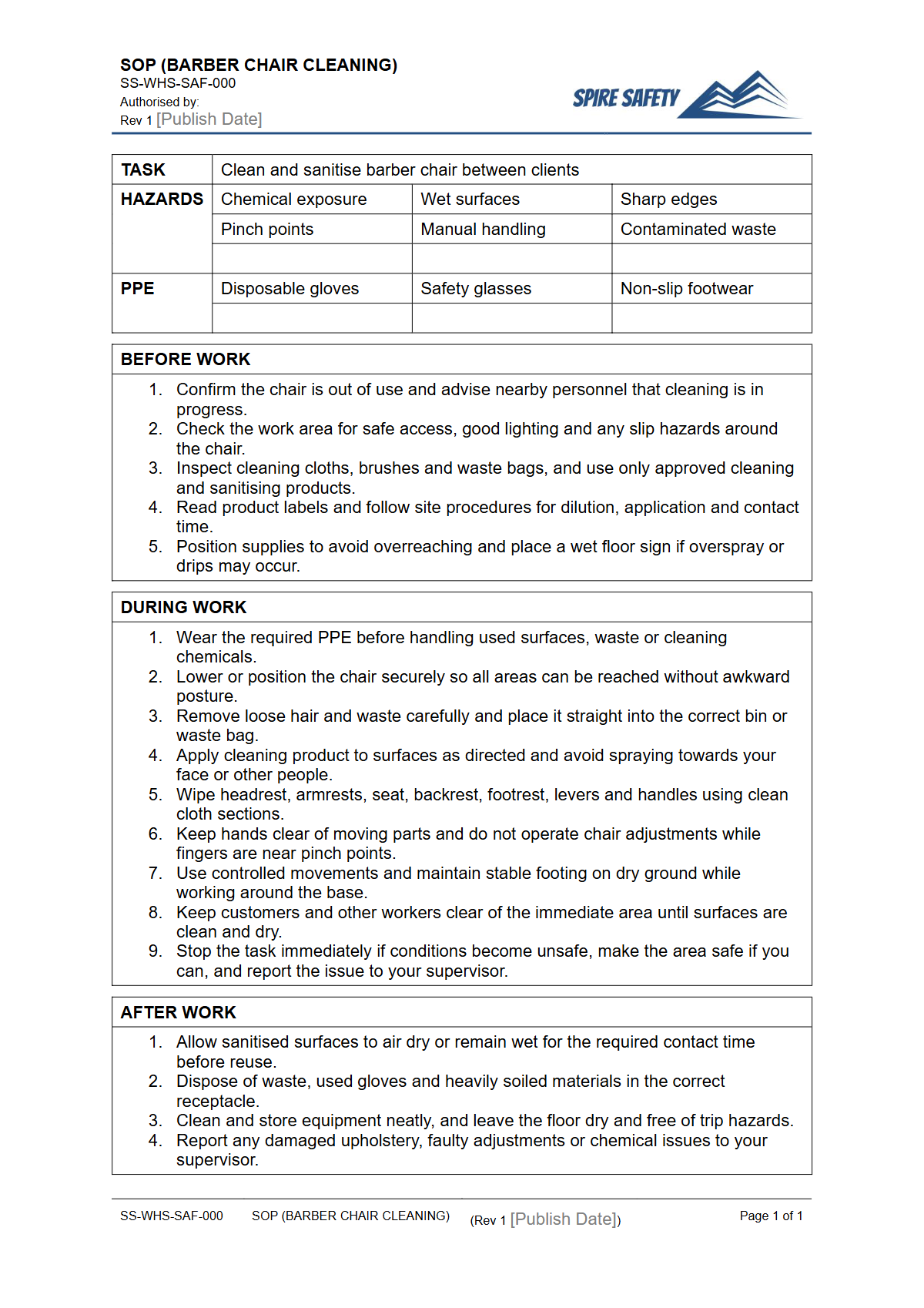
Maintaining a clean and hygienic environment is critical in any personal service setting, including barber shops and hair salons. This free Safe Operating Procedure (Barber Chair Cleaning) template provides a structured framework for documenting the correct process for cleaning and disinfecting barber chairs.
A formal SOP helps ensure consistency, reduces the risk of cross-contamination between clients, and protects workers from hazards associated with cleaning chemicals. By clearly defining the steps, required equipment, and safety precautions, you can demonstrate a commitment to health and safety, meet client expectations, and fulfil your duty of care under Australian WHS laws.
Key Elements of a Barber Chair Cleaning SOP
A comprehensive SOP for this task should be detailed and easy to follow. Our template guides you to include critical information such as:
- Required Personal Protective Equipment (PPE): Specifies the gloves, eye protection, or other gear needed to handle cleaning chemicals safely.
- Chemicals and Materials: Lists the approved hospital-grade disinfectants, cleaning cloths, and other necessary supplies. It should also reference Safety Data Sheets (SDS) for each chemical.
- Step-by-Step Procedure: Outlines the sequence of actions, from removing loose hair and debris to applying disinfectant and observing the required contact time before wiping down.
- Frequency: Defines when cleaning must occur, such as between every client and as part of a more thorough end-of-day routine.
- Waste Disposal: Describes how to correctly dispose of used cloths, paper towels, and other contaminated waste.
- Emergency Procedures: Details the response for chemical spills or accidental skin/eye contact.
Integrating clear SOPs like this one is a fundamental part of building effective WHS management systems, creating a safer environment for everyone in the workplace.
Video walkthrough
How to use the Free Safe Operating Procedure (Barber Chair Cleaning) Template
This document is provided as a starting point in both DOCX and PDF formats. It is designed to be adapted to the specific context of your business.
To use it effectively, download the template and customise it to reflect your unique operational needs, equipment, and the specific cleaning products you use.
Important: This is a template only. We have developed it as a guide, and you must adapt it to your specific workplace.
You need to identify your own hazards, assess the risks, and implement control measures that are suitable for your business. Ensure all details are accurate and relevant before implementation.
When to use it
This Safe Operating Procedure should be the go-to reference for all staff responsible for salon hygiene. It should be actively used and enforced in several key situations:
- Between Clients: To perform a quick but thorough sanitisation of all contact surfaces on the chair.
- End of Day: As part of a comprehensive deep cleaning routine for the entire workstation.
- Staff Training: When inducting new employees or conducting refresher training on hygiene protocols.
- After a Contamination Event: If there has been a spill of any kind on the chair.
- Barbers and Stylists
- Salon Apprentices and Assistants
- Designated Cleaning Staff
- Salon and Shop Managers
Clear documentation ensures every task, whether it's cleaning a chair or using equipment outlined in a step ladder SOP, is performed to the same high standard every time.
Who should use it
This SOP is intended for any person whose duties involve cleaning and maintaining the hygiene of barber chairs. This includes:
Managers are responsible for ensuring that all relevant personnel are trained on the contents of the SOP and that they understand its importance. Competency should be verified, and records of training should be maintained as part of your safety management system.
For complex safety challenges beyond standard procedures, engaging external support can provide clarity; our WHS consulting services help businesses of all sizes navigate their obligations.
Maintaining Hygiene and Safety Standards
A single SOP is part of a larger commitment to workplace health and safety. The principles of identifying hazards and controlling risks apply to all tasks, not just operating complex machinery.
For instance, just as a workshop documents procedures in a free air compressor SOP, a salon must document its specific hygiene and chemical handling tasks. This proactive approach helps prevent incidents, from minor skin irritations caused by cleaning agents to slips on wet floors or more serious infection control breaches.
Regular reviews and updates to your SOPs ensure they remain relevant as you introduce new products or change your processes. By embedding these procedures into your daily operations, you build a resilient safety culture that protects both your team and your clients.
If you need more templates or safety documents, you can browse our complete free WHS resources library for a wide range of tools.
Common mistakes
Common mistakes to avoid
- Using the wrong cleaning products, such as surface sprays that aren't hospital-grade disinfectants.
- Not allowing for the manufacturer's recommended 'contact time' for disinfectants to work.
- Forgetting to wear Personal Protective Equipment (PPE) like gloves when handling chemicals.
- Failing to pre-clean the chair of visible hair and debris before applying disinfectant.
Legal references
Legal considerations
The following legal requirements may be relevant to this type of work.
- Work Health and Safety Act (Harmonised) — Provides the primary duties for protecting workers and other people from work health and safety risks.
- Work Health and Safety Regulations (Harmonised) — Sets out requirements supporting the management of workplace hazards and risks.
The following codes may be relevant to this type of work.
- Managing WHS Risks Code of Practice — Provides practical guidance on identifying hazards, assessing risks and applying effective controls.
- Work Health and Safety Consultation, Cooperation and Coordination Code of Practice — Provides practical guidance on consulting workers and coordinating with other duty holders.
- Managing the Work Environment and Facilities Code of Practice — Provides practical guidance on safe work environments, workplace facilities and related controls.
Did you know
Contact Time is Critical
Most disinfectants are not instantaneous. They require a specific 'contact time'—often 1 to 10 minutes—where the surface must remain wet with the solution to effectively kill germs. Wiping it off too early can render the disinfection process ineffective.
Two-Step Process
For effective disinfection, cleaning should be a two-step process. First, clean the surface with a detergent to remove physical soil and debris, then apply the disinfectant. Disinfectants work best on pre-cleaned surfaces.
FAQ
Frequently asked questions
01Why is an SOP needed for a simple task like cleaning a barber chair?
02How often should a barber chair be cleaned according to a Safe Operating Procedure?
03What kind of chemicals should be used for cleaning barber chairs?
04Can I use this barber chair cleaning SOP for other salon equipment?
Share this resource
Free Safe Operating Procedure (Barber Chair Cleaning) Template
Browse Categories
How To Use It
- 1Download and open in Word or PDF.
- 2Replace the placeholders with your business details.
- 3Get it reviewed by a WHS specialist before rollout.
Need it customised?
Our WHS consultants can adapt this template to your site, run a gap analysis, or audit what you already have in place.
Book a Free Consultation WHS consulting servicesor call 1300 156 382
Related templates
- Free Safe Operating Procedure (Bare Root Planting) Template
- Free Safe Operating Procedure (Barrel Handling) Template
- Free Safe Operating Procedure (Basement Cleaning) Template
- Free Safe Operating Procedure (Basement Pump Check) Template
- Free Safe Operating Procedure (Bath Lift) Template
- Free Safe Operating Procedure (Bathroom Aid Cleaning) Template