
Free Safe Operating Procedure (Barrel Handling) Template
Download our free Safe Operating Procedure (Barrel Handling) Template.
Free Safe Operating Procedure (Barrel Handling) Template
DOCX • 126 KB + PDF
Updated Oct 2026
No signup required
Purpose of the Free Safe Operating Procedure (Barrel Handling) Template
Handling barrels, drums, and similar large containers presents significant workplace hazards. These include musculoskeletal injuries from manual lifting, crushing injuries from dropped loads, and exposure to hazardous chemicals from spills.
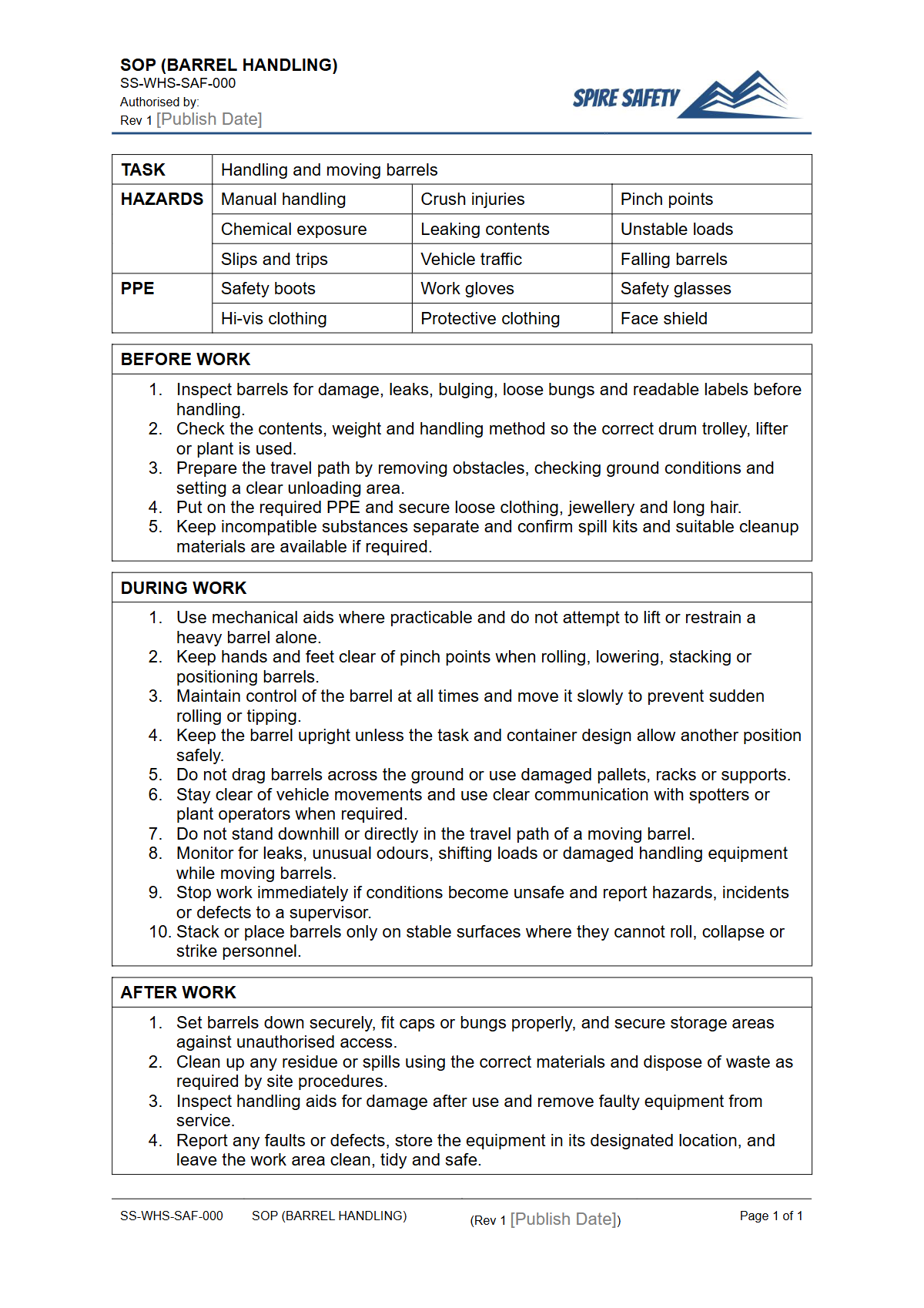
Implementing a documented procedure is a critical step in managing these risks. This free Safe Operating Procedure (Barrel Handling) Template provides a structured framework for outlining your organisation's approved methods for safely moving, storing, and decanting from barrels, whether done manually or with mechanical aids.
Using a standardised SOP ensures that all workers follow the same tested, safe process, reducing variability and the likelihood of incidents. It forms a key component of a comprehensive WHS management system, demonstrating a commitment to proactive risk management.
This template helps you identify the specific hazards at your site, detail step-by-step controls, and define the personal protective equipment (PPE) required for the task. It also serves as an essential training and competency assessment tool.
Key Hazards in Barrel Handling:
- Musculoskeletal Disorders (MSDs): Resulting from awkward postures, high force, and repetition when lifting, rolling, or tilting heavy barrels.
- Impact and Crushing: Caused by loss of control over a barrel, leading to it rolling or falling onto a person.
- Chemical Exposure: Inhalation of vapours or skin contact with contents due to spills during transport or decanting.
- Slips, Trips, and Falls: Resulting from spills or poor housekeeping in the handling area.
Video walkthrough
How to use the Free Safe Operating Procedure (Barrel Handling) Template
This document is a template and must be customised to reflect the specific circumstances of your workplace. Download the DOCX file and adapt it to your unique equipment, barrel types (e.g., steel, plastic), contents (oils, chemicals, food products), and environment.
For tasks involving powered equipment, a specific procedure like a telehandler SOP may also be required for the machinery itself.
Follow these steps to effectively implement the SOP:
- Consult with your team: Involve the workers and supervisors who perform barrel handling tasks daily. Their direct experience is invaluable for identifying practical risks and effective controls.
- Conduct a risk assessment: Use our template as a guide to perform a specific risk assessment for barrel handling at your site. Identify all potential hazards and determine the most effective control measures.
- Detail your equipment: Specify the exact mechanical aids used in your workplace, such as drum dollies, trolleys, pallet jacks, forklifts with drum clamps, or dedicated drum lifters. Include pre-operational checks for this equipment.
- Customise procedures: Edit the step-by-step instructions to describe your precise process, from collecting the barrel to placing it in its final position or decanting from it.
- Review and approve: Have a competent person, such as a WHS manager or supervisor, review and formally approve the final document before it is issued for use. For complex operations, seeking guidance from expert WHS consulting services can ensure your procedures are robust and practical.
When to use this Safe Operating Procedure
A Safe Operating Procedure for barrel handling should be a readily accessible document used in several key situations. It must be consulted by workers before starting any non-routine or complex barrel handling task.
It is a mandatory resource during worker induction and onboarding, as well as for specific refresher training sessions to ensure competency is maintained. The SOP should also be a primary reference document when investigating any incident or near miss related to barrel handling, helping to identify any procedural gaps or failures.
Integrating the review of this SOP into your schedule of regular WHS compliance audits ensures it remains current and effective.
Who should use this Safe Operating Procedure
This SOP is intended for a range of personnel within an organisation. Workers are the primary users, as it directs their actions to ensure they perform the task safely.
Supervisors and Team Leaders must use the SOP to induct new team members, conduct toolbox talks, and monitor compliance with safe work practices on the floor. WHS Managers and Advisors will use the template to establish a baseline standard for barrel handling across the business and integrate it into the broader safety management system.
They are also typically responsible for managing the review and update cycle. Lastly, Trainers and Assessors will use the approved SOP as the basis for developing training programs and assessing worker competency.
A well-written SOP ensures everyone, regardless of their role, has a clear understanding of the 'one safe way' to handle barrels. This document is just one example of the many procedures you may need, which can be found in our free WHS resources library.
Common mistakes
Common mistakes to avoid
- Failing to inspect mechanical aids like drum trolleys or lifters before use.
- Using incorrect manual lifting techniques, such as bending the back instead of the knees.
- Neglecting to wear appropriate PPE, such as safety glasses, gloves, and steel-capped boots.
- Not customising the generic template to account for site-specific conditions and barrel contents.
Legal references
Legal considerations
The following legal requirements may be relevant to this type of work.
- Work Health and Safety Act (Harmonised) — Provides the primary duties for protecting workers and other people from work health and safety risks.
- Work Health and Safety Regulations (Harmonised) — Sets out requirements supporting the management of workplace hazards and risks.
The following codes may be relevant to this type of work.
- Managing WHS Risks Code of Practice — Provides practical guidance on identifying hazards, assessing risks and applying effective controls.
- Work Health and Safety Consultation, Cooperation and Coordination Code of Practice — Provides practical guidance on consulting workers and coordinating with other duty holders.
- Managing the Work Environment and Facilities Code of Practice — Provides practical guidance on safe work environments, workplace facilities and related controls.
Did you know
The Weight of the Problem
A standard 205-litre (44-gallon) steel drum can weigh over 200kg when full, placing it well into the high-risk category for manual handling injuries according to Safe Work Australia guidelines.
Serious Injuries
According to Safe Work Australia, serious claims for injuries resulting from muscular stress while lifting objects are among the most common, accounting for a significant portion of all workplace incidents.
FAQ
Frequently asked questions
01What should be included in a barrel handling SOP?
02Is a Safe Operating Procedure a legal requirement for handling barrels in Australia?
03How often should we review our barrel handling procedures?
04What's the difference between manual and mechanical barrel handling?
Share this resource
Free Safe Operating Procedure (Barrel Handling) Template
Browse Categories
How To Use It
- 1Download and open in Word or PDF.
- 2Replace the placeholders with your business details.
- 3Get it reviewed by a WHS specialist before rollout.
Need it customised?
Our WHS consultants can adapt this template to your site, run a gap analysis, or audit what you already have in place.
Book a Free Consultation WHS consulting servicesor call 1300 156 382
Related templates
- Free Safe Operating Procedure (Basement Cleaning) Template
- Free Safe Operating Procedure (Basement Pump Check) Template
- Free Safe Operating Procedure (Bath Lift) Template
- Free Safe Operating Procedure (Bathroom Aid Cleaning) Template
- Free Safe Operating Procedure (Battery Bank Testing) Template
- Free Safe Operating Procedure (Battery Charging) Template