
Free Safe Operating Procedure (Battery Charging) Template
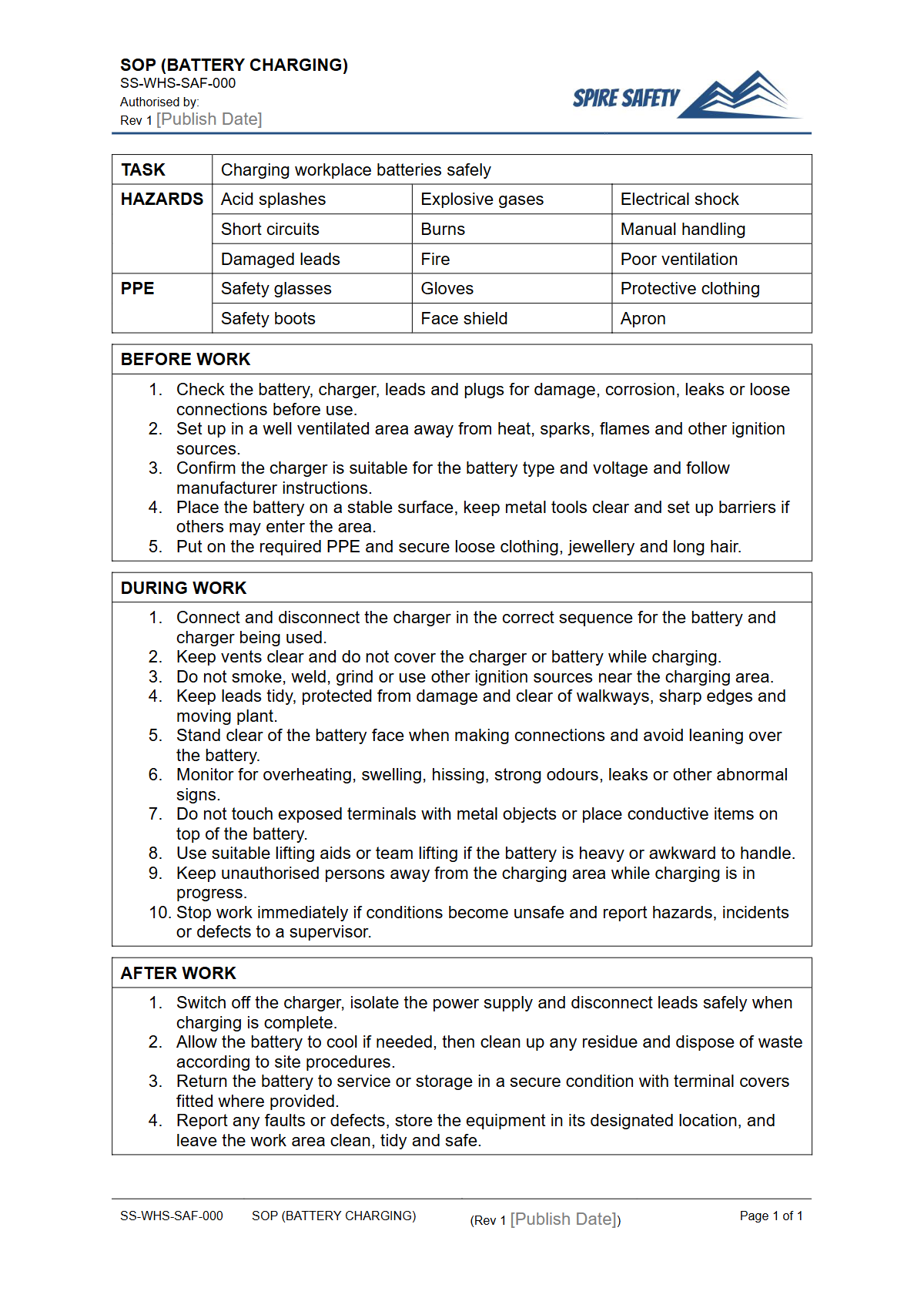
Download our free Safe Operating Procedure (SOP) template for battery charging. This customisable DOCX and PDF resource helps you outline safe work practices.
Free Safe Operating Procedure (Battery Charging) Template
DOCX • 126 KB + PDF
Updated Oct 2026
No signup required
Purpose of the Free Safe Operating Procedure (Battery Charging) Template
This Free Safe Operating Procedure (Battery Charging) Template provides a structured framework for managing the significant risks associated with charging industrial batteries, commonly used in forklifts, electric vehicles, and backup power systems. Following a documented procedure helps your organisation meet its duty of care and protects workers from hazards such as electric shock, chemical burns from acid spills, fire and explosion from hydrogen gas accumulation, and ergonomic strains from manual handling.
A well-defined SOP is a critical component of a proactive safety culture. It standardises the process, ensures all necessary precautions are taken, and forms part of your overall safety documentation.
Integrating this procedure into your broader WHS management systems demonstrates a commitment to operational safety and risk control.
Video walkthrough
How to use the Free Safe Operating Procedure (Battery Charging) Template
Our Free Safe Operating Procedure (Battery Charging) Template is available in both an editable DOCX format for customisation and a print-ready PDF. The document is designed as a comprehensive starting point, aligned with Australian WHS principles and industry best practices.
It covers key areas including hazard identification, required personal protective equipment (PPE), step-by-step instructions, and emergency response.
Important: This template is a guide, not a finished document. We have created this resource as a starting point; you must customise it to reflect the specific batteries, chargers, ventilation systems, and unique environmental conditions of your workplace.
Ensure you add site-specific details, emergency contacts, and cross-reference your own risk assessments to make it relevant and effective for your team.
When to use a Battery Charging SOP
A Safe Operating Procedure for battery charging should be used as a primary reference tool in several situations. It is essential for training new employees or inducting contractors who will be involved in the task.
It should also be readily available in the charging area for operators to consult before, during, and after the charging process. Furthermore, the SOP serves as a benchmark for workplace inspections, a guide for refresher training sessions, and a key document to review during an incident investigation to identify any procedural gaps or non-conformance.
The process of charging is often part of operating heavy equipment, which requires its own set of safety protocols. For example, a worker might need to consult both this document and a machine-specific guide like the FREE Telehandler SOP Template before starting their shift.
Who should use this Safe Operating Procedure
This procedure is intended for several key roles within an organisation. Primarily, it is for the workers who physically perform the battery charging task.
They need to understand and follow each step to ensure their own safety and that of their colleagues. Supervisors and managers must use the SOP to train their staff, enforce safe work practices, and conduct safety observations.
Additionally, WHS and safety professionals can use this template to develop and integrate robust safety documentation into the company’s overall risk management framework. By clearly defining roles and responsibilities, the SOP ensures everyone understands their part in maintaining a safe workplace.
Regular review of all workplace procedures is essential for continuous improvement. Formalising this process through periodic WHS compliance auditing helps ensure that documents like this SOP remain current and effective against evolving operational risks.
Similar structured procedures are necessary for other workshop equipment, and our Free Air Compressor SOP Template provides another example of a task-specific safety document.
You can find a wide range of similar documents covering various plant, equipment, and high-risk tasks in our free WHS resources library, helping you build a comprehensive suite of safety resources.
Common mistakes
Common mistakes to avoid
- Charging batteries in a confined, poorly ventilated space, allowing hydrogen gas to accumulate.
- Wearing metal jewellery (rings, watches, necklaces) which can cause a short circuit and severe burns.
- Using a charger that is not matched to the battery's voltage and chemistry, leading to overcharging and damage.
- Failing to inspect cables and connectors for damage before use, creating a risk of electric shock or sparks.
- Topping up battery cells with acid instead of distilled or deionised water.
Legal references
Legal considerations
The following legal requirements may be relevant to this type of work.
- Work Health and Safety Act (Harmonised) — Provides the primary duties for protecting workers and other people from work health and safety risks.
- Work Health and Safety Regulations (Harmonised) — Sets out requirements supporting the management of workplace hazards and risks.
The following codes may be relevant to this type of work.
- Managing WHS Risks Code of Practice — Provides practical guidance on identifying hazards, assessing risks and applying effective controls.
- Work Health and Safety Consultation, Cooperation and Coordination Code of Practice — Provides practical guidance on consulting workers and coordinating with other duty holders.
- Managing the Work Environment and Facilities Code of Practice — Provides practical guidance on safe work environments, workplace facilities and related controls.
Did you know
Explosive Potential
The hydrogen gas released during battery charging is explosive in concentrations as low as 4%. A single spark from connecting or disconnecting a cable can be enough to ignite it.
Surprising Weight
A single industrial forklift battery can weigh over 1,800 kilograms. This makes proper mechanical lifting equipment and procedures essential to prevent serious crush injuries.
FAQ
Frequently asked questions
01What are the main hazards of battery charging?
02What PPE is required for charging lead-acid batteries?
03Why is ventilation so important in battery charging areas?
04Can any worker charge a battery?
Share this resource
Free Safe Operating Procedure (Battery Charging) Template
Browse Categories
How To Use It
- 1Download and open in Word or PDF.
- 2Replace the placeholders with your business details.
- 3Get it reviewed by a WHS specialist before rollout.
Need it customised?
Our WHS consultants can adapt this template to your site, run a gap analysis, or audit what you already have in place.
Book a Free Consultation WHS consulting servicesor call 1300 156 382
Related templates
- Free Safe Operating Procedure (Battery Crimping Tool) Template
- Free Safe Operating Procedure (Battery Load Test) Template
- Free Safe Operating Procedure (Battery Recycling Intake) Template
- Free Safe Operating Procedure (Battery Rivet Gun) Template
- Free Safe Operating Procedure (Battery Spill Cleanup) Template
- Free Safe Operating Procedure (Battery Storage) Template