
Free Safe Operating Procedure (Battery Crimping Tool) Template
Download our free Safe Operating Procedure (Battery Crimping Tool) template. This customisable DOCX & PDF helps you define safe work practices for your team.
Free Safe Operating Procedure (Battery Crimping Tool) Template
DOCX • 126 KB + PDF
Updated Oct 2026
No signup required
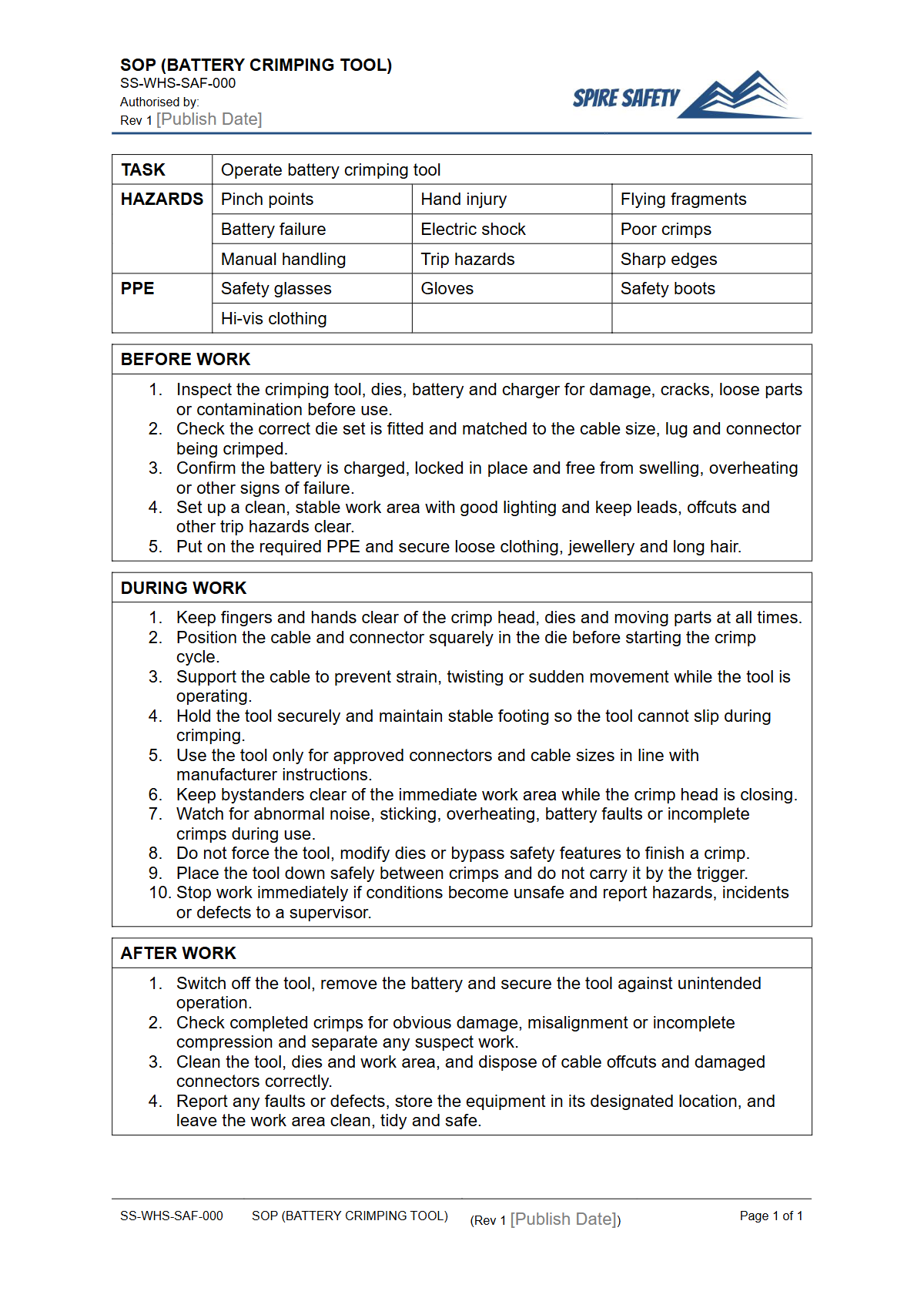
Purpose of the Free Safe Operating Procedure (Battery Crimping Tool) Template
Operating any powered equipment introduces risks into the workplace, and battery crimping tools are no exception. This Free Safe Operating Procedure (Battery Crimping Tool) Template provides a structured starting point for your business to document the required steps for safely using this equipment.
Formalising your process helps control risks associated with electrical energy, pinch points, ergonomic strain from repetitive use, and tool maintenance. By clearly defining pre-start checks, operational steps, and required personal protective equipment (PPE), you can ensure workers are informed and competent, forming a key part of your risk management activities.
A well-developed SOP is a fundamental component of robust WHS management systems. It serves as a vital training resource for new operators and a consistent reference for experienced staff, promoting a proactive safety culture within your organisation. Using this template helps you systematically address hazards and demonstrate your commitment to providing a safe working environment for all personnel.
Video walkthrough
How to use the Free Safe Operating Procedure (Battery Crimping Tool) Template
This resource is available for immediate download in both DOCX and PDF formats. The DOCX version is fully editable, allowing you to tailor the content directly to your operational needs.
Simply download the file and open it in Microsoft Word or a compatible program to begin customisation. We recommend adding your company branding, specific model numbers for your crimping tools, and details about the unique environment in which they are used.
Important: This is a template, not a finished safety document. To be effective, you must adapt it to your specific workplace conditions and legal obligations.
We take no responsibility for any action or inaction taken based on this document. You are responsible for ensuring its accuracy and suitability for your business.
For guidance on customisation and implementation, consider seeking specialist WHS consulting support.
When to use it
A Safe Operating Procedure (SOP) should be developed and implemented before any worker is permitted to use a battery crimping tool. It is a critical document for worker training and induction programs, ensuring everyone understands the established safe method of work from the outset.
The SOP should be readily accessible in the work area for quick reference. It is also a key document to review during incident investigations or when new models of crimping tools are introduced.
Regular reviews, typically annually or as part of a scheduled safety audit, ensure the procedure remains current and effective.
Who should use it
This template is designed for use by managers, supervisors, and Work Health and Safety (WHS) professionals who are responsible for creating and maintaining workplace safety documentation. They will use the template as a foundation to draft a site-specific SOP in consultation with the workers who actually operate the equipment. Once finalised, the SOP is used by:
- Operators: As a primary training document and ongoing reference for correct and safe operation.
- Supervisors: To enforce safe work practices, conduct competency assessments, and lead toolbox talks.
- Trainers: As a core part of the curriculum for training workers on the use of battery crimpers.
The process is similar for other equipment, whether you are creating an SOP for a handheld power tool, like with our FREE Circular Saw SOP (Safe Operating Procedure) Template, or for larger workshop machinery.
Key Elements of a Battery Crimper SOP
Your customised procedure should cover several key areas to be comprehensive. These include pre-operational checks such as inspecting the tool for damage, ensuring the battery is charged, and verifying that the correct die set is available for the job.
The operational section should detail the step-by-step process for making a crimp, emphasising correct tool positioning and ensuring the tool completes its full cycle. Finally, post-operational tasks like cleaning the tool, removing the battery, and returning the tool and dies to their designated storage location are essential for safety and longevity.
This might also involve tasks performed at height, which should be covered by separate risk assessments, potentially using our FREE Step Ladder SOP Template as a guide for ladder safety.
Just as you would for other electrical equipment detailed in a resource like our FREE Plasma Cutter SOP (Safe Operating Procedure) Template, your procedure must specify the required PPE. For battery crimpers, this typically includes safety glasses to protect from projectiles and may include gloves depending on the application and associated risks. You can find more templates like this across our complete free WHS resources library.
Common mistakes
Common mistakes to avoid
- Using incorrect die sets for the specific lug or cable size.
- Failing to perform a pre-start inspection of the tool, battery, and dies.
- Not allowing the tool to complete its full hydraulic cycle, resulting in a poor crimp.
- Creating a generic SOP that isn't customised for the specific model and workplace.
Legal references
Legal considerations
The following legal requirements may be relevant to this type of work.
- Work Health and Safety Act (Harmonised) — Provides the primary duties for protecting workers and other people from work health and safety risks.
- Work Health and Safety Regulations (Harmonised) — Sets out requirements supporting the management of workplace hazards and risks.
The following codes may be relevant to this type of work.
- Managing WHS Risks Code of Practice — Provides practical guidance on identifying hazards, assessing risks and applying effective controls.
- Work Health and Safety Consultation, Cooperation and Coordination Code of Practice — Provides practical guidance on consulting workers and coordinating with other duty holders.
- Managing the Work Environment and Facilities Code of Practice — Provides practical guidance on safe work environments, workplace facilities and related controls.
Did you know
Ergonomic Advantage
Hydraulic and battery-powered crimping tools can exert forces exceeding 10 tonnes. They significantly reduce the risk of musculoskeletal disorders compared to manual tools, which require high repetitive force from the operator.
Die Selection is Critical
Using the wrong die set is a primary cause of failed electrical connections. An incorrect die can result in an under-crimp (a loose, high-resistance connection) or an over-crimp (which damages the conductor and connector).
FAQ
Frequently asked questions
01What should a Safe Operating Procedure for a battery crimper include?
02Is specific training required to use a battery crimping tool?
03How often should battery crimping tools be inspected?
04Who is responsible for writing a Safe Operating Procedure?
Share this resource
Free Safe Operating Procedure (Battery Crimping Tool) Template
Browse Categories
How To Use It
- 1Download and open in Word or PDF.
- 2Replace the placeholders with your business details.
- 3Get it reviewed by a WHS specialist before rollout.
Need it customised?
Our WHS consultants can adapt this template to your site, run a gap analysis, or audit what you already have in place.
Book a Free Consultation WHS consulting servicesor call 1300 156 382
Related templates
- Free Safe Operating Procedure (Battery Load Test) Template
- Free Safe Operating Procedure (Battery Recycling Intake) Template
- Free Safe Operating Procedure (Battery Rivet Gun) Template
- Free Safe Operating Procedure (Battery Spill Cleanup) Template
- Free Safe Operating Procedure (Battery Storage) Template
- Free Safe Operating Procedure (Battery Tester) Template