
Free Safe Operating Procedure (Battery Spill Cleanup) Template
Need a Safe Operating Procedure for battery spills? Download our free template to outline safe cleanup steps and control measures for your workplace.
Free Safe Operating Procedure (Battery Spill Cleanup) Template
DOCX • 126 KB + PDF
Updated Oct 2026
No signup required
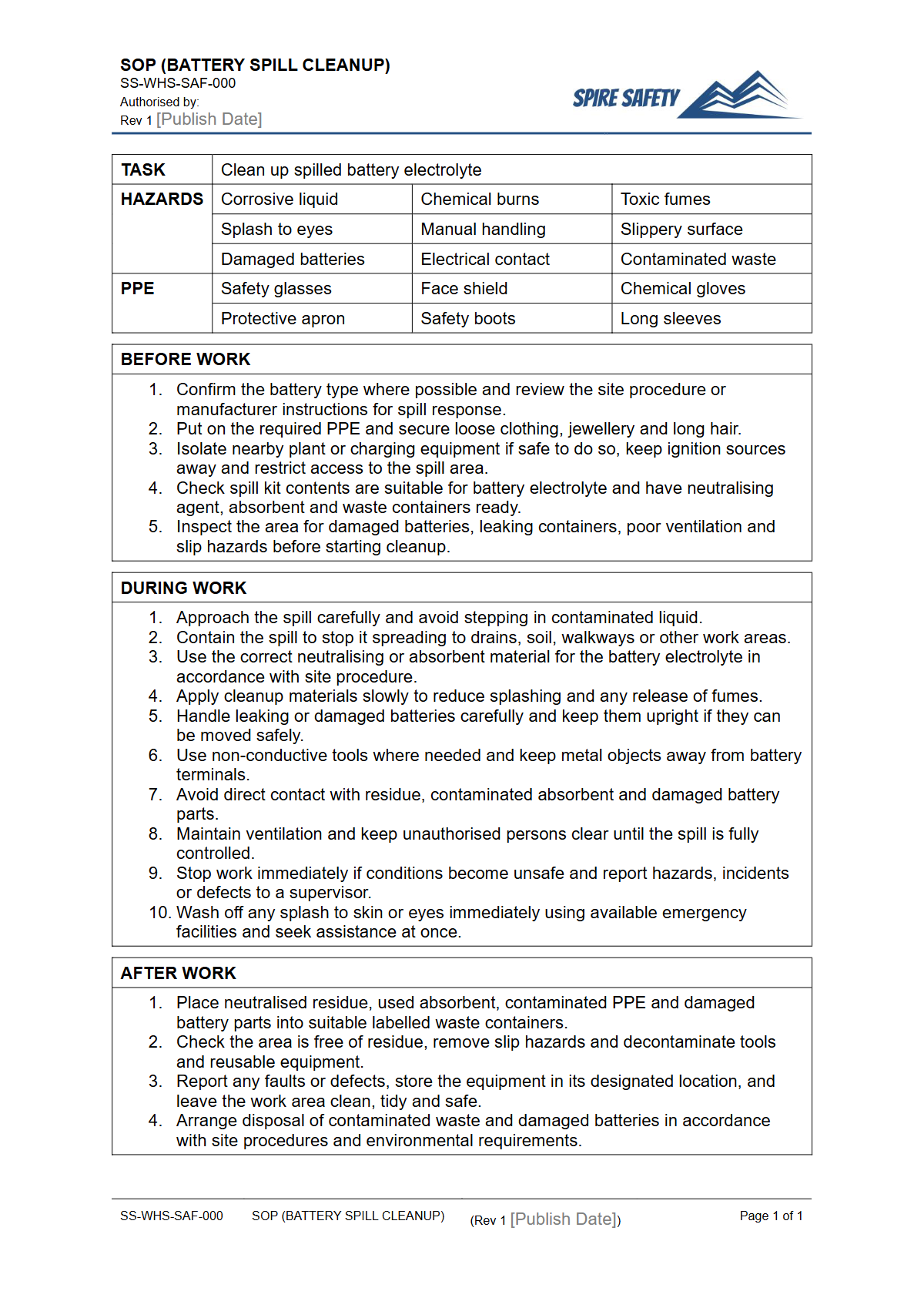
Purpose of the Free Safe Operating Procedure (Battery Spill Cleanup) Template
Managing a battery acid spill requires a swift, safe, and systematic response. Our Free Safe Operating Procedure (Battery Spill Cleanup) Template provides a structured framework for documenting these critical steps.
Battery spills, particularly from lead-acid batteries common in vehicles, forklifts, and uninterruptible power supplies (UPS), pose significant risks. These include severe chemical burns from sulphuric acid, respiratory irritation from fumes, and the potential for fire or explosion from hydrogen gas produced during charging or short-circuiting.
Having a documented SOP ensures that workers have clear, unambiguous instructions to follow, minimising harm to people and the environment.
A well-developed SOP is a cornerstone of a proactive safety culture and a key element in demonstrating compliance with WHS duties. This template helps a Person Conducting a Business or Undertaking (PCBU) control the risks associated with hazardous chemicals by defining required personal protective equipment (PPE), spill containment methods, neutralisation processes, and waste disposal protocols.
Integrating such procedures is fundamental to building robust WHS management systems that protect your team and your organisation.
Video walkthrough
How to use the Free Safe Operating Procedure (Battery Spill Cleanup) Template
This downloadable template is provided in both DOCX and PDF formats to serve as a comprehensive starting point. It is not a finished document.
You must adapt it to reflect the specific hazards and operational context of your worksite. The procedure must be developed in consultation with your workers and any health and safety representatives.
To properly implement this Safe Operating Procedure, you should:
- Conduct a site-specific risk assessment for battery handling, storage, and spill scenarios.
- Specify the exact type and location of batteries used (e.g., forklift charging bays, data centre UPS rooms).
- List the precise brand and type of neutralising agent available on-site (e.g., sodium bicarbonate, soda ash).
- Detail the specific PPE required, ensuring it is rated for sulphuric acid protection.
- Include site-specific emergency contact numbers and assembly points.
- Review and approve the final document before training workers on its use.
Please note: We have drafted this template to be as comprehensive as possible, but it must be customised to the specific batteries, chemicals, equipment, and conditions in your workplace. In workshops where vehicle maintenance occurs, integrating this procedure with others, such as a Safe Operating Procedure for body trucks, ensures comprehensive coverage of related tasks and hazards.
When to use it
This SOP should be actioned immediately upon the discovery of any leak or spill from a lead-acid battery. It is a response document intended for emergency situations.
Beyond its use during an incident, it serves as a vital training tool. All relevant personnel should be inducted and trained on this procedure before they are required to work with or near large batteries.
Regular refresher training, including practical spill drills, is recommended to ensure competency and preparedness. The finalised procedure should be kept with the spill kit and be clearly visible in all areas where batteries are stored, charged, or handled.
This level of preparation is crucial in any industrial setting. For instance, a workshop might have procedures for various equipment, and the battery cleanup SOP complements other documents like an air compressor SOP by addressing a specific, high-risk hazard within that environment.
Who should use it
This Safe Operating Procedure is primarily for workers and emergency response teams who are trained and authorised to clean up hazardous chemical spills. They are the individuals who will follow the step-by-step instructions during an incident.
Supervisors and managers also have a critical role; they must ensure that the necessary resources, including fully-stocked spill kits and appropriate PPE, are available and that workers are adequately trained. They are also responsible for overseeing the cleanup process and ensuring the procedure is followed correctly.
WHS managers and PCBUs use the document to fulfil their due diligence obligations. Regular reviews and updates to the SOP, triggered by incidents, changes in legislation, or workplace changes, are essential.
The effectiveness of such procedures is often a key focus during internal and external safety reviews, which can be part of a formal WHS compliance auditing program. Similar to how a plasma cutter Safe Operating Procedure guides safe equipment use, this SOP guides a safe response to a specific hazardous event.
This template is one of many documents designed to help your organisation manage workplace risks effectively. For more tools to support your safety systems, explore our complete free WHS resources library for checklists, policies, and other procedure templates.
Common mistakes
Common mistakes to avoid
- Using water to clean up a concentrated acid spill, which can cause a violent reaction and splash acid.
- Failing to properly ventilate the area, allowing flammable hydrogen gas to accumulate.
- Incorrect disposal of cleanup materials, which are considered hazardous waste.
- Wearing inadequate or incorrect PPE, leading to chemical burns or respiratory injury.
Legal references
Legal considerations
The following legal requirements may be relevant to this type of work.
- Work Health and Safety Act (Harmonised) — Provides the primary duties for protecting workers and other people from work health and safety risks.
- Work Health and Safety Regulations (Harmonised) — Sets out requirements supporting the management of workplace hazards and risks.
The following codes may be relevant to this type of work.
- Managing WHS Risks Code of Practice — Provides practical guidance on identifying hazards, assessing risks and applying effective controls.
- Work Health and Safety Consultation, Cooperation and Coordination Code of Practice — Provides practical guidance on consulting workers and coordinating with other duty holders.
- Managing the Work Environment and Facilities Code of Practice — Provides practical guidance on safe work environments, workplace facilities and related controls.
Did you know
Acid Strength
The sulphuric acid in a fully charged lead-acid battery is highly concentrated, typically between 30-50%, with a pH of around 0.5. This makes it extremely corrosive and capable of causing severe chemical burns on contact.
Hydrogen Gas
A byproduct of charging lead-acid batteries is hydrogen gas. It is colourless, odourless, and highly flammable, posing a significant explosion risk if it accumulates in an enclosed space with an ignition source.
FAQ
Frequently asked questions
01What PPE is required for cleaning up a battery acid spill?
02How do you neutralise a lead-acid battery spill?
03What are the legal requirements for managing hazardous chemical spills in Australia?
04Can I use this SOP for lithium-ion battery incidents?
Share this resource
Free Safe Operating Procedure (Battery Spill Cleanup) Template
Browse Categories
How To Use It
- 1Download and open in Word or PDF.
- 2Replace the placeholders with your business details.
- 3Get it reviewed by a WHS specialist before rollout.
Need it customised?
Our WHS consultants can adapt this template to your site, run a gap analysis, or audit what you already have in place.
Book a Free Consultation WHS consulting servicesor call 1300 156 382
Related templates
- Free Safe Operating Procedure (Battery Storage) Template
- Free Safe Operating Procedure (Battery Tester) Template
- Free Safe Operating Procedure (BBQ Area Cleanup) Template
- Free Safe Operating Procedure (Beading Machine) Template
- Free Safe Operating Procedure (Beam Clamp) Template
- Free Safe Operating Procedure (Bearing Puller) Template