
Free Safe Operating Procedure (Beam Clamp) Template
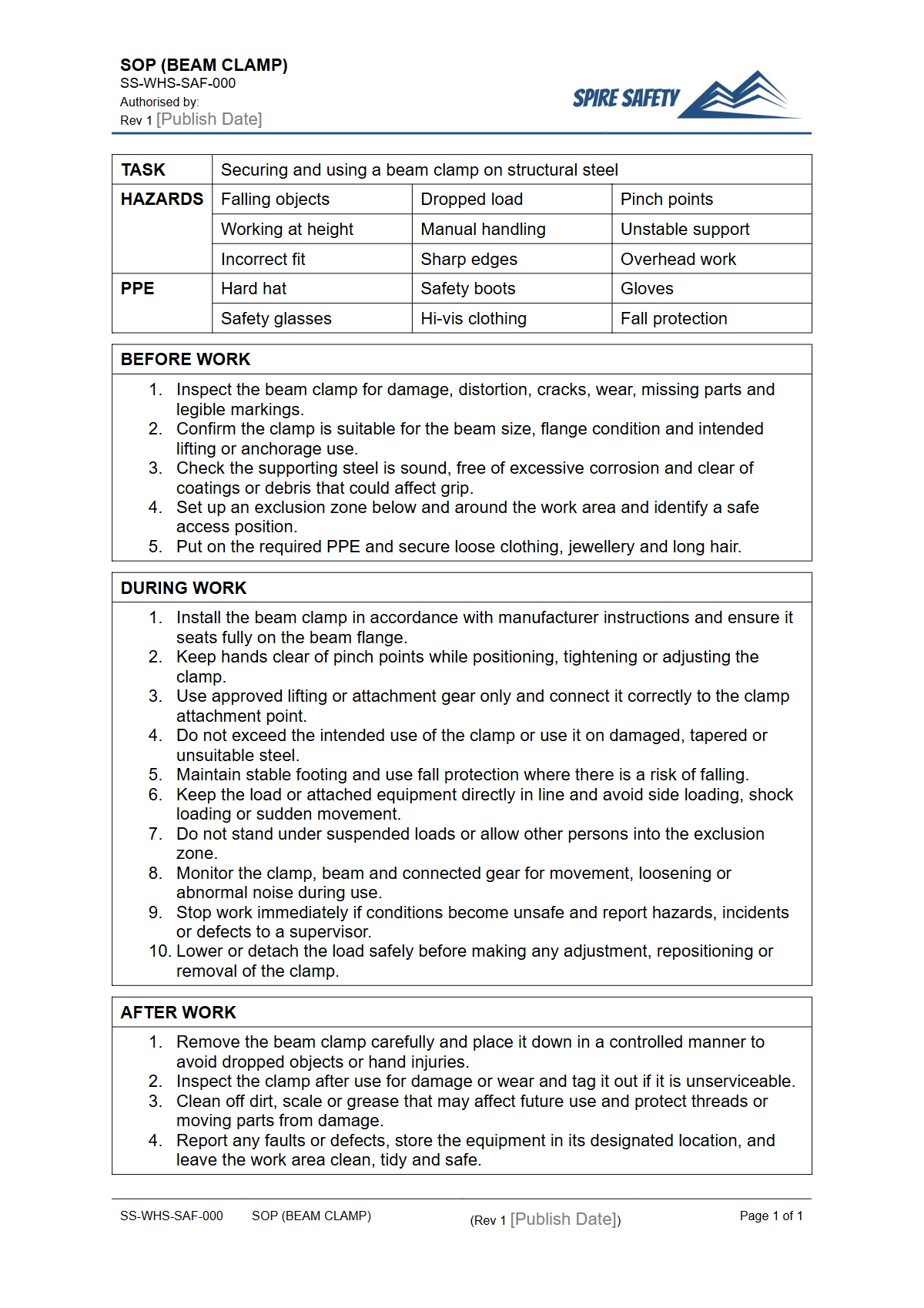
Download our free Beam Clamp SOP template. This customisable Safe Operating Procedure helps you document safe work methods in DOCX and PDF formats.
Free Safe Operating Procedure (Beam Clamp) Template
DOCX • 126 KB + PDF
Updated Oct 2026
No signup required
Purpose of the Free Safe Operating Procedure (Beam Clamp) Template
A beam clamp is a common piece of lifting gear used to create a secure anchor point on an I-beam or similar structural member. While highly effective, their misuse can lead to catastrophic failures, including dropped loads and structural damage.
This Free Safe Operating Procedure (Beam Clamp) Template provides a structured starting point for documenting the required steps to use this equipment safely. It guides you in outlining the pre-operational checks, correct attachment methods, and operational controls needed to manage risks.
Developing a clear SOP helps your organisation meet its duty of care under Australian WHS laws by providing workers with clear instruction, training, and supervision. It formalises the expected safety behaviour when setting up, using, and inspecting beam clamps.
Proper documentation is a cornerstone of effective WHS management systems, ensuring consistent and safe practices across all teams.
Video walkthrough
How to use the Free Safe Operating Procedure (Beam Clamp) Template
This document is provided in DOCX format, allowing for full customisation to suit your specific workplace, equipment, and operational context. A PDF version is also available for easy distribution and printing.
To use this Safe Operating Procedure template effectively, you must identify the specific models of beam clamps used on your site and incorporate their manufacturer-supplied operating instructions, load capacities, and limitations.
Important: This is a template only. We are not familiar with your specific operational environment, the plant you use, or the unique risks in your workplace.
It is your responsibility to customise this document to reflect your actual processes and ensure it is suitable for your business needs. Generic procedures are insufficient; they must be made site-specific to be effective.
For assistance in adapting this or other technical documents, consider our general WHS consulting services.
When to use a Beam Clamp SOP
A Safe Operating Procedure for beam clamps should be used as a primary reference document in several key situations. It forms the basis of operator training and competency assessments for any worker tasked with rigging loads or using lifting equipment.
It should also be readily available in the work area for quick reference during pre-start checks or task planning.
The SOP is also a critical tool for supervisors when conducting safety observations or task audits. Following an incident or near-miss involving lifting operations, the SOP should be reviewed and updated to incorporate any lessons learned.
Similarly, if you are working with different equipment, you might require a specific telehandler SOP for that machinery.
Who should use this Safe Operating Procedure
This procedure is intended for use by all personnel involved in lifting operations using beam clamps. This includes, but is not limited to:
- Workers and operators responsible for attaching and using beam clamps.
- Riggers and doggers who plan and execute lifts.
- Supervisors and team leaders who oversee work involving lifting gear.
- WHS managers and advisors responsible for developing and reviewing safety documentation.
- Maintenance personnel who inspect, test, and tag lifting equipment.
Ensuring that documented procedures are followed is a key part of operational safety. Regular checks can confirm that the steps outlined in the SOP are being implemented correctly on the ground, which is a common focus of a WHS compliance auditing program.
If your workplace uses other common equipment, you may also benefit from our step ladder SOP to ensure consistency in your safety documentation.
This SOP is one of many useful documents available in our free WHS resources library, which covers a wide range of equipment and work tasks.
Common mistakes
Common mistakes to avoid
- Using the clamp on a beam flange that is too thick, too thin, or tapered.
- Failing to properly tighten the clamp's threaded spindle to the manufacturer's torque specification.
- Applying a load from an angle (side loading) to a clamp not specifically rated for it.
- Neglecting to inspect the clamp's pads, spindle, and body for wear, cracks, or deformation before each use.
Legal references
Legal considerations
The following legal requirements may be relevant to this type of work.
- Work Health and Safety Act (Harmonised) — Provides the primary duties for protecting workers and other people from work health and safety risks.
- Work Health and Safety Regulations (Harmonised) — Sets out requirements supporting the management of workplace hazards and risks.
The following codes may be relevant to this type of work.
- Managing WHS Risks Code of Practice — Provides practical guidance on identifying hazards, assessing risks and applying effective controls.
- Work Health and Safety Consultation, Cooperation and Coordination Code of Practice — Provides practical guidance on consulting workers and coordinating with other duty holders.
- Managing the Work Environment and Facilities Code of Practice — Provides practical guidance on safe work environments, workplace facilities and related controls.
Did you know
Direction Matters
Most standard beam clamps are designed for vertical loading only. Applying a side load or 'fleeting' angle can dramatically reduce the clamp's Working Load Limit (WLL) and may cause it to slip or fail.
Proof Load Testing
Under Australian Standard AS 4991, lifting devices like beam clamps are typically proof load tested by the manufacturer to twice their WLL before being sold. This test verifies the integrity of the clamp but does not mean it can be used above its WLL in service.
FAQ
Frequently asked questions
01What is a Safe Operating Procedure (SOP) for a beam clamp?
02Is a Safe Work Method Statement (SWMS) the same as an SOP for a beam clamp?
03How often should a beam clamp SOP be reviewed?
04Who is responsible for inspecting a beam clamp before use?
Share this resource
Free Safe Operating Procedure (Beam Clamp) Template
Browse Categories
How To Use It
- 1Download and open in Word or PDF.
- 2Replace the placeholders with your business details.
- 3Get it reviewed by a WHS specialist before rollout.
Need it customised?
Our WHS consultants can adapt this template to your site, run a gap analysis, or audit what you already have in place.
Book a Free Consultation WHS consulting servicesor call 1300 156 382
Related templates
- Free Safe Operating Procedure (Bearing Puller) Template
- Free Safe Operating Procedure (Beauty Bed Cleaning) Template
- Free Safe Operating Procedure (Bed Alarm Setup) Template
- Free Safe Operating Procedure (Bed Rail Inspection) Template
- Free Safe Operating Procedure (Bed Table Cleaning) Template
- Free Safe Operating Procedure (Bed Wheel Lock Check) Template