
Free Safe Operating Procedure (Bed Alarm Setup) Template
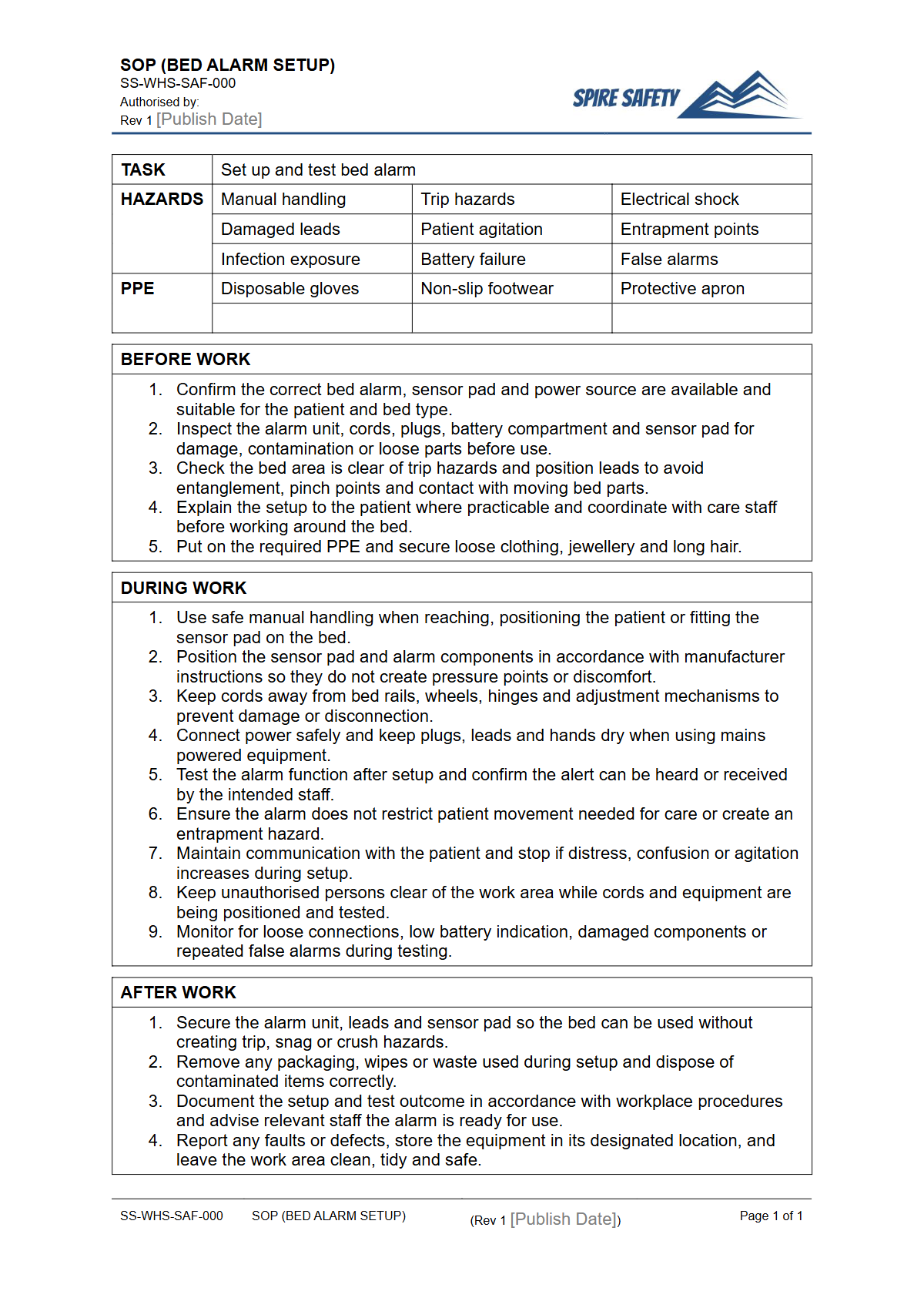
Download our free Safe Operating Procedure (Bed Alarm Setup) template for healthcare and aged care.
Free Safe Operating Procedure (Bed Alarm Setup) Template
DOCX • 126 KB + PDF
Updated Oct 2026
No signup required
Purpose of the Free Safe Operating Procedure (Bed Alarm Setup) Template
Establishing a clear and consistent process for using patient safety equipment is critical in healthcare and aged care settings. This Free Safe Operating Procedure (Bed Alarm Setup) Template provides a structured framework for correctly installing, testing, and monitoring bed alarm systems.
The primary purpose is to minimise the risk of patient falls, which are a leading cause of injury, by ensuring staff follow a standardised, best-practice method. A well-documented SOP demonstrates a commitment to patient safety and forms a vital part of your facility's overall risk management strategy.
Using this template helps ensure that all team members, regardless of their shift or experience level, handle bed alarms in the same way. This consistency is fundamental for reliable care delivery and reduces ambiguity in critical tasks.
Documenting procedures like this is a core component of effective WHS management systems, providing clarity for workers and evidence of proactive risk control.
Video walkthrough
How to use the Free Safe Operating Procedure (Bed Alarm Setup) Template
This document is a template, not a finished procedure. To be effective, it must be adapted to the specific context of your organisation.
Download the DOCX file and customise it to reflect your equipment, environment, and internal protocols. Your final SOP should detail the exact make and model of the bed alarms you use, specific battery check procedures, and your facility's unique escalation process if an alarm is triggered and the patient is not in bed.
The process for implementation involves several key steps:
- Customise: Add your company name, logo, and specific procedural details. Reference the manufacturer's instructions for your particular alarm models.
- Review: Have a senior clinician or WHS officer review the customised document to ensure it aligns with clinical governance and safety standards.
- Train: Formally train all relevant clinical and care staff on the finalised SOP. This must include hands-on demonstration, not just reading the document.
- Implement: Roll out the SOP across all relevant wards or areas. Ensure supervisors monitor its application.
- Review Regularly: Schedule periodic reviews of the SOP (e.g., annually or after a fall-related incident) to ensure it remains current and effective. Just as you might have an SOP for using a step ladder to prevent physical injury, this procedure is vital for preventing patient harm.
A Note on Customisation
We have provided this template as a starting point based on common industry practice. You must take responsibility for adapting it to your specific workplace.
This includes conducting your own risk assessment for the task and ensuring the final document is practical, understood by your staff, and meets all relevant clinical and safety standards for your jurisdiction.
When to use it
This Safe Operating Procedure should be integrated into your facility’s falls prevention program and care planning processes. It should be consulted and followed every time a bed alarm is initiated, adjusted, or discontinued for a patient or resident.
Key triggers for using the SOP include a new patient admission where a falls risk is identified, a change in a patient's mobility or cognitive status, or as a response to a recent fall.
The procedure also serves as a crucial training tool for new staff and a reference for annual competency refreshers. It can be used during internal safety reviews and audits to benchmark practice against documented standards.
Regularly reviewing its application is a key activity in any WHS compliance auditing program focused on clinical safety.
Who should use it
This SOP is intended for all clinical and care staff responsible for direct patient care in environments where bed alarms are used. This typically includes:
- Registered Nurses (RNs)
- Enrolled Nurses (ENs)
- Assistants in Nursing (AINs)
- Personal Care Workers (PCWs)
Managers, team leaders, and clinical educators should also use the document to oversee implementation, provide training, and ensure consistent application. Work Health and Safety (WHS) officers and consultants can use it as part of a broader strategy to manage risks within the healthcare environment.
If your organisation needs assistance developing comprehensive safety procedures, Spire Safety offers expert WHS consulting tailored to the healthcare sector.
You can explore our complete collection of procedural templates and checklists in our free WHS resources library to support safety across all your operations.
Common mistakes
Common mistakes to avoid
- Placing the sensor mat incorrectly in the bed, leading to false alarms or missed activations.
- Failing to test the alarm's sound and connection to the nurse call system after setup.
- Not clearly communicating the purpose of the alarm to the patient or their family, causing anxiety or confusion.
- Relying solely on the alarm and reducing the frequency of essential in-person checks on the patient.
Legal references
Legal considerations
The following legal requirements may be relevant to this type of work.
- Work Health and Safety Act (Harmonised) — Provides the primary duties for protecting workers and other people from work health and safety risks.
- Work Health and Safety Regulations (Harmonised) — Sets out requirements supporting the management of workplace hazards and risks.
The following codes may be relevant to this type of work.
- Managing WHS Risks Code of Practice — Provides practical guidance on identifying hazards, assessing risks and applying effective controls.
- Work Health and Safety Consultation, Cooperation and Coordination Code of Practice — Provides practical guidance on consulting workers and coordinating with other duty holders.
- Managing the Work Environment and Facilities Code of Practice — Provides practical guidance on safe work environments, workplace facilities and related controls.
Did you know
Falls in Aged Care
In Australia, it is estimated that up to 50% of residents in aged care facilities fall at least once every year. Bed alarms are a key technological aid used as part of a multi-faceted falls prevention strategy.
FAQ
Frequently asked questions
01What is a bed alarm and why is a Safe Operating Procedure necessary?
02Is this template suitable for all types of bed alarms (e.g., pressure pads, infrared beams)?
03How often should our Bed Alarm Setup SOP be reviewed?
04Can this SOP template replace hands-on staff training?
Share this resource
Free Safe Operating Procedure (Bed Alarm Setup) Template
Browse Categories
How To Use It
- 1Download and open in Word or PDF.
- 2Replace the placeholders with your business details.
- 3Get it reviewed by a WHS specialist before rollout.
Need it customised?
Our WHS consultants can adapt this template to your site, run a gap analysis, or audit what you already have in place.
Book a Free Consultation WHS consulting servicesor call 1300 156 382
Related templates
- Free Safe Operating Procedure (Bed Rail Inspection) Template
- Free Safe Operating Procedure (Bed Table Cleaning) Template
- Free Safe Operating Procedure (Bed Wheel Lock Check) Template
- Free Safe Operating Procedure (Bedroom Safety Check) Template
- Free Safe Operating Procedure (Bedside Curtain Change) Template
- Free Safe Operating Procedure (Bedside Locker Cleaning) Template