
Free Safe Operating Procedure (Bedside Curtain Change) Template
Download our free Safe Operating Procedure (Bedside Curtain Change) template. This DOCX & PDF resource helps manage infection control and manual handling risks.
Free Safe Operating Procedure (Bedside Curtain Change) Template
DOCX • 126 KB + PDF
Updated Oct 2026
No signup required
Purpose of the Free Safe Operating Procedure (Bedside Curtain Change) Template
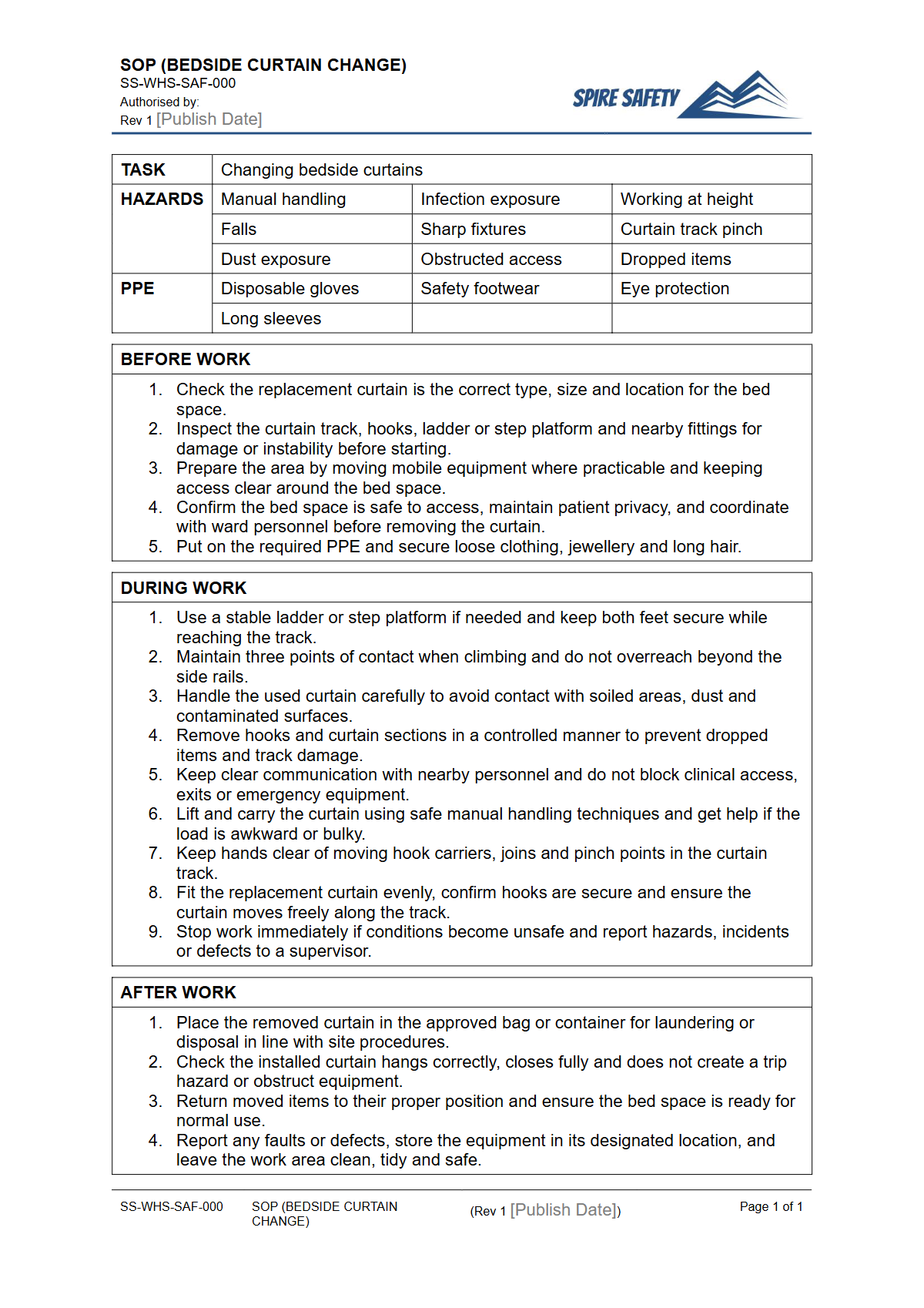
Changing bedside and privacy curtains in healthcare, aged care, or clinical settings presents several workplace health and safety risks. Our Free Safe Operating Procedure (Bedside Curtain Change) Template provides a structured framework for documenting the required steps to perform this task safely.
Following a formal SOP helps your organisation manage its duty of care by controlling hazards, standardising procedures, and providing a clear resource for worker training and supervision.
This Safe Operating Procedure template is designed to address key risks associated with the task. These include biological hazards from contact with soiled or contaminated fabrics, musculoskeletal injuries from awkward postures and forceful movements, and the risk of falls when working at height. Formalising your process helps integrate safety measures directly into the workflow, forming a critical component of your facility's infection control program and broader WHS management systems.
Key Hazards Addressed
- Biological/Infection Control: Handling used curtains can expose workers to bacteria, viruses, and other pathogens. The SOP outlines steps for using appropriate Personal Protective Equipment (PPE) and correct handling and disposal methods to minimise cross-contamination.
- Ergonomic/Manual Handling: Removing and hanging curtains, which can be heavy and awkward, often involves reaching overhead, twisting, and applying force. These actions can lead to sprains, strains, and other musculoskeletal disorders. The procedure guides workers on correct body positioning and handling techniques.
- Falls from Height: Accessing curtain tracks often requires the use of a step ladder or stool. A fall, even from a low height, can cause serious injury. The SOP reinforces the need for correct equipment selection and use, consistent with procedures detailed in resources like our FREE Step Ladder SOP Template.
Video walkthrough
How to use the Free Safe Operating Procedure (Bedside Curtain Change) Template
This document is a template and must be customised to suit the specific environment and equipment at your workplace. Download the DOCX file and adapt it by adding your company name, logo, and site-specific details.
Consult with your workers during this process to ensure the procedure is practical and reflects the realities of the task. Pay close attention to sections covering PPE, emergency procedures, and waste disposal, as these can vary significantly between facilities.
Once customised, the SOP should be used as a primary reference for training all relevant personnel. It should be made readily accessible in the work area.
To remain effective, the document requires periodic review. We recommend reviewing your SOP annually, after any incident, or whenever there is a change in equipment (e.g., new curtain track system), chemicals, or work practices.
Incorporating this review into a schedule of WHS compliance auditing ensures your safety documentation remains current and effective.
The specific process for disposing of used curtains must be clearly defined. This may be part of a larger waste management plan that involves dedicated transport and handling protocols. For related tasks involving vehicles, a similar procedural approach is necessary, such as that outlined in our free Body Truck SOP template.
When to use this Safe Operating Procedure
A Safe Operating Procedure for changing bedside curtains should be used consistently as the standard for performing the task. Its primary applications include the induction and training of new staff, refresher training for existing workers, and as a tool for supervisors to monitor and confirm correct procedure.
It also serves as an excellent pre-start checklist, allowing workers to quickly reference key safety steps before they begin.
This document provides a consistent structure that can be applied across various operational tasks within your organisation. Adopting a standardised format, similar to our templates for different equipment like an air compressor SOP, helps create a cohesive and easy-to-understand system of safety documents for your workforce.
Who should use this document
This SOP is intended for any person required to change bedside or privacy curtains as part of their duties. This includes a range of roles within healthcare and associated facilities, such as:
- Healthcare Workers (Nurses, Assistants in Nursing)
- Cleaners and Environmental Services Staff
- Facility Maintenance Personnel
- Supervisors and Team Leaders responsible for health and safety
By providing clear, step-by-step instructions, the SOP empowers workers to carry out their duties with a full understanding of the associated risks and control measures. For more procedural documents and safety templates, explore our complete free WHS resources library.
Common mistakes
Common mistakes to avoid
- Forgetting to communicate with the patient or resident before entering their space.
- Using incorrect manual handling techniques when removing or hanging heavy or awkward curtains.
- Failing to wear the required PPE, such as gloves and gowns, when handling soiled items.
- Not performing hand hygiene before and after the task is completed.
Legal references
Legal considerations
The following legal requirements may be relevant to this type of work.
- Work Health and Safety Act (Harmonised) — Provides the primary duties for protecting workers and other people from work health and safety risks.
- Work Health and Safety Regulations (Harmonised) — Sets out requirements supporting the management of workplace hazards and risks.
The following codes may be relevant to this type of work.
- Managing WHS Risks Code of Practice — Provides practical guidance on identifying hazards, assessing risks and applying effective controls.
- Work Health and Safety Consultation, Cooperation and Coordination Code of Practice — Provides practical guidance on consulting workers and coordinating with other duty holders.
- Managing the Work Environment and Facilities Code of Practice — Provides practical guidance on safe work environments, workplace facilities and related controls.
Did you know
Infection Control Hotspot
Studies have shown that hospital privacy curtains can become contaminated with potentially dangerous bacteria like MRSA within a week of being laundered, highlighting their role as a vehicle for healthcare-associated infections (HAIs).
Working at Low Heights
According to Safe Work Australia, a significant number of falls-related serious claims result from falls from a height of less than one metre. Using a step ladder or stool requires a formal safety procedure.
FAQ
Frequently asked questions
01What hazards are associated with changing bedside curtains?
02Why can't I just use a generic procedure for changing curtains?
03How often should our Bedside Curtain Change SOP be reviewed?
04Who is responsible for training workers on this SOP?
Share this resource
Free Safe Operating Procedure (Bedside Curtain Change) Template
Browse Categories
How To Use It
- 1Download and open in Word or PDF.
- 2Replace the placeholders with your business details.
- 3Get it reviewed by a WHS specialist before rollout.
Need it customised?
Our WHS consultants can adapt this template to your site, run a gap analysis, or audit what you already have in place.
Book a Free Consultation WHS consulting servicesor call 1300 156 382
Related templates
- Free Safe Operating Procedure (Bedside Locker Cleaning) Template
- Free Safe Operating Procedure (Beer Line Cleaning) Template
- Free Safe Operating Procedure (Beer Tap Cleaning) Template
- Free Safe Operating Procedure (Belt Loader) Template
- Free Safe Operating Procedure (Belt Sander) Template
- Free Safe Operating Procedure (Bench Polisher) Template