
Free Safe Operating Procedure (Belt Sander) Template
Download our free Safe Operating Procedure (SOP) template for belt sanders. A structured starting point for Australian workplaces to manage risks.
Free Safe Operating Procedure (Belt Sander) Template
DOCX • 126 KB + PDF
Updated Oct 2026
No signup required
Purpose of the Free Safe Operating Procedure (Belt Sander) Template
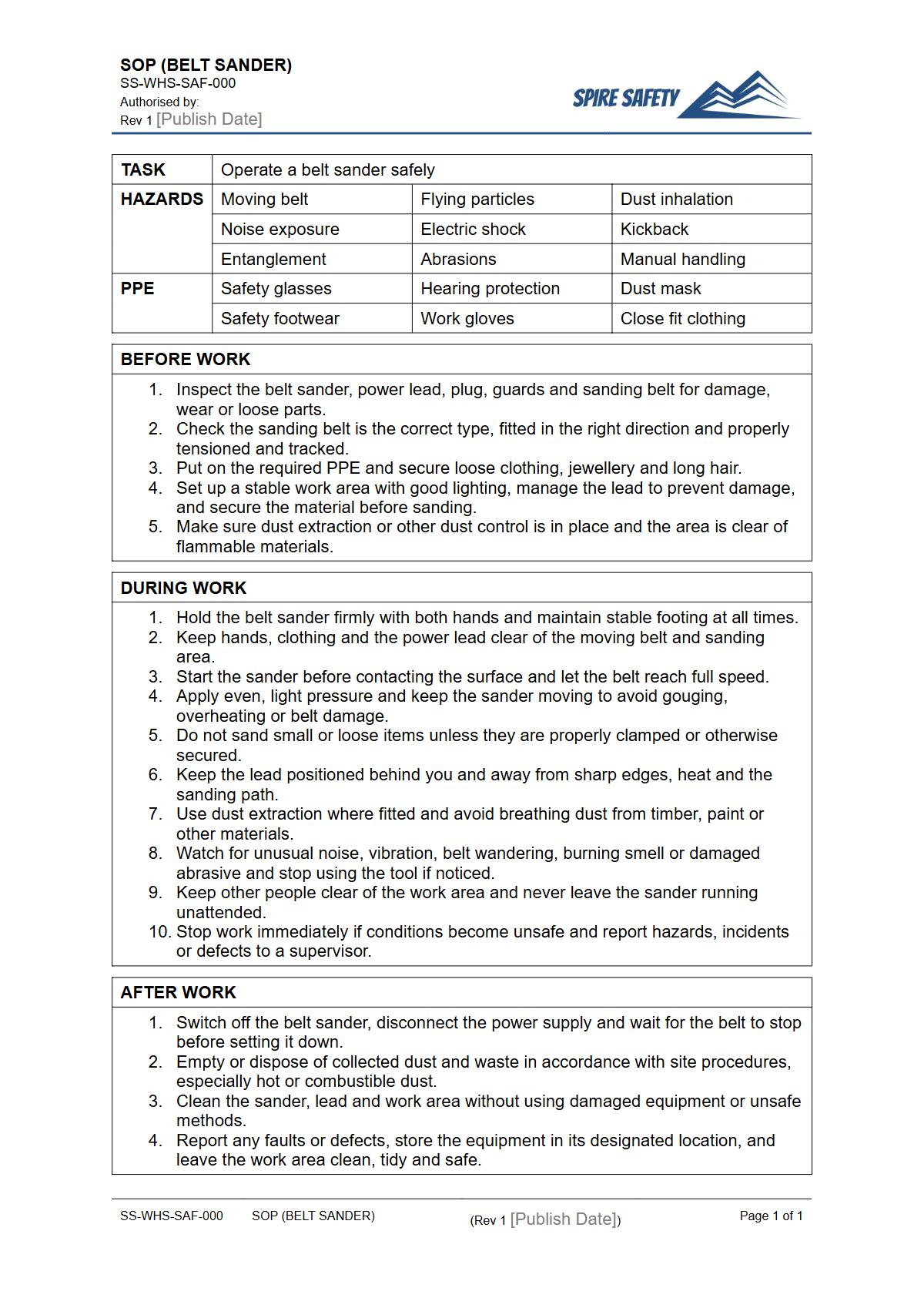
This Free Safe Operating Procedure (Belt Sander) Template provides a structured framework for documenting the safe use of belt sanders in your workplace. Using a belt sander, whether portable or fixed, introduces significant risks including airborne dust, entanglement, abrasion, noise, and vibration.
This template helps you systematically identify these hazards, assess the risks, and outline clear, step-by-step control measures for operators to follow. Formalising your process is a critical component of robust WHS management systems, ensuring that every worker understands the required safety protocols before, during, and after operation.
By implementing a specific Safe Operating Procedure (SOP) for this equipment, your organisation can standardise training, improve worker competency, and demonstrate a commitment to meeting its duties under Australian WHS legislation. The document serves as a practical tool for supervisors during toolbox talks and as a reference for workers to ensure they are following the safest method of work.
Video walkthrough
How to use the Free Safe Operating Procedure (Belt Sander) Template
The template is available for download as a DOCX file, which is fully editable in Microsoft Word or other compatible software, and as a PDF for easy distribution and printing. To use it effectively, you should gather information specific to your workplace, including the make and model of the belt sanders in use, the types of materials being worked on, and the existing workshop environment.
Work through each section of the template, replacing the placeholder text with your site-specific details. This includes listing the required Personal Protective Equipment (PPE), detailing pre-start checks, outlining the operational steps, and defining shutdown and cleaning procedures. For similar woodworking or finishing tools, you can adapt the structure from resources like our free Circular Saw SOP template.
Important: This document is a template and not a complete Safe Operating Procedure. We have created it as a solid starting point, but you must customise it to reflect the specific equipment, tasks, and unique environmental conditions of your workplace.
It is essential to consult with the workers who operate the equipment during this customisation process to ensure the SOP is practical and reflects how the work is actually done.
When to use a Safe Operating Procedure
A Safe Operating Procedure for a belt sander should be used as a core part of your safety processes. It is not a document to be filed away and forgotten. It should be actively used in several key situations, including:
- Worker Inductions: When a new worker starts, the SOP should form part of their initial training on the equipment.
- Refresher Training: For existing workers, the SOP can be reviewed periodically during toolbox talks or formal training sessions to reinforce safe practices.
- Before High-Risk Tasks: If a non-standard or particularly hazardous sanding task is required, operators should review the SOP beforehand.
- After an Incident: Following a near-miss or injury involving a belt sander, the SOP must be reviewed and updated to prevent a recurrence.
- During Audits: The SOP serves as evidence of a documented safe system of work during internal or external safety audits.
Consistently using SOPs for various equipment helps build a proactive safety culture. You can establish similar documents for other tools, such as our free Plasma Cutter SOP, to standardise safety across your operations.
Who should use it
Various personnel within an organisation have a role in the development, implementation, and use of this Safe Operating Procedure:
- Workers/Operators: The primary users of the SOP. They must understand and follow the documented procedures every time they use a belt sander.
- Supervisors and Managers: Responsible for ensuring workers are trained on the SOP, have access to it, and are following the procedures. They also lead its implementation and review.
- Persons Conducting a Business or Undertaking (PCBUs): Have the ultimate responsibility to provide safe systems of work, which includes ensuring adequate SOPs are developed and effectively implemented.
- WHS/HSE Professionals: Often facilitate the development and review of SOPs, ensuring they align with legislative requirements and best practices. They may find that seeking expert WHS consulting support can streamline the process of developing a full suite of procedural documents.
Key Hazards and Controls
A belt sander presents several key hazards that must be managed. Your SOP should detail controls for each, including:
- Airborne Dust: Wood, metal, or composite dust can cause respiratory diseases. The primary control is using an integrated dust extraction system connected to the sander. Respiratory Protective Equipment (RPE) should also be specified.
- Entanglement: The moving belt can catch loose clothing, hair, or jewellery. Controls include tying back long hair, removing jewellery, and wearing close-fitting clothing.
- Abrasion/Contact: Accidental contact with the moving belt can cause severe skin abrasions. Controls include maintaining focus, using clamps to secure small workpieces, and keeping hands clear of the belt.
- Noise: Belt sanders can exceed safe noise exposure levels. Controls include specifying the required class of hearing protection.
- Vibration: Prolonged use can lead to Hand-Arm Vibration Syndrome (HAVS). Controls include job rotation, taking regular breaks, and maintaining the sander to minimise vibration.
These controls should align with the hierarchy of controls, prioritising engineering solutions like dust extraction over administrative controls or PPE alone. The principles are similar for other workshop equipment, as outlined in documents like our Air Compressor SOP template. For more guidance, explore our complete free WHS resources library.
Common mistakes
Common mistakes to avoid
- Failing to securely clamp the workpiece, leading to it being thrown by the sander.
- Applying excessive pressure, which can damage the motor, scorch the material, and reduce control.
- Neglecting to use or connect an appropriate dust extraction system, creating a serious respiratory hazard.
- Sanding against the edge of the belt, which can cause the workpiece to be violently kicked back.
Legal references
Legal considerations
The following legal requirements may be relevant to this type of work.
- Work Health and Safety Act (Harmonised) — Provides the primary duties for protecting workers and other people from work health and safety risks.
- Work Health and Safety Regulations (Harmonised) — Sets out requirements supporting the management of workplace hazards and risks.
The following codes may be relevant to this type of work.
- Managing WHS Risks Code of Practice — Provides practical guidance on identifying hazards, assessing risks and applying effective controls.
- Work Health and Safety Consultation, Cooperation and Coordination Code of Practice — Provides practical guidance on consulting workers and coordinating with other duty holders.
- Managing the Work Environment and Facilities Code of Practice — Provides practical guidance on safe work environments, workplace facilities and related controls.
Did you know
Wood Dust Hazard
Certain types of wood dust are classified as carcinogenic to humans by Safe Work Australia. Effective dust extraction and respiratory protection are not just best practice; they are critical health controls.
Belt Speed
The abrasive belt on a typical belt sander can travel at speeds of over 1,000 metres per minute. This high speed is what makes it effective for rapid material removal but also extremely dangerous if contact occurs.
FAQ
Frequently asked questions
01What should be included in a Safe Operating Procedure for a belt sander?
02How often should a belt sander SOP be reviewed?
03Is training required in addition to having an SOP?
04What are the main hazards of using a belt sander?
Share this resource
Free Safe Operating Procedure (Belt Sander) Template
Browse Categories
How To Use It
- 1Download and open in Word or PDF.
- 2Replace the placeholders with your business details.
- 3Get it reviewed by a WHS specialist before rollout.
Need it customised?
Our WHS consultants can adapt this template to your site, run a gap analysis, or audit what you already have in place.
Book a Free Consultation WHS consulting servicesor call 1300 156 382
Related templates
- Free Safe Operating Procedure (Bench Polisher) Template
- Free Safe Operating Procedure (Bench Shears) Template
- Free Safe Operating Procedure (Bench Vice) Template
- Free Safe Operating Procedure (Bending Machine) Template
- Free Safe Operating Procedure (Berry Harvesting) Template
- Free Safe Operating Procedure (Bilge Cleaning) Template