
Free Safe Operating Procedure (Bilge Cleaning) Template
Download our free Safe Operating Procedure (Bilge Cleaning) template.
Free Safe Operating Procedure (Bilge Cleaning) Template
DOCX • 126 KB + PDF
Updated Oct 2026
No signup required
Purpose of the Free Safe Operating Procedure (Bilge Cleaning) Template
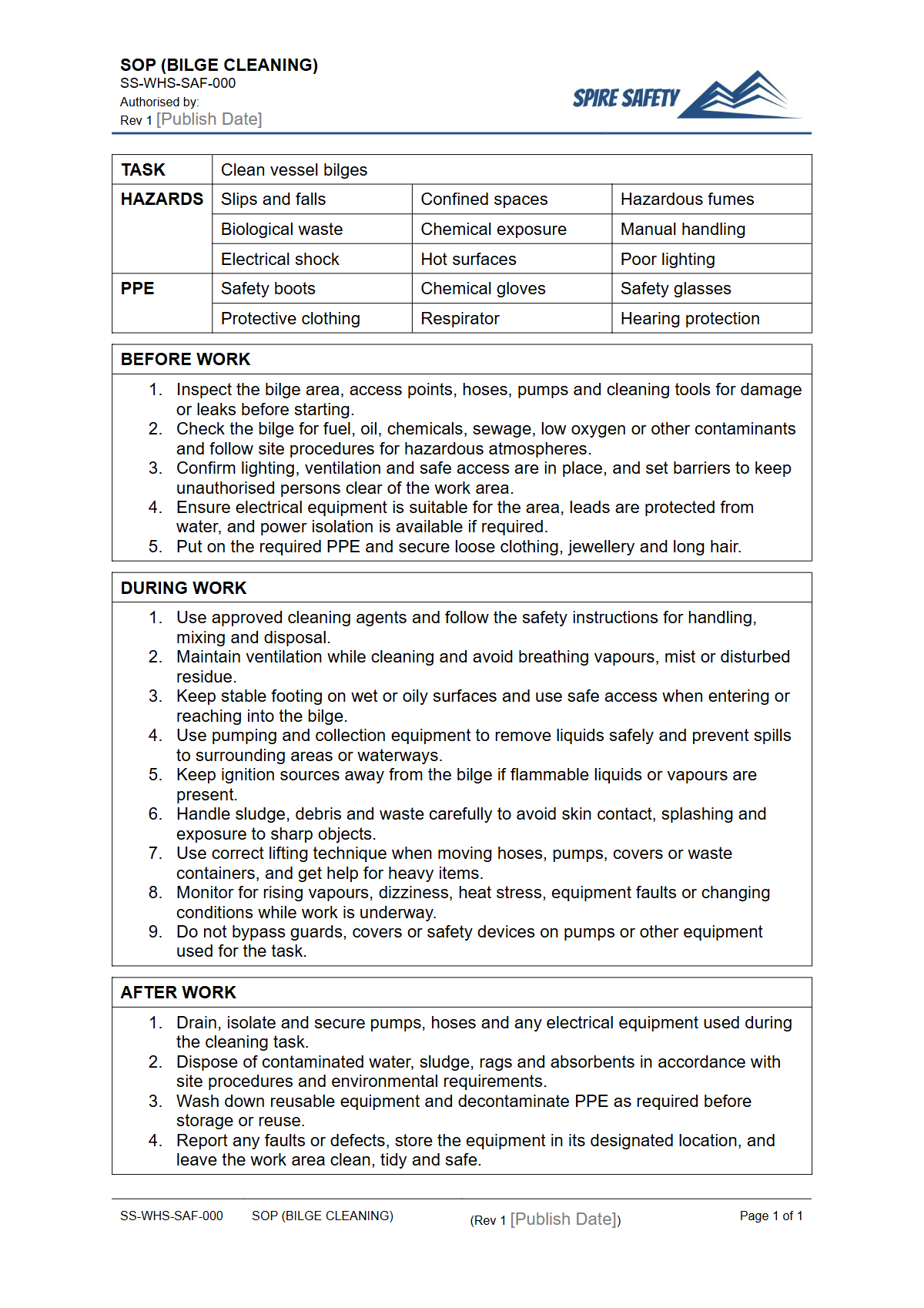
Bilge cleaning is a critical maintenance task on any vessel, but it comes with significant health, safety, and environmental risks. This free Safe Operating Procedure (Bilge Cleaning) Template provides a structured framework to help your organisation document a clear, step-by-step process for performing this work safely.
It prompts you to identify hazards such as confined spaces, hazardous atmospheres, chemical exposure, and slip risks, and to implement effective control measures.
Using a standardised SOP helps ensure that all workers follow the same safe work method every time, reducing the chance of incidents. It forms a key part of your safety documentation and demonstrates a commitment to managing risks.
Properly documented procedures are a cornerstone of effective and comprehensive WHS management systems, providing clarity for workers and supervisors alike.
Video walkthrough
How to use the Free Safe Operating Procedure (Bilge Cleaning) Template
This Safe Operating Procedure for bilge cleaning is provided in both an editable DOCX format and a ready-to-print PDF. To use it effectively, you must download the file and thoroughly customise it to your specific workplace.
This includes adding your company branding and detailing the particular vessels, equipment (pumps, vacuums), cleaning agents, and personal protective equipment (PPE) used by your team. You should also detail procedures for accessing the bilge, which may require referencing your procedures for the safe use of step ladders.
It is crucial to remember that this is a template, not a finished document. We strongly advise you conduct a site-specific risk assessment and customise the content to reflect your unique operational environment, machinery, and legal obligations.
Once customised, the SOP should be used to train all relevant personnel, and a copy should be made easily accessible in the work area.
When to use this Safe Operating Procedure
An SOP for bilge cleaning should be developed and implemented before any such work is carried out. It should be a primary reference document for worker training, inductions, and pre-task safety briefings (toolbox talks).
It also serves as a critical piece of evidence during safety reviews or regular WHS compliance auditing to verify that safe systems of work are in place and being followed.
The SOP should be formally reviewed and updated whenever there is a change to the task, such as the introduction of new cleaning chemicals, new equipment, or after any reported incident or near miss. For example, if new equipment like pneumatic tools are introduced, referencing your free Air Compressor SOP may be necessary.
Who should use it
This template is designed for anyone responsible for the safety and management of maritime or vessel maintenance operations. This includes:
- WHS Managers and Safety Officers
- Vessel Masters, Skippers, and Chief Engineers
- Maintenance Supervisors and Team Leaders
- Marine mechanics and maintenance crew
- Business owners in the maritime or commercial fishing industries
Ultimately, any person conducting, supervising, or planning bilge cleaning activities will benefit from a clear and detailed SOP. If you require assistance in developing complex procedures or integrating them into your existing safety framework, seeking specialist WHS consulting can provide valuable expertise.
You can also explore our free WHS resources library for other useful templates.
Common mistakes
Common mistakes to avoid
- Failing to test the atmosphere for oxygen levels and toxic gases before entry.
- Using incorrect or incompatible cleaning chemicals, creating hazardous reactions.
- Neglecting to secure proper ventilation, leading to a build-up of fumes.
- Improper disposal of oily water and contaminated waste, violating environmental regulations.
Legal references
Legal considerations
The following legal requirements may be relevant to this type of work.
- Work Health and Safety Act (Harmonised) — Provides the primary duties for protecting workers and other people from work health and safety risks.
- Work Health and Safety Regulations (Harmonised) — Sets out requirements supporting the management of workplace hazards and risks.
The following codes may be relevant to this type of work.
- Managing WHS Risks Code of Practice — Provides practical guidance on identifying hazards, assessing risks and applying effective controls.
- Work Health and Safety Consultation, Cooperation and Coordination Code of Practice — Provides practical guidance on consulting workers and coordinating with other duty holders.
- Managing the Work Environment and Facilities Code of Practice — Provides practical guidance on safe work environments, workplace facilities and related controls.
Did you know
Oily Water Separators
Many commercial vessels are required by international MARPOL regulations to have an Oily Water Separator (OWS) to treat bilge water before it can be discharged overboard, preventing marine pollution.
Confined Space Risk
A ship's bilge is often classified as a confined space, meaning it has restricted entry/exit and is not designed for continuous occupancy, posing significant risks from atmospheric hazards.
FAQ
Frequently asked questions
01What are the main hazards involved in bilge cleaning?
02Is a Safe Operating Procedure a legal requirement for bilge cleaning in Australia?
03What should be included in a bilge cleaning SOP?
04How often should a Bilge Cleaning SOP be reviewed?
Share this resource
Free Safe Operating Procedure (Bilge Cleaning) Template
Browse Categories
How To Use It
- 1Download and open in Word or PDF.
- 2Replace the placeholders with your business details.
- 3Get it reviewed by a WHS specialist before rollout.
Need it customised?
Our WHS consultants can adapt this template to your site, run a gap analysis, or audit what you already have in place.
Book a Free Consultation WHS consulting servicesor call 1300 156 382
Related templates
- Free Safe Operating Procedure (Bin Lift Area Setup) Template
- Free Safe Operating Procedure (Bin Wash Station) Template
- Free Safe Operating Procedure (Biohazard Spill Cleanup) Template
- Free Safe Operating Procedure (Biosafety Cabinet) Template
- Free Safe Operating Procedure (Biosolids Handling) Template
- Free Safe Operating Procedure (Bird Net Installation) Template