
Free Safe Operating Procedure (Biosolids Handling) Template
Download our free Safe Operating Procedure (Biosolids Handling) template. This DOCX/PDF resource helps manage biological hazards. Customise it for your site.
Free Safe Operating Procedure (Biosolids Handling) Template
DOCX • 126 KB + PDF
Updated Oct 2026
No signup required
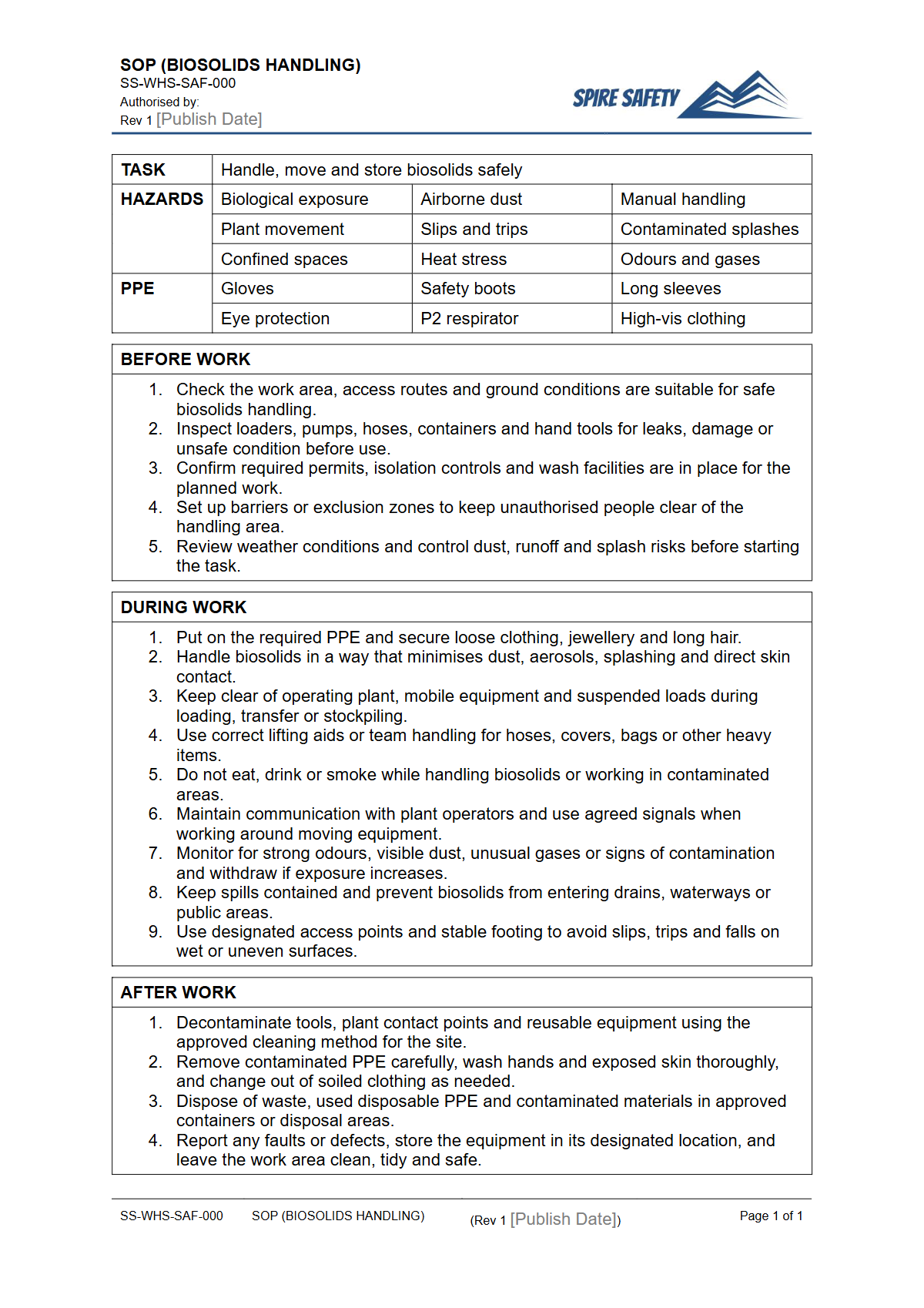
Purpose of the Free Safe Operating Procedure (Biosolids Handling) Template
Handling biosolids, the organic solids produced during wastewater treatment, presents significant health and safety risks if not managed correctly. This free Safe Operating Procedure (Biosolids Handling) Template provides a structured framework for documenting the required steps to perform this task safely.
It is designed to help your organisation control exposure to biological hazards, pathogens, chemicals, and physical risks associated with the collection, transport, storage, and application of biosolids.
Using this template helps a Person Conducting a Business or Undertaking (PCBU) meet their primary duty of care under WHS law. It provides clear, actionable instructions for workers, reducing the likelihood of incidents, injuries, or long-term health effects. The document prompts consideration of key safety elements such as hazard identification, required Personal Protective Equipment (PPE), pre-operational checks, and emergency response, forming a critical component of your overall WHS management systems.
Video walkthrough
How to use the Free Safe Operating Procedure (Biosolids Handling) Template
This document serves as a comprehensive starting point, aligned with Australian WHS principles. To implement it effectively, you must adapt it to the unique context of your operations.
The process involves downloading the DOCX or PDF, reviewing the content with your team, and customising it to detail your specific machinery, site conditions, types of biosolids handled, and established control measures.
Worker consultation is a mandatory step in this process. Engage with operators, drivers, and supervisors who perform the work to ensure the SOP is practical, accurate, and reflects on-the-ground realities.
Once finalised, the SOP should be used for training, induction, and ongoing competency verification. Regular reviews and updates are essential to keep it relevant.
IMPORTANT: This is a template only. We are not your WHS consultant.
You MUST customise this document to reflect the specific hazards, equipment, controls, and legal requirements of your workplace. If you need assistance, consider engaging specialist WHS consulting services.
When to use it
A Safe Operating Procedure for biosolids handling should be developed and used for all tasks involving potential exposure. This includes, but is not limited to:
- Loading and unloading biosolids from treatment facilities into trucks or containers.
- Transporting biosolids on public roads or across private land. A specific Body Truck SOP may also be relevant for this activity.
- Stockpiling and storing biosolids at designated sites.
- Operating machinery for the land application or incorporation of biosolids.
- Collecting samples for testing and analysis.
- Cleaning and decontaminating equipment and vehicles used in handling operations.
Who should use it
This SOP is intended for all personnel involved in or supervising biosolids handling activities. Key users include:
- Plant Operators and Technicians: For safe operation of dewatering, loading, and storage equipment at treatment plants.
- Truck Drivers and Equipment Operators: For the safe transport and application of biosolids, often involving machinery covered by documents like a Dozer Safe Operating Procedure.
- Agricultural and Landscaping Workers: For tasks related to the receiving and application of biosolids on land.
- Supervisors and Managers: To ensure procedures are followed, provide training, and conduct risk assessments.
- WHS Professionals: To integrate the SOP into the broader safety management system and use it as a basis for audits and inspections.
Properly documented procedures are also vital for demonstrating due diligence and ensuring a consistent, safe approach across all shifts and teams. Using a formal SOP helps standardise work methods and provides a clear benchmark for performance and safety compliance. For tasks involving earthmoving equipment for land application, you might also require a free Scraper SOP.
This is just one of many templates designed to improve workplace safety. For more tools to support your safety systems, browse our complete free WHS resources library.
Common mistakes
Common mistakes to avoid
- Using inadequate or poorly maintained Personal Protective Equipment (PPE).
- Failing to enforce strict personal hygiene practices, such as hand washing, before eating, drinking, or smoking.
- Neglecting to control the generation of dust and aerosols during handling, which can lead to inhalation exposure.
- Not training workers on the specific biological and chemical hazards associated with the grade of biosolids being handled.
Legal references
Legal considerations
The following legal requirements may be relevant to this type of work.
- Work Health and Safety Act (Harmonised) — Provides the primary duties for protecting workers and other people from work health and safety risks.
- Work Health and Safety Regulations (Harmonised) — Sets out requirements supporting the management of workplace hazards and risks.
The following codes may be relevant to this type of work.
- Managing WHS Risks Code of Practice — Provides practical guidance on identifying hazards, assessing risks and applying effective controls.
- Work Health and Safety Consultation, Cooperation and Coordination Code of Practice — Provides practical guidance on consulting workers and coordinating with other duty holders.
- Managing the Work Environment and Facilities Code of Practice — Provides practical guidance on safe work environments, workplace facilities and related controls.
Did you know
Beneficial Reuse
In Australia, over 75% of biosolids are beneficially reused, primarily in agriculture as a fertiliser and soil conditioner, returning valuable nutrients and organic matter to the land.
Pathogen Grading
Biosolids are graded based on pathogen and contaminant levels. This grading determines how they can be safely used, with the highest grades suitable for a wider range of applications.
FAQ
Frequently asked questions
01What are the main hazards of handling biosolids?
02What PPE is typically required for handling biosolids?
03Is this SOP template compliant with Australian regulations?
04How often should a Biosolids Handling SOP be reviewed?
Share this resource
Free Safe Operating Procedure (Biosolids Handling) Template
Browse Categories
How To Use It
- 1Download and open in Word or PDF.
- 2Replace the placeholders with your business details.
- 3Get it reviewed by a WHS specialist before rollout.
Need it customised?
Our WHS consultants can adapt this template to your site, run a gap analysis, or audit what you already have in place.
Book a Free Consultation WHS consulting servicesor call 1300 156 382
Related templates
- Free Safe Operating Procedure (Bird Net Installation) Template
- Free Safe Operating Procedure (Biscuit Jointer) Template
- Free Safe Operating Procedure (Bitumen Kettle) Template
- Free Safe Operating Procedure (Bitumen Sprayer) Template
- Free Safe Operating Procedure (Blade Change) Template
- Free Safe Operating Procedure (Blast Chiller) Template