
Free Safe Operating Procedure (Bitumen Kettle) Template
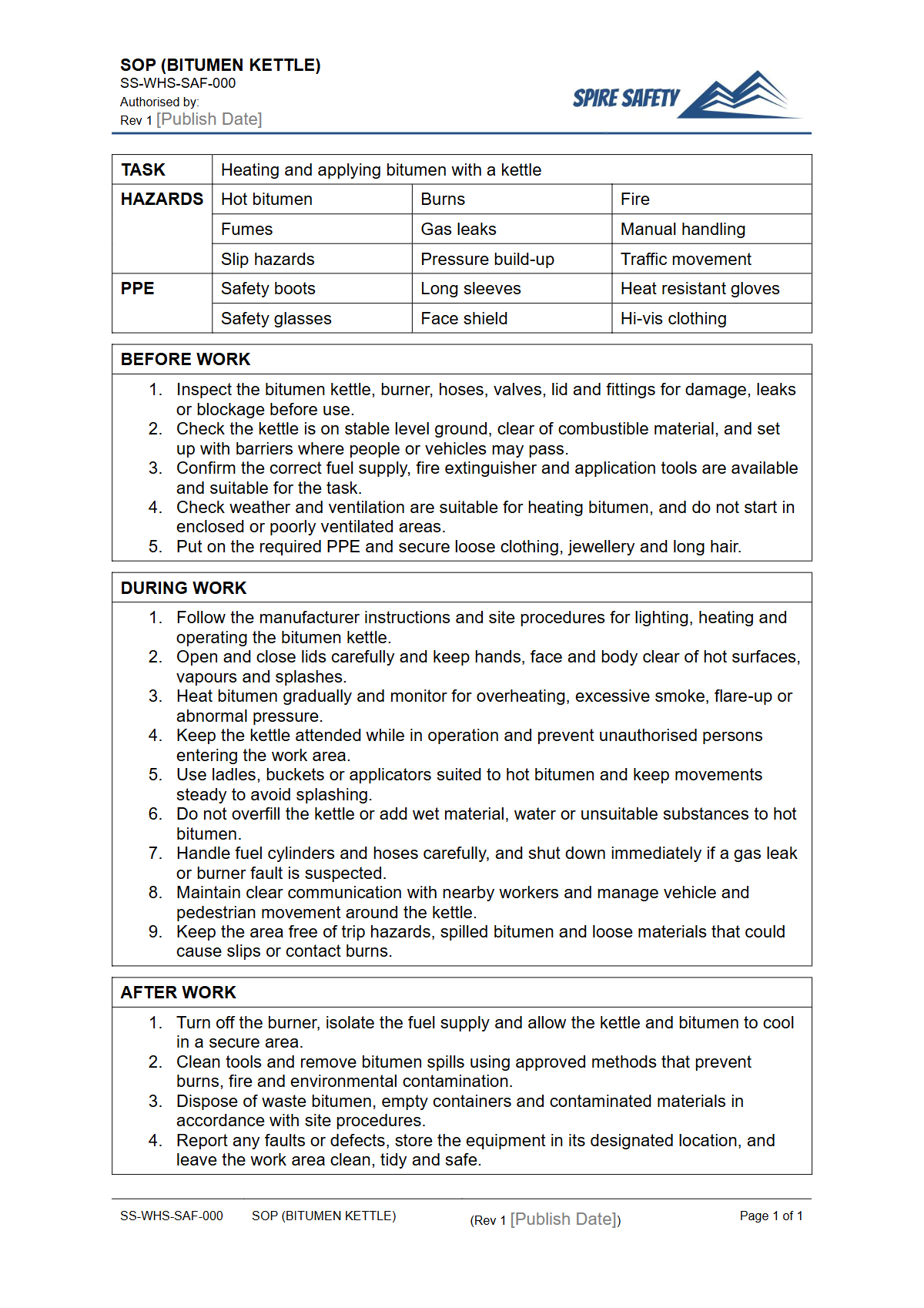
Get a free Safe Operating Procedure for bitumen kettles. This DOCX & PDF template helps document controls to manage severe risks like burns and fires.
Free Safe Operating Procedure (Bitumen Kettle) Template
DOCX • 126 KB + PDF
Updated Oct 2026
No signup required
Purpose of the Free Safe Operating Procedure (Bitumen Kettle) Template
The primary purpose of this Safe Operating Procedure for a bitumen kettle is to provide a clear, documented system of work that minimises risk. Bitumen kettles operate at extremely high temperatures, presenting severe hazards if not managed correctly.
A well-drafted SOP standardises the process, ensuring every operator follows the same safety-critical steps. It serves as a key component of your overall safety management system, demonstrating due diligence in controlling known risks.
This template covers key areas including Personal Protective Equipment (PPE) requirements, pre-start inspections, safe lighting procedures, temperature monitoring, and shutdown protocols. Implementing a thorough SOP is a key control measure, much like having documented procedures for other high-risk plant, such as our free Dozer SOP template.
Video walkthrough
How to use the Free Safe Operating Procedure (Bitumen Kettle) Template
This document is a template, not a finished procedure. To make it effective, you must adapt it to the specific context of your workplace.
Download the DOCX file and begin by reviewing each section against the make and model of bitumen kettle you use, your site conditions, and the specific tasks your workers perform. It is a mandatory WHS requirement to consult with your workers during this process.
They have direct, hands-on experience and can provide invaluable input on the practicalities and risks involved. We strongly recommend that you customise this template in consultation with your team to ensure it is relevant and effective for your business. Once finalised, the SOP should be incorporated into your WHS management systems, used for training, and made readily accessible to all relevant personnel.
When to use this Safe Operating Procedure
A Safe Operating Procedure for a bitumen kettle should be used consistently throughout the equipment's lifecycle at your worksite. Its primary use is as a practical guide for workers before and during operation.
It forms the basis of operator training and competency assessments. The SOP should also be reviewed:
- After any incident, accident, or near-miss involving the bitumen kettle.
- When a new model of kettle is introduced to the worksite.
- If the work environment or the task changes significantly.
- Periodically, as part of a scheduled document review process, which can be verified through a WHS compliance auditing program.
Consistent use and review ensure the procedure remains relevant and effective. Procedures for associated equipment, like those detailed in our free Body Truck SOP template, should also be readily available to workers on site.
Who should use this Safe Operating Procedure
This SOP is intended for several groups within an organisation. Workers and Operators are the primary users; they must follow the documented steps to perform their work safely.
Supervisors and Managers must use the SOP to train workers, induct new staff, and monitor compliance on-site. They are responsible for ensuring the procedure is understood and followed.
Persons Conducting a Business or Undertaking (PCBUs) and WHS Managers use the finalised SOP as evidence of risk management and to meet their duties under WHS legislation. It's a key document that underpins a safe system of work for high-risk activities, similar to procedures for using hazardous tools covered in our free Plasma Cutter SOP.
A robust safety culture relies on having clear, accessible documentation for all types of tasks, from complex machinery to everyday equipment. Even seemingly simple tasks can carry significant risk if not performed correctly.
For example, ensuring proper setup and use of access equipment is critical, which is why we also provide resources like a free Step Ladder SOP template. By documenting safe procedures for all equipment, you build a comprehensive safety framework. You can explore our full range of document templates in our free WHS resources library.
Common mistakes
Common mistakes to avoid
- Failing to customise the generic template for the specific equipment and worksite.
- Neglecting to consult with operators during the drafting and review process.
- Using the SOP as a one-time 'tick-box' exercise instead of a live training and operational document.
- Not establishing and enforcing a clear exclusion zone around the kettle during operation.
Legal references
Legal considerations
The following legal requirements may be relevant to this type of work.
- Work Health and Safety Act (Harmonised) — Provides the primary duties for protecting workers and other people from work health and safety risks.
- Work Health and Safety Regulations (Harmonised) — Sets out requirements supporting the management of workplace hazards and risks.
The following codes may be relevant to this type of work.
- Managing WHS Risks Code of Practice — Provides practical guidance on identifying hazards, assessing risks and applying effective controls.
- Work Health and Safety Consultation, Cooperation and Coordination Code of Practice — Provides practical guidance on consulting workers and coordinating with other duty holders.
- Managing the Work Environment and Facilities Code of Practice — Provides practical guidance on safe work environments, workplace facilities and related controls.
Did you know
Extreme Temperatures
Bitumen for roading applications is typically heated to between 150°C and 180°C. A splash at these temperatures can cause instantaneous, severe third-degree burns.
Vapour Ignition
The fumes from heated bitumen are flammable. A bitumen kettle fire can be extremely dangerous and difficult to extinguish, often requiring specialised foam agents, not water.
FAQ
Frequently asked questions
01What are the most critical hazards to include in a bitumen kettle SOP?
02Is a Safe Operating Procedure a legal requirement in Australia?
03How often should a bitumen kettle SOP be reviewed?
04Can I use this template for any type of bitumen kettle?
Share this resource
Free Safe Operating Procedure (Bitumen Kettle) Template
Browse Categories
How To Use It
- 1Download and open in Word or PDF.
- 2Replace the placeholders with your business details.
- 3Get it reviewed by a WHS specialist before rollout.
Need it customised?
Our WHS consultants can adapt this template to your site, run a gap analysis, or audit what you already have in place.
Book a Free Consultation WHS consulting servicesor call 1300 156 382
Related templates
- Free Safe Operating Procedure (Bitumen Sprayer) Template
- Free Safe Operating Procedure (Blade Change) Template
- Free Safe Operating Procedure (Blast Chiller) Template
- Free Safe Operating Procedure (Blast Hole Drill) Template
- Free Safe Operating Procedure (Bleacher Cleaning) Template
- Free Safe Operating Procedure (Blockage Clearing) Template