
Free Safe Operating Procedure (Bleacher Cleaning) Template
Download our free Safe Operating Procedure (Bleacher Cleaning) template.
Free Safe Operating Procedure (Bleacher Cleaning) Template
DOCX • 126 KB + PDF
Updated Oct 2026
No signup required
Purpose of the Free Safe Operating Procedure (Bleacher Cleaning) Template
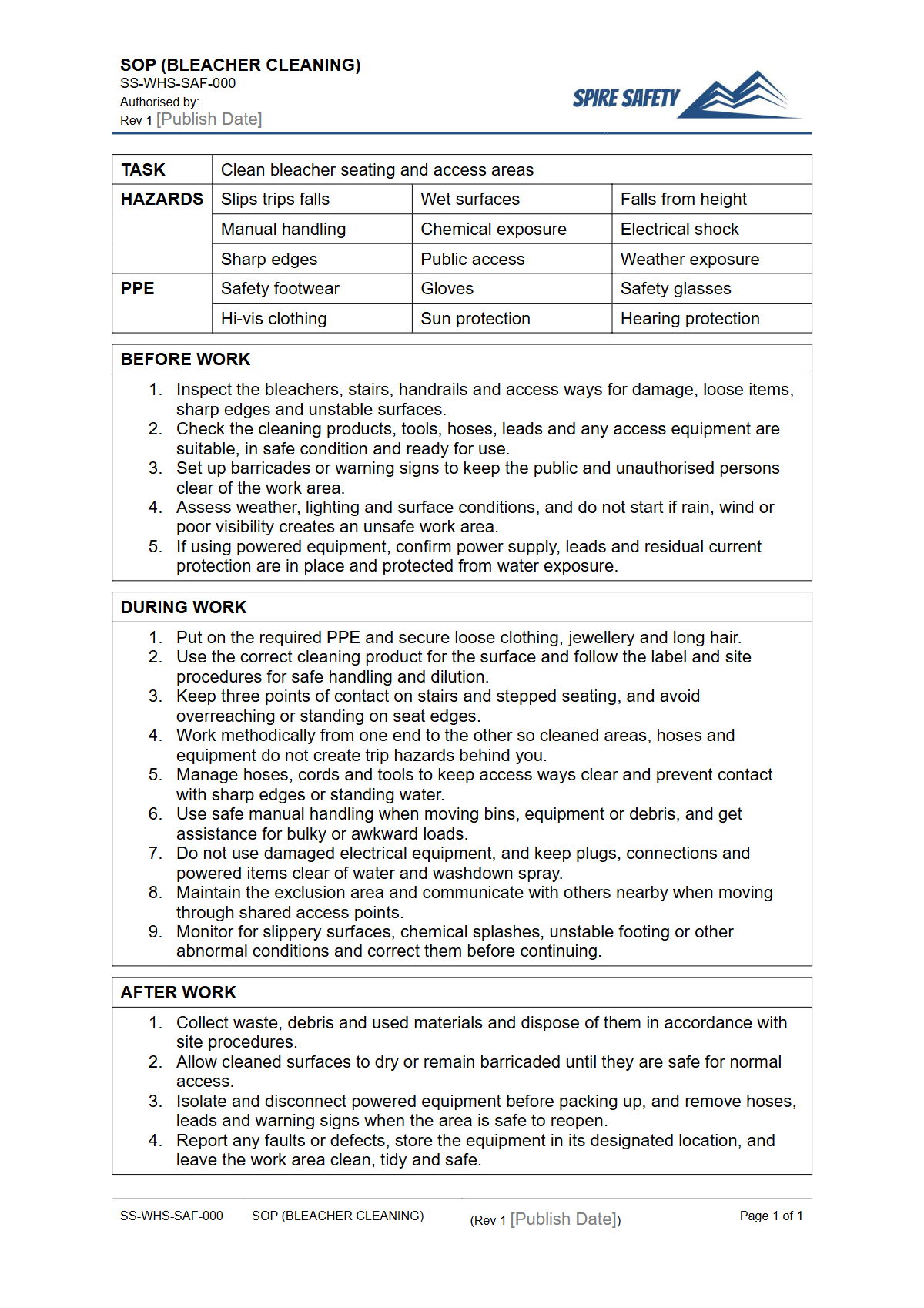
This Free Safe Operating Procedure (Bleacher Cleaning) Template provides a structured framework for documenting the required steps to clean stadium, gymnasium, or event seating safely and effectively. Cleaning bleachers, whether they are portable or fixed, introduces a range of workplace hazards that must be controlled.
A documented SOP is a critical tool for managing these risks and ensuring all workers follow a consistent, safe process.
Key hazards addressed in this procedure include manual tasks (lifting, carrying, bending), exposure to cleaning chemicals, working at heights to access upper tiers, and the potential for slips, trips, and falls on wet surfaces. Using a formal SOP helps in training staff, clarifying responsibilities, and demonstrating due diligence in managing WHS obligations.
For tasks involving ladders to access elevated areas, our free step ladder SOP template provides a specific guide for managing this common hazard.
Video walkthrough
How to use the Free Safe Operating Procedure (Bleacher Cleaning) Template
To implement this SOP, download the DOCX file and adapt it to the specific context of your workplace. It is essential to conduct a site-specific risk assessment to identify all potential hazards associated with your unique environment and cleaning processes.
Important: This document is a template and must be customised to your specific equipment, chemicals, work area, and legal obligations. We recommend you consult with your workers, supervisors, and any health and safety representatives during its development.
Ensure you populate all sections with relevant details, including the specific personal protective equipment (PPE) required, emergency response procedures, and pre-operational checks for any equipment used.
Detail all specific equipment used, from basic hand tools to powered machinery. If your process involves pressure washers or other powered equipment, ensure separate procedures are in place; you can use our free air compressor SOP template as a reference for these documents.
Once finalised and approved, the SOP should be used as a primary document for worker training and regular toolbox talks. This SOP should form a key part of your overall WHS management system, ensuring safety is integrated into standard operations.
When to use it
A Safe Operating Procedure for bleacher cleaning should be a living document, actively used in day-to-day operations. It should be consulted before any cleaning task commences to ensure all safety controls are in place.
The SOP is a fundamental resource during the induction and training of new employees or contractors assigned to cleaning duties, providing them with clear, step-by-step instructions.
Supervisors should use it as a reference tool to monitor work practices and ensure adherence to the established safety standards. Furthermore, the SOP is invaluable when reviewing processes, investigating an incident or near miss, or preparing for a safety review.
It also serves as a critical document during any formal WHS compliance audit, demonstrating a systematic approach to risk management for the task.
Who should use it
This template is designed for anyone responsible for managing or performing cleaning and maintenance tasks in venues with bleacher seating. This includes:
- Facility Managers and Operations Managers
- School Principals and Maintenance Supervisors
- Cleaning Business Owners and Contractors
- Persons Conducting a Business or Undertaking (PCBU)
- Work Health and Safety (WHS) Managers and Officers
- Team Leaders and Supervisors overseeing cleaning crews
Workers who perform the cleaning should be thoroughly trained on the contents of the final, customised SOP. It gives them the knowledge and authority to carry out their work safely and consistently.
For tailored support in developing and implementing your safety framework, our WHS consulting services can provide expert guidance. You can also explore our complete free WHS resources library for more templates and guides.
Common mistakes
Common mistakes to avoid
- Using unsafe methods to reach high areas, such as standing on chairs or railings.
- Failing to adequately cordon off the work area, posing a risk to workers and the public.
- Using incorrect or poorly diluted cleaning chemicals, leading to surface damage or health risks.
- Not allowing surfaces to dry completely before reopening the area, creating a significant slip hazard.
Legal references
Legal considerations
The following legal requirements may be relevant to this type of work.
- Work Health and Safety Act (Harmonised) — Provides the primary duties for protecting workers and other people from work health and safety risks.
- Work Health and Safety Regulations (Harmonised) — Sets out requirements supporting the management of workplace hazards and risks.
The following codes may be relevant to this type of work.
- Managing WHS Risks Code of Practice — Provides practical guidance on identifying hazards, assessing risks and applying effective controls.
- Work Health and Safety Consultation, Cooperation and Coordination Code of Practice — Provides practical guidance on consulting workers and coordinating with other duty holders.
- Managing the Work Environment and Facilities Code of Practice — Provides practical guidance on safe work environments, workplace facilities and related controls.
Did you know
Slips, Trips, and Falls
Slips, trips, and falls are a leading cause of serious, preventable workplace injuries in Australia, making procedures for managing wet floors and access critical.
Hierarchy of Control
When customising an SOP, always apply the hierarchy of risk control. Try to eliminate hazards first before relying on lower-level controls like Personal Protective Equipment (PPE).
FAQ
Frequently asked questions
01What are the main hazards when cleaning bleachers?
02Is an SOP legally required for bleacher cleaning in Australia?
03How often should a bleacher cleaning SOP be reviewed?
04Can I use a generic cleaning SOP for bleachers?
Share this resource
Free Safe Operating Procedure (Bleacher Cleaning) Template
Browse Categories
How To Use It
- 1Download and open in Word or PDF.
- 2Replace the placeholders with your business details.
- 3Get it reviewed by a WHS specialist before rollout.
Need it customised?
Our WHS consultants can adapt this template to your site, run a gap analysis, or audit what you already have in place.
Book a Free Consultation WHS consulting servicesor call 1300 156 382
Related templates
- Free Safe Operating Procedure (Blockage Clearing) Template
- Free Safe Operating Procedure (Blower Vacuum) Template
- Free Safe Operating Procedure (Boarding Gate Setup) Template
- Free Safe Operating Procedure (Boat Cabin Cleaning) Template
- Free Safe Operating Procedure (Boat Fender Handling) Template
- Free Safe Operating Procedure (Boat Launching) Template