
Free Safe Operating Procedure (Blower Vacuum) Template
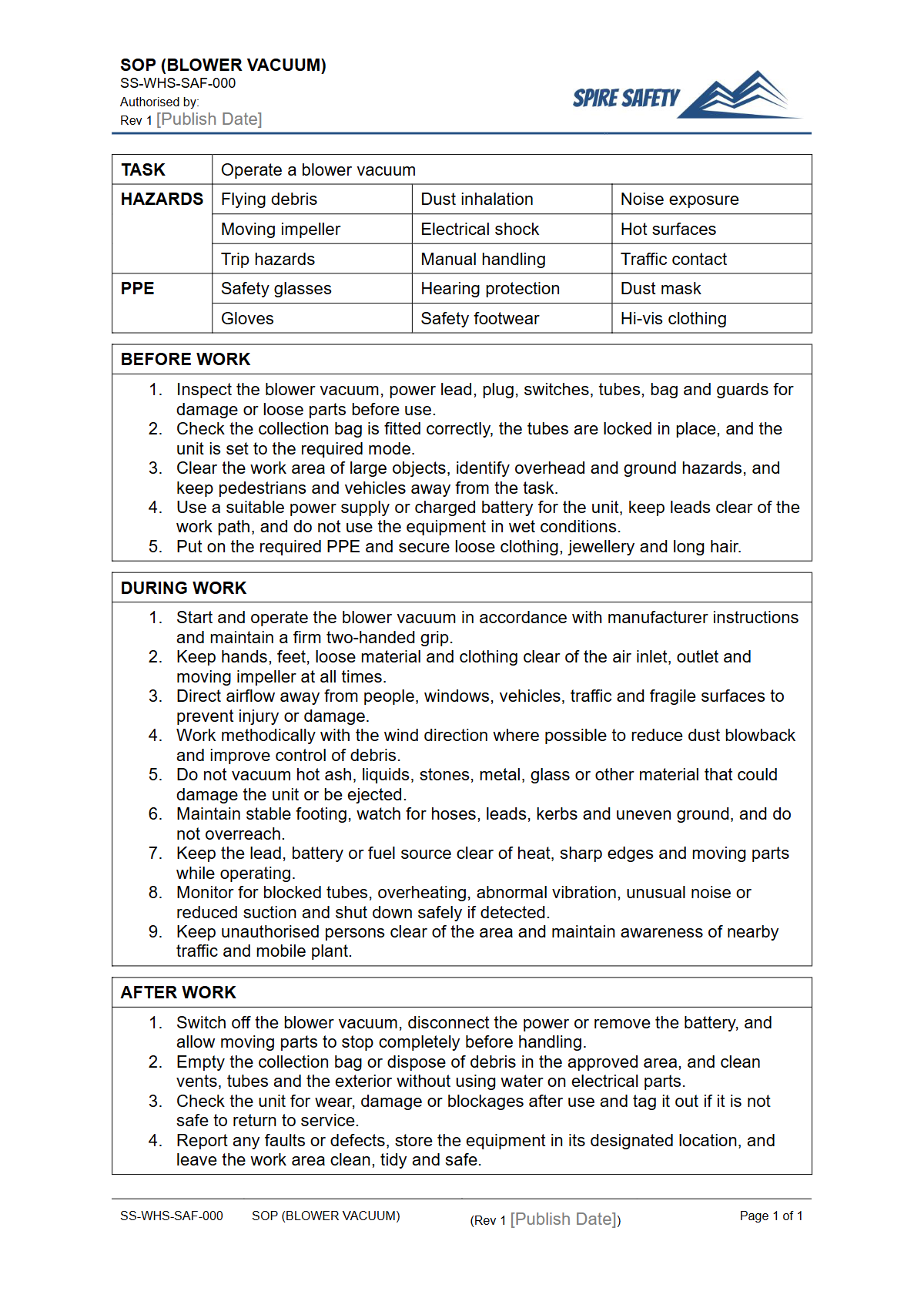
Download our Free Safe Operating Procedure (Blower Vacuum) Template to formalise safe work practices for groundskeeping and maintenance tasks.
Free Safe Operating Procedure (Blower Vacuum) Template
DOCX • 126 KB + PDF
Updated Oct 2026
No signup required
Purpose of the Free Safe Operating Procedure (Blower Vacuum) Template
A Safe Operating Procedure (SOP) is a foundational document for ensuring worker safety. This Free Safe Operating Procedure (Blower Vacuum) Template provides a structured framework for documenting the step-by-step process for the safe use of petrol or electric blower vacuums.
Using a blower vacuum introduces several hazards, including airborne particles, high noise levels, projectiles, and risks associated with fuel or electricity. A formalised SOP helps to identify these risks and outline the specific control measures required to manage them effectively, fulfilling a key part of your duty of care as a PCBU.
This template is designed as a clear starting point, aligned with Australian WHS principles, to help you create a workplace-specific document. A well-developed SOP is more than a compliance document; it is a critical training tool that ensures all workers understand the expected safe behaviours and precautions.
Much like our free Circular Saw SOP, it standardises the approach to operating potentially hazardous equipment, reducing the likelihood of incidents and injuries.
Video walkthrough
How to use the Free Safe Operating Procedure (Blower Vacuum) Template
This downloadable document provides a comprehensive guide for managing the safe operation of blower vacuums. To implement it correctly, you should download the DOCX file and adapt it to the specific context of your workplace. This involves a few key steps:
- Customisation: Add your company name, logo, and the specific details of the blower vacuum models used on your site.
- Site-Specific Risks: Review the pre-listed hazards and controls. Conduct a site-specific risk assessment and add any unique risks relevant to your operating environment (e.g., working near public areas, on uneven ground, or in dusty conditions).
- PPE Requirements: Specify the exact Personal Protective Equipment (PPE) required. This commonly includes safety glasses or goggles, hearing protection (earmuffs or plugs), respiratory protection (P2/N95 masks), and sturdy, non-slip footwear.
- Consultation: Involve your workers and health and safety representatives in the review process. Their firsthand experience is invaluable for creating a practical and effective procedure.
Important Note: This document is a template only. It is not a complete or ready-to-use Safe Operating Procedure.
It is essential that you customise this template to reflect the specific equipment, tasks, and environment of your workplace. We cannot guarantee that this document will be suitable for your specific circumstances and take no liability for any loss or damage arising from its use.
When to use a Blower Vacuum SOP
A Safe Operating Procedure for a blower vacuum should be used as a central part of your safety management system. It should be readily available and referred to during several key activities.
Use this SOP when conducting new worker inductions and for task-specific training before an employee operates a blower vacuum for the first time. It is also an essential tool for periodic refresher training to reinforce safe work habits.
Furthermore, the SOP should be reviewed and updated following any incident or near-miss, or whenever a new model of blower vacuum is introduced. The principles of documenting procedures apply to many pieces of equipment; for example, processes documented in a free Air Compressor SOP template serve a similar function for workshop tools.
Integrating this procedure into your broader WHS management systems ensures a consistent and documented approach to managing equipment-related risks across your organisation. Regular reviews and updates are critical to its ongoing relevance and effectiveness.
Who should use it
This Safe Operating Procedure is intended for use by a range of personnel within an organisation. Workers and operators are the primary users, as it directs their actions and outlines the safety precautions they must follow.
Supervisors and managers are responsible for implementing the SOP, ensuring workers are trained on its contents, and monitoring compliance on-site. They use it as a benchmark for performance and a tool for safety conversations.
WHS managers and safety officers will use this template as a basis for developing and integrating equipment-specific procedures into the overall safety framework. They may also lead the risk assessment and consultation process required for its customisation.
For organisations without dedicated internal safety resources, engaging external expertise can be highly beneficial. This ensures your procedures are robust and effectively implemented.
You can find more information about how expert advice can help your business through WHS consulting services.
Ultimately, a comprehensive SOP ensures everyone, from the operator to senior management, has a clear understanding of their responsibilities for safe equipment use. You can explore a wide variety of similar templates in our free WHS resources library to build out your procedural documentation for other common tools and tasks.
Common mistakes
Common mistakes to avoid
- Failing to wear appropriate PPE, especially eye, hearing, and respiratory protection.
- Using petrol-powered blowers in poorly ventilated or enclosed spaces, leading to carbon monoxide build-up.
- Neglecting pre-start checks, such as inspecting for fuel leaks or damaged electrical cords.
- Directing the blower nozzle towards people, animals, or brittle structures like windows.
Legal references
Legal considerations
The following legal requirements may be relevant to this type of work.
- Work Health and Safety Act (Harmonised) — Provides the primary duties for protecting workers and other people from work health and safety risks.
- Work Health and Safety Regulations (Harmonised) — Sets out requirements supporting the management of workplace hazards and risks.
The following codes may be relevant to this type of work.
- Managing WHS Risks Code of Practice — Provides practical guidance on identifying hazards, assessing risks and applying effective controls.
- Work Health and Safety Consultation, Cooperation and Coordination Code of Practice — Provides practical guidance on consulting workers and coordinating with other duty holders.
- Managing the Work Environment and Facilities Code of Practice — Provides practical guidance on safe work environments, workplace facilities and related controls.
Did you know
Airspeed Hazards
Commercial-grade blower vacuums can produce airspeeds exceeding 300 km/h. This high velocity can turn small objects like pebbles, mulch, and twigs into dangerous projectiles, making eye protection essential.
Invisible Danger
Blowing dry soil, dust, and organic matter can release fine crystalline silica and fungal spores into the air. Inhaling these can lead to serious long-term respiratory illnesses, highlighting the need for appropriate respiratory protection.
FAQ
Frequently asked questions
01Is a Safe Operating Procedure a legal requirement for a blower vacuum in Australia?
02What PPE is required when operating a blower vacuum?
03Can I use this template for both petrol and electric blower vacuums?
04How often should our blower vacuum SOP be reviewed?
Share this resource
Free Safe Operating Procedure (Blower Vacuum) Template
Browse Categories
How To Use It
- 1Download and open in Word or PDF.
- 2Replace the placeholders with your business details.
- 3Get it reviewed by a WHS specialist before rollout.
Need it customised?
Our WHS consultants can adapt this template to your site, run a gap analysis, or audit what you already have in place.
Book a Free Consultation WHS consulting servicesor call 1300 156 382
Related templates
- Free Safe Operating Procedure (Boarding Gate Setup) Template
- Free Safe Operating Procedure (Boat Cabin Cleaning) Template
- Free Safe Operating Procedure (Boat Fender Handling) Template
- Free Safe Operating Procedure (Boat Launching) Template
- Free Safe Operating Procedure (Boat Line Stowage) Template
- Free Safe Operating Procedure (Boat Refuelling) Template